
The question comes up every year. The National Hurricane Center says the Atlantic hurricane season runs from June 1 to November 30, and that its peak is September 10, "with most activity occurring between mid-August and mid-October" [3]. The season is not over when this post publishes.
Cooling is also more than comfort. The National Weather Service office in Miami recorded 33 indirect deaths in South Florida from Hurricane Irma, "including 14 after the storm due to hyperthermia in a nursing home in Hollywood" [4]. The CDC notes that "Older adults do not adjust as well as young people to sudden changes in temperature" [5]. Getting the air conditioner running again matters. Getting it running safely matters more.
Key takeaways
- Dry equipment and no visible damage: restart in order, and expect a pause of a few minutes before the outdoor unit starts.
- Flood water on any part of the system: leave it off and call a professional first [1] [2].
- A roof or window leak near wiring: turn the breakers off before anything else [6].
- Take photos before and after any repair, and keep the receipts [7].
- AC will not restart? Call or text Direct Cooling at (561) 210-7605.
Four Storm Scenarios and What Each One Means for the AC
What you do with the air conditioner after a storm depends on what the storm did to your home. This post sorts storm outcomes into four situations: the power went out and nothing got wet, water came in through the roof or a window, flood water reached the equipment, or the outdoor unit was hit or moved. Each one has a different first step.
| What happened | First step | Start the AC? | Source |
|---|---|---|---|
| Power outage only. Equipment dry, nothing damaged. | Thermostat to Off, wait for steady power, then follow the restart sequence below. | Yes, in order. | FPL [8] |
| Roof or window leak. Water in walls or ceiling. | "Immediately turn off your circuit breakers" and unplug appliances. Never stand in water to do it. | Not until the wiring has been checked. | FPL [6] |
| Flood water reached the air handler, the outdoor unit or the ducts. | Leave the system off. Photograph it. Call a licensed contractor. | No. | EPA [1], CDC [2], AHRI [9] |
| Outdoor unit hit by debris, tilted or moved off its pad. | Leave the system off. Photograph it. Call a licensed contractor. | No. | AHRI [9], Palm Beach County [10] |
Read the table from the top and stop at the first row that describes your home. The rows are ours: we built them from the five sources in the last column, and no single agency publishes them as one list. If two rows apply, follow the stricter one.
The last row deserves a note. AHRI, the trade association for heating and cooling manufacturers, warns that if flood water has moved either unit of a split system "by only a small amount, there is the potential for a breached refrigerant system" [9]. AHRI wrote that about flood water. We apply the same caution to a unit that wind or debris has shifted, because the copper lines do not care what moved them.
Power Back, No Water: The Restart Sequence
A time-delay relay is a control that keeps an air conditioner from restarting for a few minutes after power returns. Florida Power & Light describes it as preventing a restart "for about three to five minutes, minimizing the possibility of damage to your air conditioner's compressor" [8]. A short pause after an outage is the system protecting itself. It is not a fault.
If the equipment stayed dry and you see no damage, restart in this order. The order is ours, built around FPL's guidance [8]. It is not a manufacturer procedure.
- Set the thermostat to Off. Do this while the power is still out, or as soon as you are home. It keeps the system from starting on unsteady power.
- Wait for steady power. FPL lists air conditioning interruption among the symptoms of sags, swells and flickers on the line [8], so give the lights a few minutes to hold steady first.
- Look at the outdoor unit. Clear branches, fronds and shutter panels from around it. Do not open the cabinet.
- Check the breaker once. FPL's instruction is specific: "If the breaker for your air conditioner is tripped, wait five minutes before resetting it." [8] Reset it one time. If it trips again, leave it off and call.
- Set the thermostat to Cool. Lower it once, to the temperature you live at.
- Wait out the delay. FPL's figure is about three to five minutes [8]. Do not switch the system off and on while you wait.
- Watch one full cycle. You want cool air at the vents, a steady outdoor unit and no water at the indoor unit.
If the outdoor unit hums and does not start, or the system starts and shuts off again within a few minutes, turn it off at the thermostat. That is the point where the sequence ends and a service call starts.
In Palm Beach County an outdoor unit is not held to the High-Velocity Hurricane Zone rules that apply across the Broward line, but it still has to be anchored. The county's Building Code Advisory Board states that "the equipment must be adequately anchored to the rated stand, slab, or other approved means so as to resist the wind loads required by the latest Florida Building Code" [10]. If the unit rocks when you press on a corner, tell the technician. Our AC repair in West Palm Beach page covers the county's wind rules and storm history in more detail.
AC will not restart after the storm? Call or text Direct Cooling at (561) 210-7605, or see how our emergency AC repair service works.
Flood Water Changes the Answer
If flood water reached any part of the air conditioning system, do not turn it on. The EPA's instruction is direct: "If any part of your HVAC system was affected by the flood, do not use it to help dry out your house" [1]. The CDC says to have the system checked and cleaned by a professional experienced in mold cleanup before you start it [2].
The CDC explains the reason in one sentence: "If the HVAC system was flooded with water, turning on the mold-contaminated HVAC will spread mold throughout the house." [2] An air conditioner moves air through every room. Whatever is inside the air handler and the ducts goes with it.
A flooded AC unit in Palm Beach County is sometimes repairable and sometimes not, and that call belongs to a licensed contractor. AHRI's published position is that "Flood-damaged heating and cooling equipment and systems should be replaced and not repaired" [9]. The same AHRI page says that for a split system the decision to repair or replace "should be made by a qualified professional on a case-by-case basis" [9]. Both statements come from one page, so read them together: replacement is the default, and a technician confirms it unit by unit.
What decides it is how high the water came, how long it stayed, and whether either unit moved. AHRI says that if the refrigerant system is still intact, "the entire system should be cleaned, dried, and disinfected" [9]. If the result is a new system, our AC replacement page explains how we size and permit one.
Flood exposure varies block by block. On the barrier island, our page on HVAC service in the City of Boca Raton shows the flood zones FEMA maps at two Ocean Boulevard condo buildings. If your equipment sits at ground level in a mapped flood zone, know that before the next storm, not after it.
Running the House on a Generator
A portable generator belongs outside and away from the house. The CDC says: "Only use generators outside, more than 20 feet away from any windows, doors, and vents." [11] The National Weather Service adds the reason: "Carbon monoxide poisoning is one of the leading causes of death after storms in areas dealing with power outages." [12]
How a generator is connected matters as much as where it sits. Florida Power & Light's instruction is: "Do not wire your generator directly to your breaker or fuse box, because the power you generate may flow back into power lines and cause severe injuries, or even kill a neighbor or utility crew working to restore power" [13]. A central air conditioner is wired into that breaker box. So running central air from a generator is not an extension-cord job. For an installed generator, FPL says to "Hire a licensed electrician to connect the generator to your house wiring using a transfer switch" [13].
FPL's guidance for appliances you plug in directly is to turn them on "one at a time, never exceeding the generator's rated wattage" [13]. Whether a given generator can carry a given air conditioner depends on the equipment on both sides. Ask the electrician who installs the transfer switch and the contractor who services the AC before the storm, when there is time to check.
If the house is hot and the AC cannot run, protect the people first. The CDC's advice for older adults is plain: "Do not rely on a fan as your main cooling source when it's really hot outside." [5] Go where there is working air conditioning.
Photograph First: Claims and Permits After Storm Damage
Before anyone repairs or removes storm-damaged AC equipment, photograph it. The Florida Department of Financial Services tells homeowners to "Take photos before and after the repairs and keep receipts" [7]. Emergency repairs that prevent further damage are expected. The photos and receipts are what show what the storm did and what the repair cost.
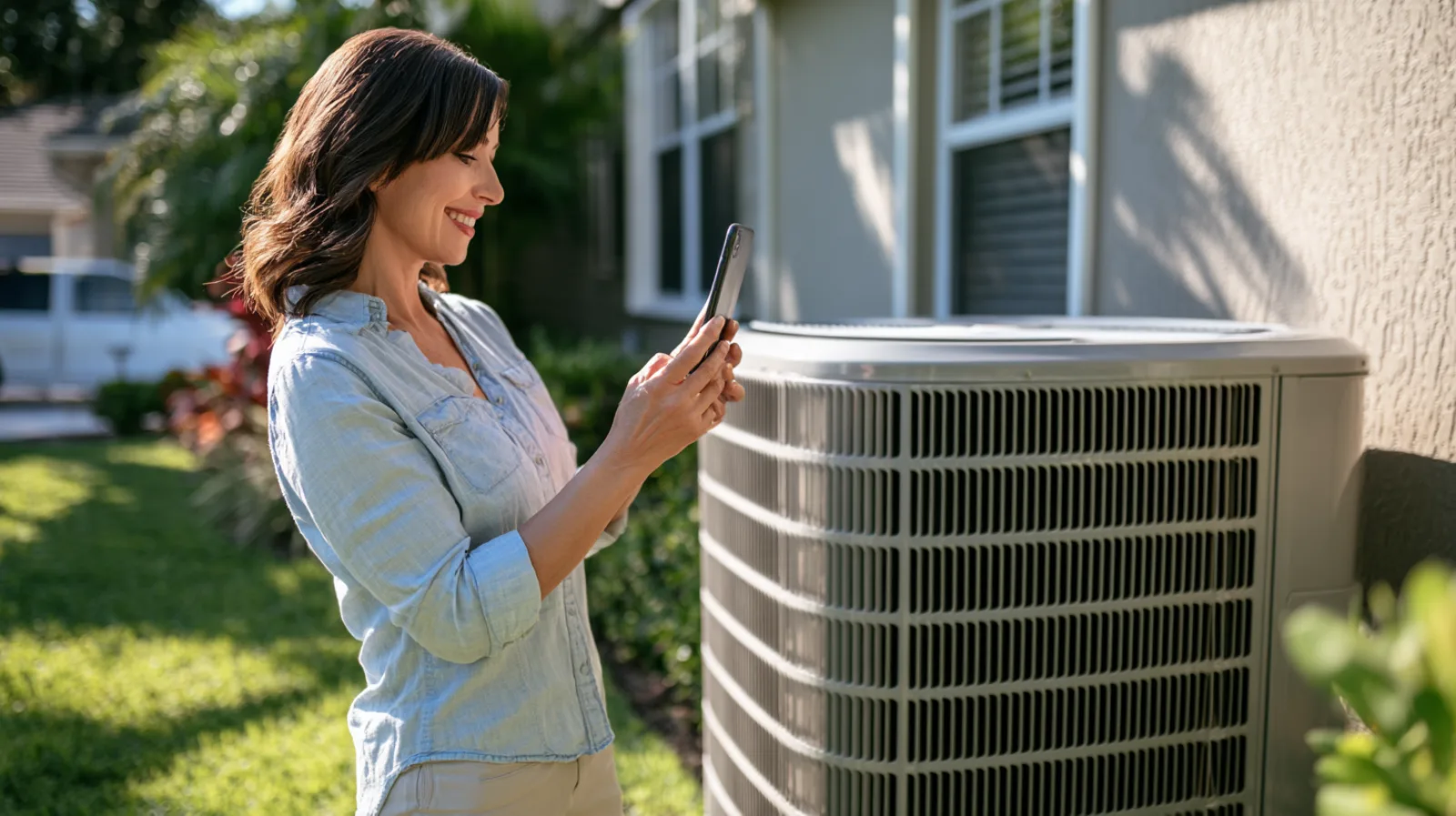
A useful set of photos covers the outdoor unit from all four sides, the pad or stand, the data plate with the model and serial numbers, the water line on the cabinet if there is one, and the indoor unit and the ceiling or floor around it. This post is not insurance advice. Your policy and your insurance company control what is covered and what they need from you.
An emergency AC replacement in Palm Beach County does not wait for a permit to be issued, but the paperwork follows fast. The county's amendments to the Florida Building Code say that where equipment replacements and repairs must be performed in an emergency, "the permit application shall be submitted within the next working business day to the building official" [14]. That is the contractor's job. Ask for the permit number for your records.
That rule is the county's. Some cities in Palm Beach County issue permits through their own building departments, and across the county line the requirements change. All of Broward County is in Florida's High-Velocity Hurricane Zone, so a replacement there needs tie-down specifications in the permit packet. Our pages on AC repair in Deerfield Beach and AC repair in Coral Springs list what those cities ask for.
What a storm repair costs depends on what failed. An outage restart that needs a part is a repair visit. Flood exposure, electrical damage, a unit that has to be re-anchored and a permit each add to the job, and AHRI's default for flood-damaged equipment is replacement [9].
Questions After the Storm
 Direct CoolingFL Certified AC Contractor CAC1819111 Dispatch 24/7
 Hi, this is Direct Cooling. Tap a question below for a straight answer.
Tap a question to ask
- Should I turn off my AC during a hurricane?
- Turn it off at the thermostat if the power goes out, so it cannot restart on unsteady power when service returns. If water comes in through the roof or windows, FPL says to "Immediately turn off your circuit breakers" and never to stand in water while you do it.
- How long after a power outage can I turn my AC on?
- Once the power is steady and the equipment is dry and undamaged, you can start it. Expect a built-in pause. FPL says a time-delay relay keeps the unit from restarting for about three to five minutes to protect the compressor. Do not cycle the system off and on during that wait.
- Can a flooded AC unit be repaired?
- Sometimes. AHRI's position is that flood-damaged equipment should be replaced and not repaired, and for split systems it says a qualified professional should decide case by case. Do not start a flooded system to find out. The EPA and the CDC both say to have a professional check it first.
Before the Next Storm
The safe order after a hurricane is short. Sort your home into one of the four scenarios. If everything stayed dry, restart in sequence and let the delay do its work. If water or wind reached the equipment, leave it off, photograph it and call.
Direct Cooling is a Florida Certified Air Conditioning Contractor, license CAC1819111, based in Boca Raton. We work across Palm Beach County and into northern Broward, and our phone is answered 24 hours a day for AC emergencies.
Call or text (561) 210-7605 if your AC will not restart after a storm.
References
- U.S. Environmental Protection Agency. Flood Cleanup: Protect Indoor Air and Your Health. Updated March 18, 2026. epa.gov/emergencies-iaq/flood-cleanup-protect-indoor-air-and-your-heal...
- Centers for Disease Control and Prevention. Safety Guidelines: Reentering Your Flooded Home. August 24, 2026. cdc.gov/floods/safety/reentering-your-flooded-home-safety.html
- NOAA National Hurricane Center. Tropical Cyclone Climatology. No date shown. nhc.noaa.gov/climo/
- National Weather Service Miami. Hurricane Irma. No date shown. weather.gov/mfl/hurricaneirma
- Centers for Disease Control and Prevention. Heat and Older Adults (Aged 65+). June 25, 2024. cdc.gov/heat-health/risk-factors/heat-and-older-adults-aged-65.html...
- Florida Power & Light. Storm Preparation Guide. No date shown. fpl.com/storm/home/guide.html
- Florida Department of Financial Services. What to Expect After Filing a Homeowners Claim Related to a Hurricane. No date shown. myfloridacfo.com/docs-sf/consumer-services-libraries/consumerservices-...
- Florida Power & Light. Power Outage Guide. No printed date (file metadata 2012). fpl.com/reliability/pdf/power-outage-guide.pdf
- Air-Conditioning, Heating, and Refrigeration Institute (AHRI). Floods and HVACR Equipment. No date shown. ahrinet.org/scholarships-education/education/homeowners/improve-safety...
- Palm Beach County Building Code Advisory Board. Technical Advisory: Wind Resistance of Exposed Mechanical Equipment or Appliances. March 15, 2017. discover.pbc.gov/pzb/building/BCAB/Wind_Resistance_of_Exposed_Mechanic...
- Centers for Disease Control and Prevention. Carbon Monoxide Poisoning Basics. January 12, 2026. cdc.gov/carbon-monoxide/about/index.html
- National Weather Service. Hurricane Safety: After a Hurricane. No date shown. weather.gov/safety/hurricane-after
- Florida Power & Light. Generator Safety. No date shown. fpl.com/storm/home/generator-safety.html
- Palm Beach County. Palm Beach County Amendments to the Florida Building Code, 8th Edition (2023), section 105.2.1. 2023. discover.pbcgov.org/pzb/building/BuildingCodes/PBC-Amendments-to-the-F...