Indoor humidity affects your home more than most people realize. Too much moisture means sticky air, musty odors, and mold and dust mites. EPA says molds can cause asthma attacks in people with asthma who are allergic to mold [2].
I've worked in HVAC for more than 20 years and started Direct Cooling in Boca Raton in 2017. This guide goes past the usual tips. It uses NOAA's 30-year weather normals for West Palm Beach to show how much water our summer air carries (an average dew point of 74.3°F in August) and what that air does indoors when the AC isn't removing it [5]. It also covers a fan setting that, in Florida Solar Energy Center tests, put moisture back.
Key takeaways
- EPA's target is below 60% humidity, ideally 30% to 50%. UF/IFAS Extension treats 55% to 60% as the point where mold and bacteria become a risk.
- My math from NOAA normals: August air at West Palm Beach, inside a 78°F house with no moisture removed, would sit near 88% humidity.
- Your AC removes water only while its coil is cold and air is crossing it. Oversizing, a fan left on On, leaky ducts and clogged drains all show up as humidity.
- Dry air is rare here. Even the driest January hours work out to about 34% indoors at 72°F.
- Reading above 60% with the AC running? Call or text Direct Cooling at (561) 210-7605.
What indoor humidity level is healthy for a Florida home?
EPA advises keeping indoor relative humidity below 60%, ideally between 30% and 50%, as part of its mold prevention guidance [1]. For a South Florida home with central air, that means aiming at or under 50% for most of the year and treating a steady reading above 60% as a problem to diagnose, not something to live with.
EPA's wording is direct: "If possible, keep indoor humidity below 60 percent (ideally between 30 and 50 percent) relative humidity" [1]. It's the same 30% to 50% goal I set out when I first wrote this guide.
UF/IFAS Extension, the University of Florida's extension service, describes indoor humidity above 55% to 60% as unsafe because it can lead to the growth of mold spores and bacteria [14].
You'll see 45% to 55% quoted online as a "Florida range," usually with no source. My advice: aim lower. EPA's ideal band stops at 50%, and UF/IFAS puts 55% at the edge of trouble, so a target that tops out at 55% leaves no margin.
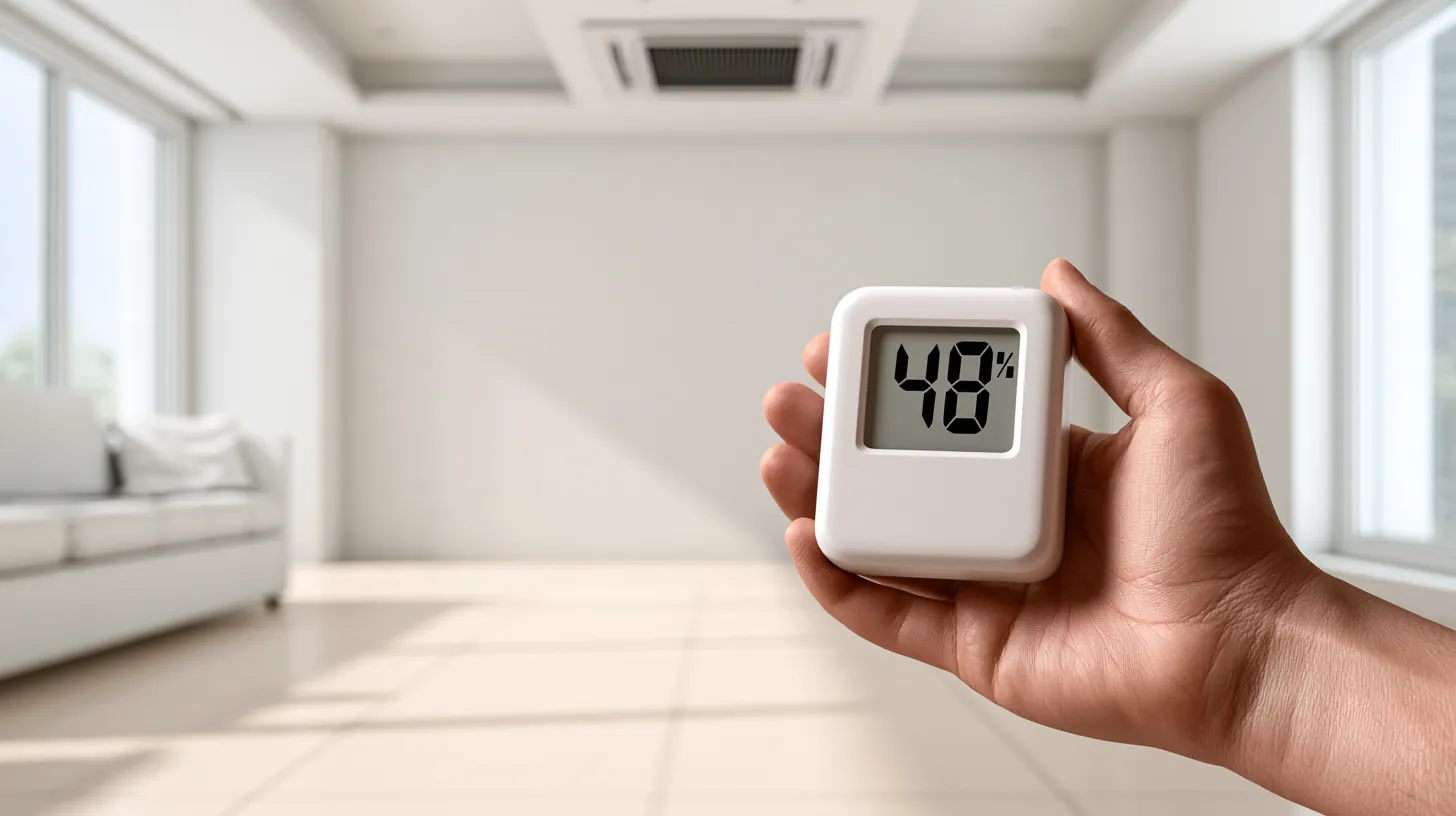
Measure before you guess. EPA notes that a humidity meter, a small, inexpensive instrument sold at many hardware stores, measures relative humidity [1]. Take readings in a few rooms with the AC running, then check one below.
Why does South Florida air make indoor humidity so hard to control?
Because the outdoor air carries so much water. NOAA's 1991-2020 climate normals for West Palm Beach put the average dew point at 72.6°F in June, 73.8°F in July, 74.3°F in August and 73.5°F in September [5]. Air that wet, brought into a 78°F house without the AC pulling moisture out, would sit near 88% relative humidity [6].
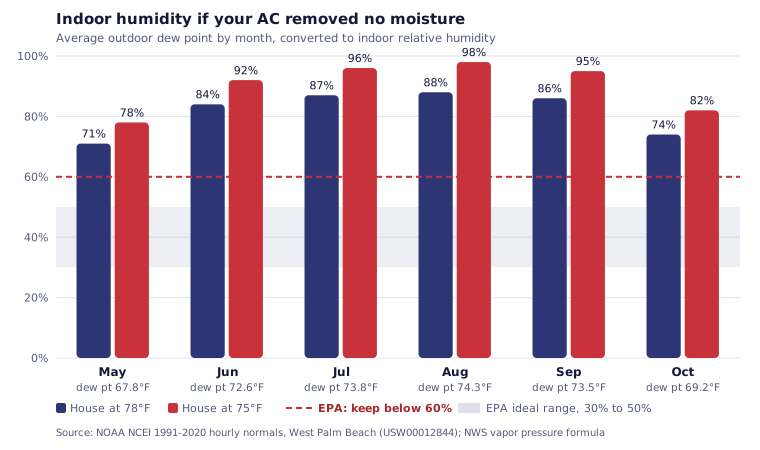
Relative humidity is how full the air is of water compared with the most it could hold at its temperature. Dew point is the temperature where that water starts to condense. It measures the actual water in the air, and it doesn't drop until water condenses out.
The table is my own calculation. I averaged NOAA's 8,760 hourly normals for West Palm Beach International Airport by month [5]. Then I used the National Weather Service vapor pressure formula [6] to work out what that air would read indoors with no moisture removed, as in a home where the AC is off or not dehumidifying.
| Month (NOAA 1991-2020 normals, West Palm Beach) | Average dew point | Indoor humidity at 78°F, no moisture removed | Indoor humidity at 75°F, no moisture removed |
|---|---|---|---|
| May | 67.8°F | 71% | 78% |
| June | 72.6°F | 84% | 92% |
| July | 73.8°F | 87% | 96% |
| August | 74.3°F | 88% | 98% |
| September | 73.5°F | 86% | 95% |
| October | 69.2°F | 74% | 82% |
To hold 50% at 78°F, a home's indoor dew point has to come down to about 58°F; at 75°F, about 55°F [6]. In August that means the air conditioner has to pull the dew point down roughly 16°F. Six months of the year, May through October, average a dew point of 65°F or higher [5].
Humidity also changes how warm a room feels. The National Weather Service puts it plainly: "the human body feels warmer in humid conditions" [7]. Its heat index chart shows 100°F air at 55% humidity feeling like 124°F [7].
> Not sure where your home sits? A Direct Cooling indoor air quality visit includes a humidity reading with your system running. See what the visit covers, or call or text (561) 210-7605.
How does an air conditioner remove humidity from a house?
An air conditioner removes humidity by passing indoor air across a cold coil. Water vapor condenses on the coil, drips into a drain pan and leaves through the condensate line. Removing that water is called latent cooling; lowering the air temperature is sensible cooling. The system only dehumidifies while the coil is cold and air is crossing it, so run time decides how much water comes out.
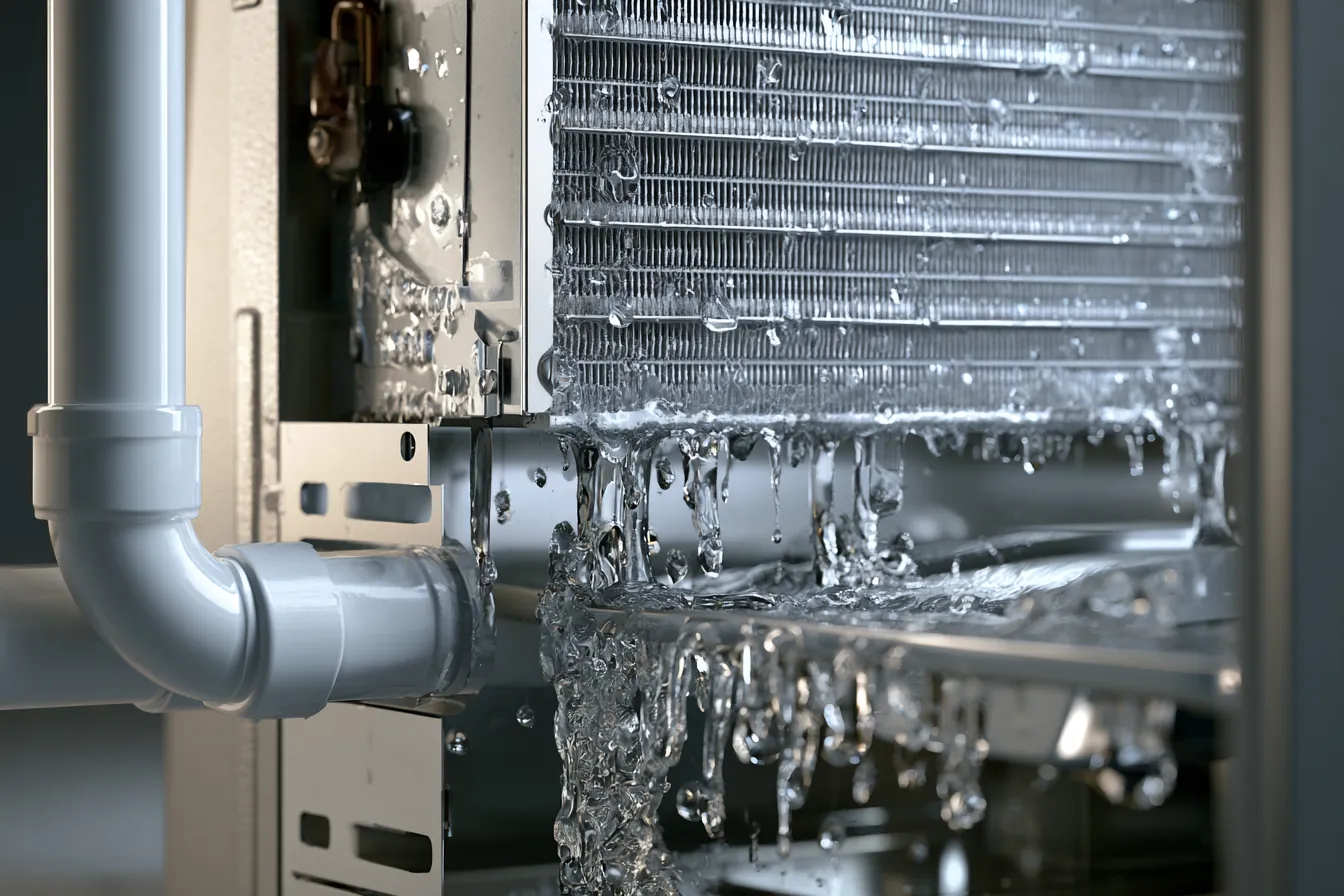
A U.S. Department of Energy Building America guide puts the stakes simply: in most homes the central cooling system is the sole source of dehumidification (unless a stand-alone dehumidifier is also used), so unless it runs, indoor humidity goes unchecked [8].
The same DOE guide explains why bigger isn't better. An oversized system satisfies the thermostat quickly and doesn't run long enough for condensate to drain off the evaporator coil. In many cases that water evaporates back into the airstream as the fan runs for a few minutes after cooling stops [8].
The drain matters as much as the coil. EPA lists keeping air conditioning drip pans clean and drain lines flowing as a mold prevention step [1]. Here the coil and pan stay wet for months, so a slow condensate line is a common reason water ends up where it shouldn't.
That's why maintenance improves moisture removal: a clean evaporator coil, a clear condensate drain and correct settings. Direct Cooling's maintenance membership includes two tune-ups a year, and our AC maintenance page lists what a tune-up measures.
Can high indoor humidity make allergies or asthma worse?
It can, through mold and dust mites. EPA says allergic reactions to mold are common, that molds can cause asthma attacks in people with asthma who are allergic to mold, and that mold exposure can irritate the eyes, skin, nose, throat and lungs of both mold-allergic and non-allergic people [2]. EPA also warns that excess moisture can encourage the growth of dust mites and molds [4].
EPA's asthma guidance adds that body parts and droppings from dust mites can trigger asthma in people who are allergic to them [3]. Dust mites live in mattresses, carpets and upholstered furniture [3].
Moisture is the lever because mold needs it. EPA says it's impossible to get rid of all mold spores indoors, but spores won't grow without moisture, and it calls moisture control "the key to mold control" [1].
EPA also advises people with asthma to avoid exposure to molds, and notes that research on mold and health effects is ongoing [2].
This is general information, not medical advice. If someone in your home has asthma, allergies or symptoms that seem worse indoors, talk with your doctor.
What does high humidity do to a house and the things in it?
Over time it damages materials and invites growth. EPA says molds gradually destroy the things they grow on [1]. UF/IFAS Extension warns that in Florida's warm, humid climate, wood, cotton, wool, leather and even traces of dirt in fabrics can decay, deteriorate and develop odors, and that exposed metals rust and corrode [14].
Watch for early signs. EPA points out that condensation on windows, walls or pipes can be a sign of high humidity, and says to dry the surface and reduce the moisture source quickly [1].
High humidity can also make wood floors and trim swell, paint blister or peel, and mold appear on ceilings and walls. A house can smell musty long before the source is obvious. A reading beats a guess.
Pests follow moisture. UF/IFAS notes that food particles and body oils left on towels, clothing and furnishings absorb water from the air and attract mildew, fungi and pests such as roaches and ants [14]. EPA adds that cockroach droppings and body parts can trigger asthma [3].
Why is my house humid even when the AC is running?
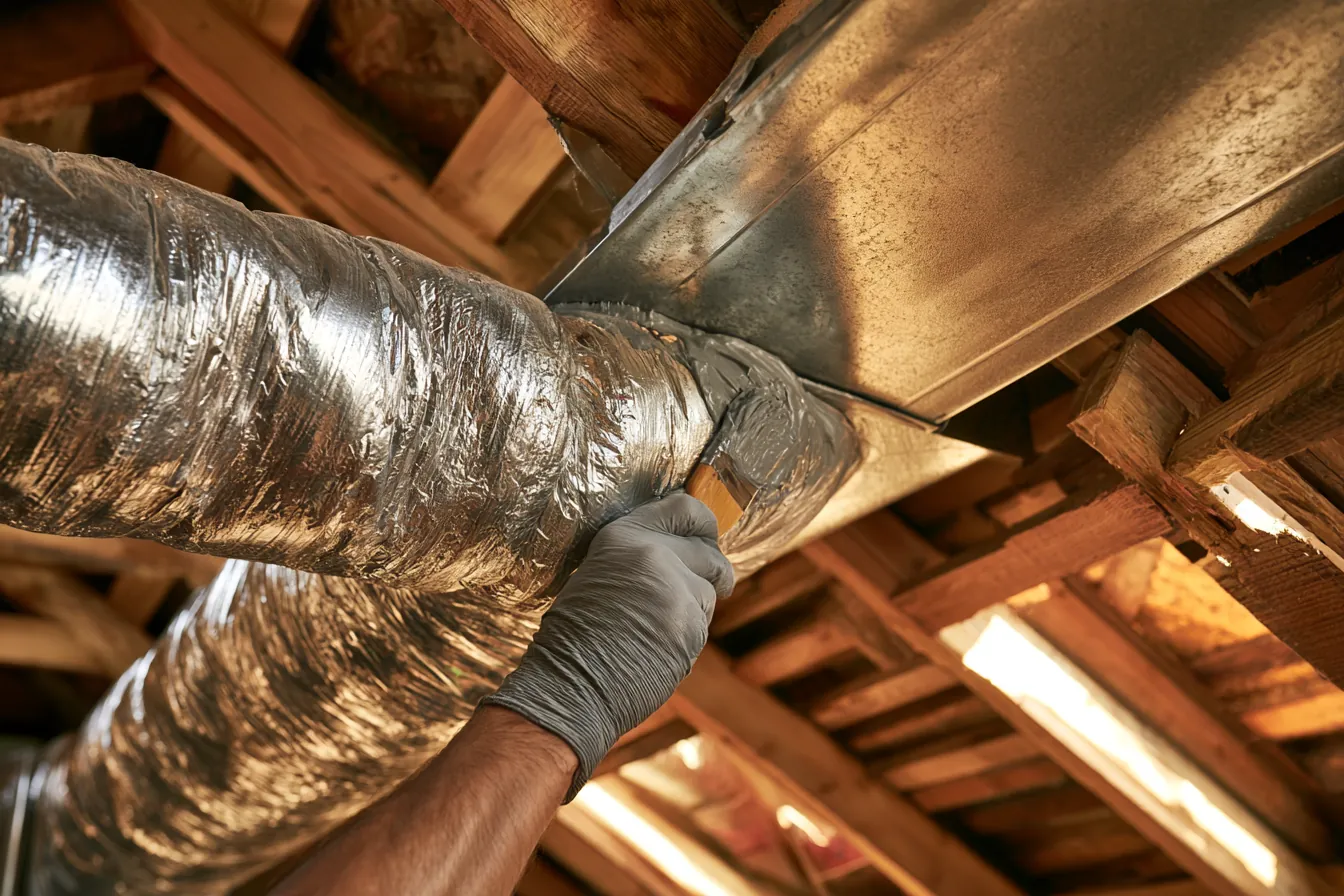
Usually because the air conditioner isn't running long enough, or the right way, to pull water out, or because humid air is getting in faster than the system can remove it. The common causes are an oversized system, a fan set to On, leaky supply ducts, a dirty coil or clogged drain, and a thermostat set too high in an empty house.
| Cause | What you notice | What fixes it | Source |
|---|---|---|---|
| Oversized system (short cycles) | Cool but clammy; the AC turns on and off quickly | Right-sizing when the system is replaced | DOE Building America [8] |
| Fan set to On | Humidity climbs between cooling cycles | Set the fan to Auto | FSEC [9] |
| Leaky supply ducts | Humid or uneven rooms; outdoor air pulled in through gaps | Duct repair and sealing | FSEC [11], ENERGY STAR [12] |
| Return leak in a hot attic | Long run times, weak cooling | Seal the return and air handler cabinet | FSEC [11] |
| Dirty coil or clogged condensate drain | Water near the indoor unit; musty smell at vents | Coil cleaning and drain clearing | EPA [1] |
| AC off or set high in an empty home | Musty smell when you return | Keep the AC set no higher than 85°F | UF/IFAS [14] |
Duct leaks are the cause people overlook. Florida Solar Energy Center researchers found that when supply leaks dominate, the house is depressurized and humid outdoor air is drawn into the living space through leaks in the building envelope [11]. The same paper reports that a 15% return leak from a hot attic (120°F air with an 80°F dew point) can cut a cooling system's effective capacity and efficiency by about 50% [11].
ENERGY STAR estimates that in a typical house about 20% to 30% of the air moving through the ducts is lost to leaks, holes and poor connections [12]. ENERGY STAR says to seal with mastic or metal tape, never duct tape [12]. Our ductwork page explains how Direct Cooling finds and seals leaks.
When Direct Cooling diagnoses a humid house, the inexpensive explanations get checked before the expensive ones: the filter, coil, pan and drain, then the air handler cabinet and return, then a humidity reading with the system running. Repairs come before any add-on equipment. If the AC is also struggling to cool, see our guide to an AC running but not cooling.
Should I run my AC fan on Auto or On to control humidity?
Auto, in most South Florida homes. On Auto, the blower stops when cooling stops, so water on the coil can drain away. On On, air keeps crossing the wet coil and carries some of that water back into the house. Florida Solar Energy Center tests measured the effect, and indoor humidity was higher with the fan on On.
The numbers come from a 1987 FSEC study by Khattar, Swami and Ramanan in ASHRAE Transactions [9]. In a 20-minute cycle with the compressor running 10 minutes and the fan running the whole time, 19% of the moisture condensed during cooling went back into the room. That was measured on a packaged terminal air conditioner. In a shorter 10-minute cycle with 5 minutes of compressor time, moisture removal was 44% lower with the fan on On than on Auto [9].
Later FSEC work by Shirey, Henderson and Raustad (2006) reached the same conclusion: a coil's moisture removal degrades at part load, especially when the fan runs continuously while the coil cycles on and off [10].
There's a trade-off. A fan that runs more pushes more air through the filter. If someone in your home needs extra filtration, talk with a technician before switching to On. In this climate, humidity is usually the bigger risk.
Is dry indoor air ever a problem in South Florida?
Rarely, and only briefly. EPA notes that dry air brings discomfort such as a dry nose, throat, lips and skin, which is why people use humidifiers [4]. But even in the driest tenth of January hours at West Palm Beach (an average dew point of 42.5°F), outdoor air warmed to 72°F works out to about 34% humidity, still inside EPA's 30% to 50% range [5][6].
On a typical January hour the normal dew point is 57.0°F, about 59% at 72°F indoors [5][6]. In our winters the risk usually stays on the humid side.
A cold front can bring a few dry days: dry skin, irritated sinuses, static. EPA lists static, peeling wallpaper and cracks in paint and furniture among the nuisances humidifiers are used for [4].
If you run a humidifier, follow EPA's two main cautions. Don't humidify above 50%, because higher humidity levels may encourage the growth of biological organisms [4]. Clean it as directed, because ultrasonic and impeller ("cool mist") units can disperse microorganisms and minerals from their tanks into the air [4]. For most homes here, a humidifier solves a problem you rarely have.
Do I need a whole-home dehumidifier if I already have central AC?
Only after the air conditioner has been ruled out. ENERGY STAR says a whole-home dehumidifier may be right for a home in a humid climate with central air, and describes its benefits for relatively well sealed homes that see humidity above 55% consistently throughout the house [13]. A humid home caused by a fan setting, a clogged drain or a duct leak needs that fixed first.
A whole-home dehumidifier typically uses the home's air ducts to dehumidify one or more rooms and is often permanent, unlike a portable unit that serves one room [13]. Most whole-home units only have a drain, routed to a floor drain or condensate line, so there's no bucket to empty [13].
ENERGY STAR certified dehumidifiers use 20% less energy than similar conventional units [13]. ENERGY STAR also notes that whole-home systems can be expensive, and that home sealing, duct sealing and regular heating and cooling maintenance improve their performance [13].
That order matters. A dehumidifier in a house with leaky supply ducts is fighting humid air the ducts keep pulling in. Direct Cooling's part is the diagnosis: a humidity reading with the system running and a check of the settings, coil, drain and ducts, so you know whether the AC can do the job before anything is added.
Can a smart thermostat help control humidity?
Some can, if the equipment supports it. A 2009 U.S. Department of Energy Building America guide describes thermostats with humidity control that drop the cooling set point by about 2 degrees and run a lower fan speed so more water condenses on the coil, and notes the approach needs a variable-speed air handler [8]. A humidity number on the screen removes no water by itself.
Manufacturers build the idea into equipment. American Standard says its Comfort-R technology links blower speed to a humidity sensor, so the system draws humid air more slowly over the coil at the start of a cooling cycle. It's available only in equipment with variable-speed blower motors [16].
If humidity keeps coming back and your system is due for replacement, ask about variable-speed equipment and humidity-control features when you compare options, including heat pumps and mini splits. Direct Cooling is an American Standard Customer Care Dealer and a Rheem Pro Partner.
A display that shows indoor humidity is still worth having. It turns a feeling into a number.
Do UV lights fix a humidity or mold problem?
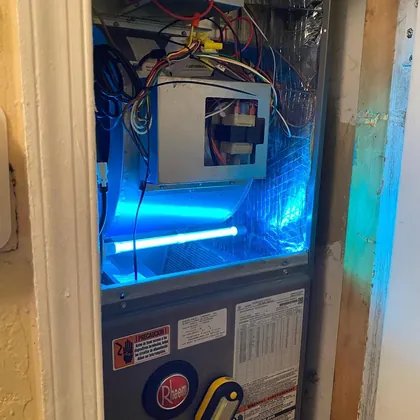
No. UV lights in the air handler keep the wet coil and drain pan cleaner, but they don't remove water from the air. EPA's technical summary on residential air cleaners cites a study that found a 99% reduction in microbial contaminants on exposed HVAC surfaces but only a 25% to 30% reduction in airborne bacteria [15].
The same EPA summary cites researchers who cautioned that moisture control, properly designed dehumidifying and cooling processes, and drain pans designed to drain should remain the primary approaches to controlling microbial growth in air handlers [15]. Limiting growth on the coil can also improve its heat transfer [15].
Direct Cooling installs UV light for the coil and whole-home air purification and air freshening systems, and they have a place: after the moisture problem is handled. We check the drain, pan, filter and humidity first.
How do I check and lower my home's humidity today?
Start with a reading, then work through the free fixes before paying for anything. Measure with a hygrometer while the AC runs, set the fan to Auto, use exhaust fans, keep the condensate drain clear and dry any leak within 24 to 48 hours. If the reading stays above 60% after that, the cause is in the system or the ducts.
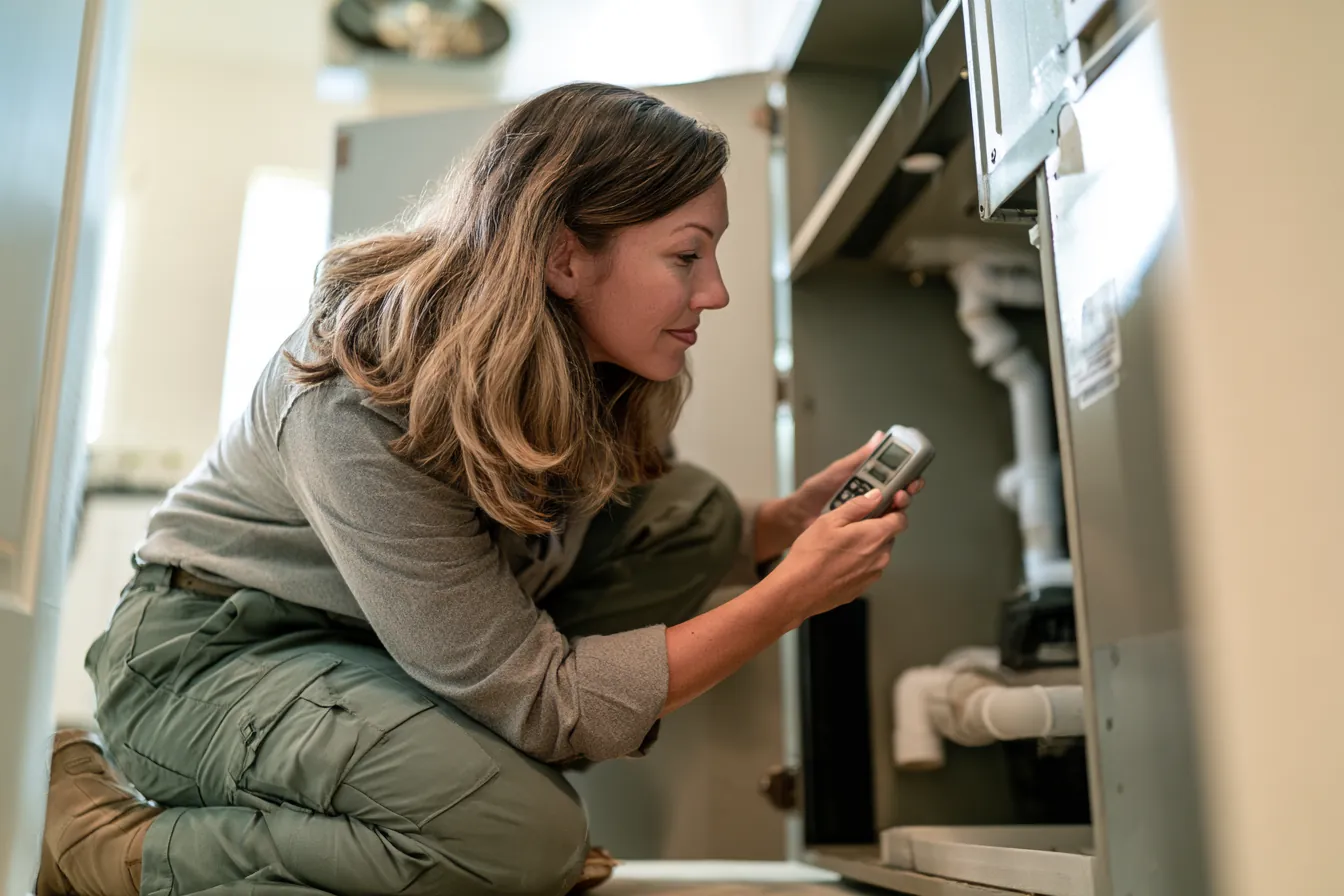
- Measure. Read a hygrometer in two or three rooms with the AC running [1].
- Compare. Below 60% is EPA's limit; 30% to 50% is ideal [1].
- Set the fan to Auto. FSEC measured higher indoor humidity with the fan on On [9].
- Vent moisture at the source. EPA advises bath fans when showering, exhaust fans when cooking or running the dishwasher, and dryers vented outside [1].
- Check the drain. Look for water around the indoor unit; EPA lists clean drip pans and flowing drain lines as mold prevention [1].
- Dry leaks fast. EPA says areas dried within 24 to 48 hours usually won't grow mold [1].
- Stop condensation. EPA suggests insulating cold surfaces such as cold water pipes [1]. Keep doors and windows closed while the AC runs.
Keep the AC running through humid stretches instead of shutting it off. A house that warms up during the day still holds the same water.
How do I keep a seasonal home from getting musty while I am away?
Leave the air conditioner on. UF/IFAS Extension advises setting it no higher than 85°F so it still cycles on, because at warmer settings indoor humidity rises above 55% to 60%, which can lead to mold and bacteria growth [14]. It also recommends a professional check-up about three weeks before you leave and a clean condensate line.
In Boca Raton's ZIP 33434, 16.0% of housing units are held for seasonal, recreational or occasional use, according to U.S. Census Bureau American Community Survey 2020-2024 estimates [17].
Before closing the house, UF/IFAS says to change or wash the AC filter and clean the condensate line leading away from the air handler, because summer heat and humidity can grow mildew and mold there [14]. A professional should check the thermostat and clean the condensate pan and pipe [14].
A clogged drain in an empty house can mean water damage by the time you return. Our area guides for Boca Raton, West Boca Raton, Delray Beach, Boynton Beach and Coral Springs cover local housing and climate details.
When should I call an HVAC technician about humidity?
Call when your hygrometer reads above 60% with the AC running, when condensation shows up on vents, windows or walls, when water collects near the indoor unit, or when a musty smell comes back after cleaning. Those signs point to sizing, airflow, drainage or duct problems a setting change won't fix.
A Direct Cooling indoor air quality visit starts with your symptoms, then the filter, coil, pan, drain and air handler, and ends with a humidity reading compared against the 60% line. Repairs are recommended before any add-on. If water is already collecting near the indoor unit, book an AC repair visit instead of waiting.
Direct Cooling is a family-run company licensed as a Florida Certified Air Conditioning Contractor (CAC1819111), BBB A+ accredited since 2021 and rated 4.9 on Google with more than 360 reviews. We serve Boca Raton, West Boca Raton, Delray Beach, Boynton Beach, Lake Worth, West Palm Beach, Deerfield Beach, Parkland and Coral Springs; see our service area or the FAQ.
Balanced humidity protects floors, furniture and walls and takes strain off your HVAC system. If your home smells musty, feels sticky or reads above 60%, call or text Direct Cooling at (561) 210-7605. Dispatch is monitored 24/7.
This guide is general information about indoor humidity and home HVAC systems, not medical advice. If you have asthma, allergies or other symptoms, talk with your doctor.
References
- U.S. Environmental Protection Agency. A Brief Guide to Mold, Moisture and Your Home. Page last updated February 18, 2026; read October 7, 2026. epa.gov/mold/brief-guide-mold-moisture-and-your-home
- U.S. Environmental Protection Agency. Mold and Health. Page last updated February 18, 2026; read October 7, 2026. epa.gov/mold/mold-and-health
- U.S. Environmental Protection Agency. Asthma Triggers: Gain Control. Page last updated July 6, 2026; read October 7, 2026. epa.gov/asthma/asthma-triggers-gain-control
- U.S. Environmental Protection Agency. Use and Care of Home Humidifiers. Page last updated April 29, 2026; read October 7, 2026. epa.gov/indoor-air-quality-iaq/use-and-care-home-humidifiers
- NOAA National Centers for Environmental Information. U.S. Climate Normals 1991-2020, hourly normals, West Palm Beach International Airport (USW00012844). Read October 7, 2026. ncei.noaa.gov/data/normals-hourly/1991-2020/access/USW00012844.csv
- National Weather Service, El Paso. Vapor Pressure (formula for vapor pressure and relative humidity). Read October 7, 2026. weather.gov/media/epz/wxcalc/vaporPressure.pdf
- National Weather Service, Amarillo. What is the heat index? Read October 7, 2026. weather.gov/ama/heatindex
- U.S. Department of Energy, Building America (Steven Winter Associates). Why Right-Size? Last update September 2, 2009; read October 7, 2026. www1.eere.energy.gov/buildings/publications/pdfs/building_america/why_...
- Khattar, M. K., Swami, M. V., and Ramanan, N. (Florida Solar Energy Center). Another Aspect of Duty Cycling: Effects on Indoor Humidity. ASHRAE Transactions, January 1987 (FSEC-PF-118-87). Read October 7, 2026. stars.library.ucf.edu/fsec/1006
- Shirey, D. B., Henderson, H., and Raustad, R. (Florida Solar Energy Center). Understanding the Dehumidification Performance of Air-Conditioning Equipment at Part-Load Conditions. 2006. Read October 7, 2026. stars.library.ucf.edu/fsec/513
- Cummings, J. B., and Withers, C. (Florida Solar Energy Center). Problems Related to Air Handler Leakage. ASHRAE Journal, January 2008 (FSEC-GP-335-08). Read October 7, 2026. publications.energyresearch.ucf.edu//wp-content/uploads/2018/06/FSEC-G...
- ENERGY STAR (U.S. EPA). Duct Sealing. Read October 7, 2026. energystar.gov/saveathome/heating-cooling/duct-sealing
- ENERGY STAR (U.S. EPA). Dehumidifiers (current specification effective October 1, 2025). Read October 7, 2026. energystar.gov/products/dehumidifiers
- Peart, V., Cantrell, R. A., England, J., and Portelos-Rometo, M. UF/IFAS Extension. Closing Your Seasonal Home (FCS3154/HE887). Read October 7, 2026. ask.ifas.ufl.edu/publication/he887
- U.S. Environmental Protection Agency. Residential Air Cleaners: A Technical Summary, 3rd ed. July 2018. Read October 7, 2026. epa.gov/sites/default/files/2018-07/documents/residential_air_cleaners...
- American Standard Heating & Air Conditioning. Comfort-R. Read October 7, 2026. americanstandardair.com/resources/glossary/comfort-r/
- U.S. Census Bureau. American Community Survey 2020-2024 5-year estimates, tables B25004 and B25001, ZCTA 33434 (via Census Reporter API). Read October 7, 2026. api.censusreporter.org/1.0/data/show/latest?table_ids=B25004,B25001&am...