

UV Light for AC in Boca Raton: What It Fixes and What It Cannot
A UV light for your AC does one job well in a humid climate: it keeps microbial growth off a constantly wet coil and drain pan. It does not filter the air, remove odors from gases, or reliably kill germs floating through the house. Here is the evidence, and how Direct Cooling installs UV-C so it actually does its one job.
- 4.9 on Google, 360+ reviews
- FL license CAC1819111
- BBB A+ accredited
Musty Vents and a Coil That Keeps Fouling
If your vents smell musty a few minutes after the AC starts, the coil gets slimy between cleanings, or the drain line clogs every summer, a UV light aimed at the coil is one of the few add-ons with research behind it. In Boca Raton the indoor coil is wet almost every hour the system runs, which is exactly the surface where mold and bacteria take hold. UV-C light delivered continuously to that surface stops much of that growth before it starts.
The best field evidence comes from humid climates like ours. The 2019 ASHRAE Handbook reports that a coil UV system in Tampa produced a 22% reduction in air-side pressure drop and a 15% increase in the coil's air-side heat transfer coefficient after less than two months of operation. In plain terms, air moved through the coil more easily and the coil exchanged heat better once the growth on it was controlled. That system was in a commercial air handler, and ASHRAE notes results were less dramatic in drier climates, so we treat it as evidence of the mechanism rather than a promise for your house.
What UV will not do is solve a moisture problem. If the drain pan holds standing water or the house sits above 60% humidity, the light is treating a symptom. We check the drain, the pan, the filter and the humidity first, and recommend UV only when the coil itself is the remaining problem.
Do UV Lights for AC Work? What the Research Shows
Most UV marketing blends two very different uses together. EPA's technical summary of residential air cleaners separates them, and the gap between the numbers is the whole story.
| Claim you will hear | What the evidence says | Source |
|---|---|---|
| Keeps the coil and drain pan clean | Supported. One study EPA cites found a 99% reduction in microbes growing on irradiated HVAC surfaces | EPA Residential Air Cleaners (2018) |
| Kills germs in the air throughout the house | Weak. The same study found only a 25% to 30% drop in airborne bacteria, and EPA says typical home units do not deliver enough dose to kill most airborne microbes | EPA Residential Air Cleaners (2018) |
| Kills mold spores | Mostly no. Spores resist UV and need much higher doses than residential units provide | EPA Residential Air Cleaners (2018) |
| Reduces allergies | Unproven. EPA found no studies showing UV reduces dust mite or mold allergenicity, and dead particles can still trigger allergies | EPA Residential Air Cleaners (2018) |
| Removes odors and VOCs | No evidence. EPA found no research showing UV removes gaseous pollutants | EPA Residential Air Cleaners (2018) |
| Replaces your filter | No. UV does not capture particles, so EPA says to use it in addition to filtration, never instead of it | EPA Residential Air Cleaners (2018) |
| Pays for itself in energy savings | Uncertain. ASHRAE says there are relatively few peer-reviewed studies of real-world performance and savings vary by climate | ASHRAE Handbook (2019), Ch. 62 |
Why Lamp Placement at the Coil Matters More Than the Brand
The difference between a UV light that works and one that does nothing is mostly where it is mounted. Air moving through a typical air handler travels around 500 feet per minute, and ASHRAE notes that at that speed an 8-foot irradiated zone gives each bit of air about one second of exposure. That is why airstream disinfection takes a lot of lamp power to accomplish much. A coil, by contrast, sits in the light all day. ASHRAE explains that a stationary surface can receive a large dose from a low irradiance because the exposure time is essentially unlimited, and that coil surface irradiance on the order of 1 microwatt per square centimeter can be effective, with 50 to 100 more typical.
So we mount the lamp to irradiate the coil face and the drain pan. Honeywell's installation guide for its UV surface treatment system puts it on the supply side so the lamp surrounds the evaporator coil and drip pan with light, while its air treatment configuration mounts on the return. ASHRAE adds a trade-off worth knowing: a lamp placed upstream of the coil runs cooler and can disinfect air more cost-effectively, but it gives up irradiating the drain pan that a downstream lamp covers. For a humid Florida system, the pan is usually where we want the light.
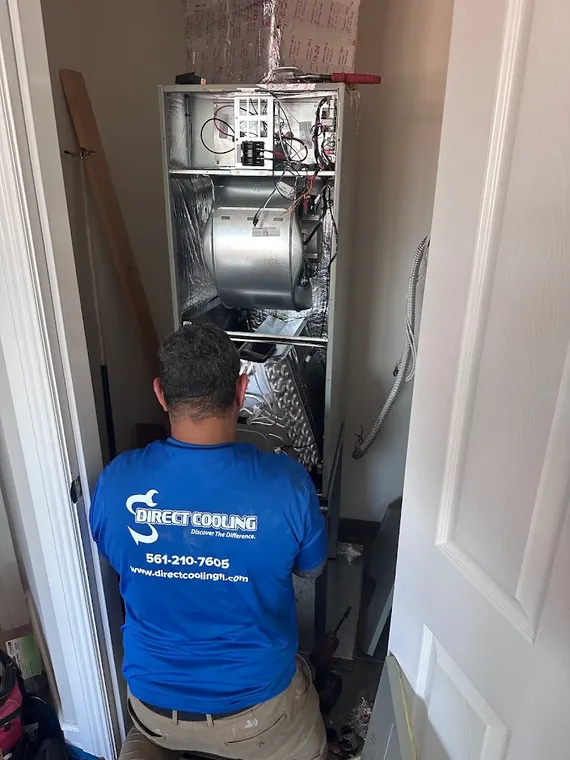
Fit matters too. The fixture has to clear the blower, sit where it can be reached for lamp changes without pulling the coil, and stay far enough from plastic and wiring to avoid damage. Those are details a quick install often skips.
Safety and Materials: The Details Installers Skip
UV-C is strong enough to damage eyes, skin and some materials, so the install has to account for all three.
- Ozone-free lampsEPA explains that uncoated UV-C lamps emitting at 254 nm and below can generate ozone, which is why manufacturers apply a special coating such as doped fused quartz. We use coated, ozone-free lamps.
- Plastics and wiringHoneywell recommends at least 3 feet between the lamp and plastic parts with unknown UV resistance, including wires and non-fiberglass filter media, and notes most drain pans are UV-C resistant.
- Keep UV off synthetic filtersASHRAE says air filters are sensitive to UV-C degradation, especially synthetic ones, and suggests shielding organic materials within about 5 feet of a lamp.
- Eyes and skinHoneywell's owner guide warns that UV-C is harmful to bare skin and eyes and that you should never look at a lit bulb. Doors should be interlocked or clearly labeled.
- Power off before serviceHoneywell says to disconnect power and let the bulb cool for at least 15 minutes before removing it.
- Mercury insideThe lamps contain mercury, so old bulbs go to recycling, not household trash.
We will not tell you a UV light kills viruses in your living room, cures allergies, removes odors or cuts your power bill by a set amount. EPA's review does not support the first three, and ASHRAE says cost effectiveness based on energy savings alone is not certain. What a UV light can do is help keep a wet coil and drain pan clean between maintenance visits.
How We Decide Whether UV Light Is Worth It for Your System
Diagnose first, sell second. Plenty of homes do not need a UV light, and we will say so.
Inspect the coil and pan
Look for growth, slime, standing water and rust, the problems a UV light is meant to prevent.
Fix the drain and moisture first
Clear the condensate line, correct pan slope and check indoor humidity. UV cannot keep up with a pan that never drains.
Check the filter
Rating, fit and bypass. UV adds nothing to particle removal, so filtration comes first.
Clean the coil if needed
ASHRAE describes coil UV as keeping surfaces clean continuously rather than restoring fouled ones, so a heavily fouled coil gets cleaned first.
Choose placement and lamp
Coated lamp, mounted to light the coil face and drain pan, with clearance from plastics and wiring.
Schedule the lamp change
A yearly replacement reminder so the system keeps working after the glow outlasts the UV.
A Year With a UV Light: What Upkeep Looks Like
UV systems are low maintenance, not no maintenance.
Confirm every lamp is lit, interlocks and labels are in place, and the lamp is aimed at the coil and pan as designed.
Check that the lamp is burning and clean. ASHRAE says dirty lamps can be wiped with a lint-free cloth and isopropyl alcohol, leaving no film.
Replace the lamp. ASHRAE notes typical rated life is about 9,000 hours and calls annual changes prudent for lamps running around the clock (8,760 hours a year).
The blue glow can continue after UV-C output fades, so do not judge by eye. Recycle the old lamp because it contains mercury.
Living With a UV System Safely
Most of the time you will never think about it. When you do open the cabinet, these rules come from the manufacturer guidance.
Safe to do yourself
- Never look at a lit lampUse the viewing window or indicator light instead of opening the panel to check it.
- Leave the interlock aloneHoneywell warns not to bypass the duct mount switch that shuts the lamp off when the unit is opened.
- Mark the replacement dateWrite the install date on the unit or set a phone reminder for 12 months out.
- Recycle old bulbsDo not put a UV bulb in household trash because it contains mercury.
Stop and call a pro
- Anything sold as an ozone purifierEPA says no federal agency has approved ozone generators for occupied spaces.
- Installing or relocating the fixturePlacement, wiring and interlocks inside the air handler are a professional job.
- A broken lampGlass and mercury cleanup needs gloves and care. Call us if a lamp breaks inside the unit.
Questions to Ask Any UV Light Installer
Whether you hire us or someone else, these questions separate a useful install from an expensive night light.
| Ask this | Why it matters |
|---|---|
| Where exactly will the lamp be mounted, and will it light the coil and drain pan? | Coil and pan placement is where the documented benefit is |
| Is the lamp coated and ozone-free? | Uncoated UV-C lamps can produce ozone, which EPA calls a lung irritant |
| What plastics, wiring or filters are within a few feet of it? | UV-C can degrade plastic HVAC materials and synthetic filter media |
| Is there an interlock or warning label on the access panel? | UV-C is harmful to eyes and skin |
| What does the lamp cost to replace, and how often? | Annual changes are typical; the glow is not proof it still works |
| Did you check my drain, filter and humidity first? | UV does not fix standing water, poor filtration or high humidity |
Where a UV Light Fits in Whole Home Air Quality
A UV light is one tool in a short list. Filtration handles particles, moisture control handles mold, ventilation and source control handle odors and chemicals, and coil UV keeps the wettest part of the system clean. EPA's summary, citing research on air handlers, notes that moisture control, coils designed to dehumidify properly, and drain pans that actually drain should remain the primary approach to controlling microbial growth in air handlers, with UV as a complement.
If you are not sure which of those your home needs, start with our indoor air quality page, or book a maintenance visit and ask the technician to show you the coil and drain pan. If they look clean and dry, you may not need a UV light at all.
Direct Cooling is a family-run, state-certified contractor (CAC1819111) based in Boca Commerce Park in west Boca Raton, rated A+ by the BBB. Call or text (561) 210-7605 to ask whether UV makes sense for your system.
Where We Handle UV Light Purification
UV installs and lamp replacements dispatch from our office in Boca Commerce Park in west Boca. Tap a pin for the city.
The interactive map is not loading right now. The areas it covers:
UV Light Purification by area
UV Light for AC: Common Questions
 Direct CoolingFL Certified AC Contractor CAC1819111 Dispatch 24/7
 Hi, this is Direct Cooling. Tap a question below for a straight answer.
Tap a question to ask
- How often do UV lamps need replacing?
- About once a year. ASHRAE notes typical rated lamp life is around 9,000 hours and calls annual replacement prudent for lamps running continuously, which is 8,760 hours a year. Honeywell's owner guide also recommends replacing the bulb once a year. The blue glow can continue after UV-C output has faded, so a lamp that looks lit is not proof it is still working.
- Will a UV light kill viruses in my home?
- Do not count on it. EPA found typical residential UV units do not deliver a high enough dose to kill or deactivate most airborne microorganisms, because air passes the lamp too quickly. EPA says UV does not appear effective as a sole control device. Where UV does work well is on surfaces like the coil and drain pan, which sit in the light continuously.
- Does a UV light for AC produce ozone?
- It can if the lamp is uncoated. EPA explains that uncoated UV-C lamps emitting at 254 nm and below can produce ozone, so manufacturers apply special coatings such as doped fused quartz to prevent it. Ask for a coated, ozone-free lamp. EPA also advises avoiding any air cleaner that intentionally produces ozone.
- Do UV lights help with allergies?
- There is no good evidence that they do. EPA found no research showing UV reduces dust mite or mold allergenicity, and notes that dead or deactivated particles can still cause allergic reactions. For allergies, better filtration and moisture control do more. A UV light helps keep the coil clean, which can reduce musty odors from the system.
- Can UV light damage my AC system?
- UV-C can degrade some plastics, wiring insulation and synthetic filter media over time. Honeywell recommends keeping the lamp at least 3 feet from plastic parts with unknown UV resistance, and ASHRAE suggests shielding organic materials within about 5 feet. Most drain pans are UV-C resistant. Proper placement and shielding prevent most problems.
- Will a UV light lower my electric bill?
- It might help a little, but we do not promise savings. Field studies in hot, humid climates, including one in Tampa, showed better airflow and heat transfer at UV-treated coils. ASHRAE also says there are relatively few peer-reviewed studies of real-world performance and that cost effectiveness based on energy savings alone is not certain.
Musty Smell From the Vents?
We will check the coil, drain pan and filter first, then tell you honestly whether a UV light will help.
Related Services
Indoor Air Quality
Filtration, UV light and humidity control for cleaner, drier air at home.
Learn moreAC Maintenance
Tune-ups that clear drains, clean coils and catch weak parts before July does.
Learn moreDuctwork
Duct repair, sealing and replacement for hot rooms, high bills and attic leaks.
Learn moreSources · page reviewed 2026-10-06
- EPA, Residential Air Cleaners: A Technical Summary, 3rd ed. (2018), read 2026-10-06
- 2019 ASHRAE Handbook, HVAC Applications, Ch. 62, UV air and surface treatment, read 2026-10-06
- Honeywell, UV lamp treatment system owner guide, read 2026-10-06
- EPA, Guide to air cleaners in the home, read 2026-10-06
- EPA, Ozone generators that are sold as air cleaners, read 2026-10-06