
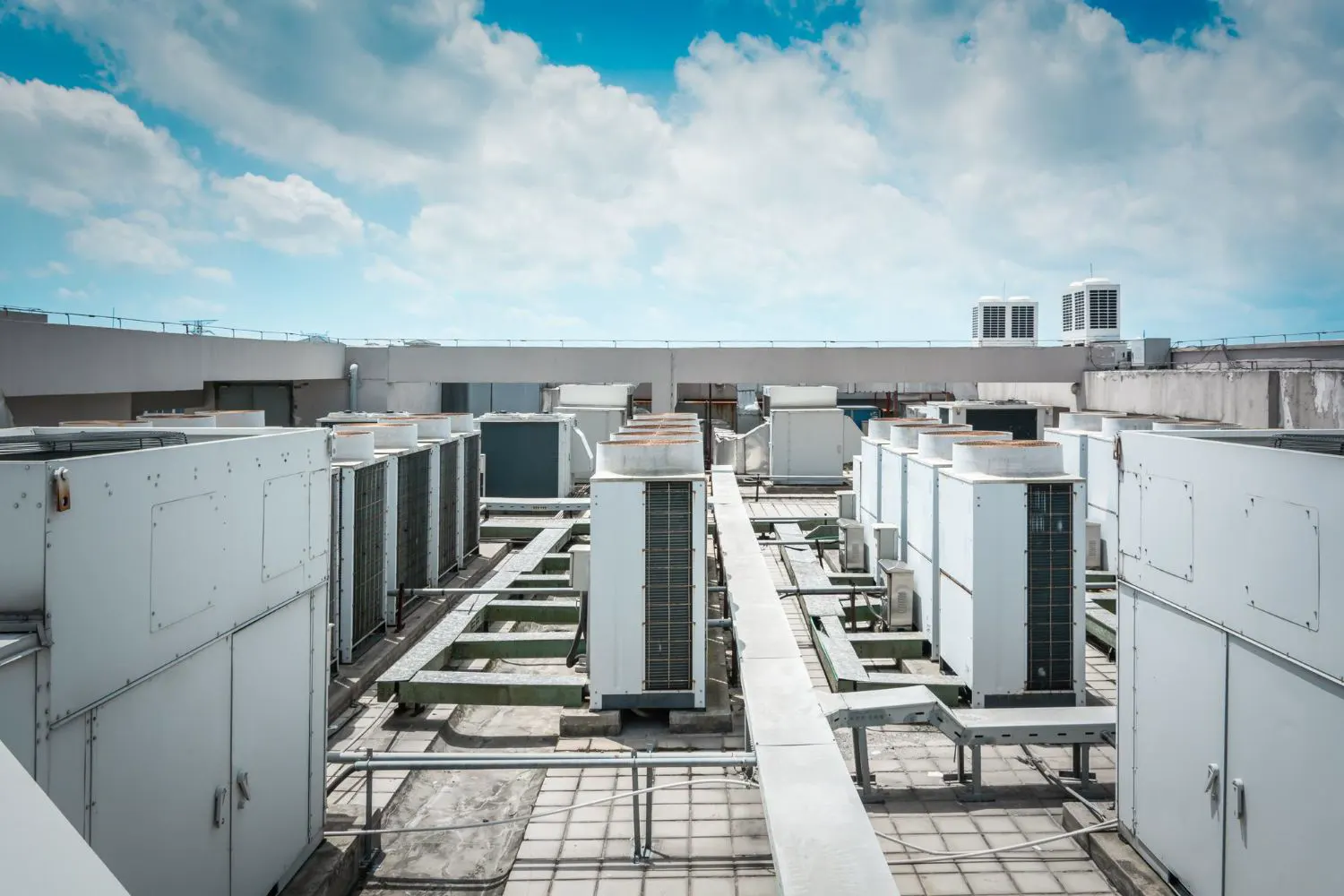
Commercial HVAC and Rooftop Unit Service in Boca Raton
Direct Cooling services, replaces and maintains commercial rooftop units and split systems for business owners, property managers and general contractors across south Palm Beach County and north Broward. You work directly with a state-certified contractor (CAC1819111) and one point of contact who knows your equipment.
- 4.9 on Google, 360+ reviews
- FL license CAC1819111
- BBB A+ accredited
Managing Buildings With Rooftop Units Across Two Counties
If you manage a few small retail or office buildings between Boca Raton and Deerfield Beach, you probably have a mix of rooftop units of different ages, a maintenance history scattered across past vendors, and tenants who call you first when a suite gets warm. What you need is one licensed contractor who services every unit on a set schedule, tells you in writing what each one needs, and plans replacements before they turn into emergency calls in August.
That is the work we do on commercial properties. Direct Cooling LLC holds Florida certified air conditioning contractor license CAC1819111, active through August 2028, and serves both Palm Beach and Broward counties. Frank Rey founded the company in 2017 after more than 20 years in HVAC. Palm Beach County permit records filed under that license include commercial jobs in unincorporated west Boca Raton and west Boynton Beach.
Crossing the county line changes the rules more than most owners expect. Broward sits in Florida's High-Velocity Hurricane Zone and Palm Beach does not, and each building department has its own permit process. We handle the permitting for the work we do, and we explain the differences below so you can plan budgets and schedules with fewer surprises.
Rooftop Unit Maintenance Schedule Based on ASHRAE/ACCA Standard 180
ANSI/ASHRAE/ACCA Standard 180 is the national standard practice for inspecting and maintaining commercial building HVAC systems. Its rooftop unit table sets these minimum frequencies, and the standard includes a procedure for changing a frequency when conditions call for it. In our humidity, we watch the wet-side tasks closely.
| Frequency | Tasks in the standard's rooftop unit table |
|---|---|
| Quarterly | Check filters for particulate buildup and clean or replace when pressure drop or airflow falls outside limits; check UV lamps where installed |
| Semiannually | Fan belt tension, wear and alignment, and sheaves; control system and devices; P-trap priming; variable frequency drives; cooling coil operation, damage and leaks |
| Annually | Control box terminations; motor contactors for pitting; fan blades and housing; refrigerant pressures or temperatures; drain pan, drain line and coil for biological growth; evaporator coil fins; moisture carryover past the drain pan |
| Annually (continued) | Panel and curb integrity and fasteners; damper operation; air-cooled condenser surfaces for damage, leaks, scale or debris; condensate pump; exposed duct and piping insulation; internally lined ductwork near the unit |
Source: ANSI/ASHRAE/ACCA Addendum a to Standard 180-2008, Table 5-20 Rooftop Units. We build each building's schedule from this table and the condition of its equipment.
Why South Florida Rooftops Need the Wet-Side Tasks Done Right
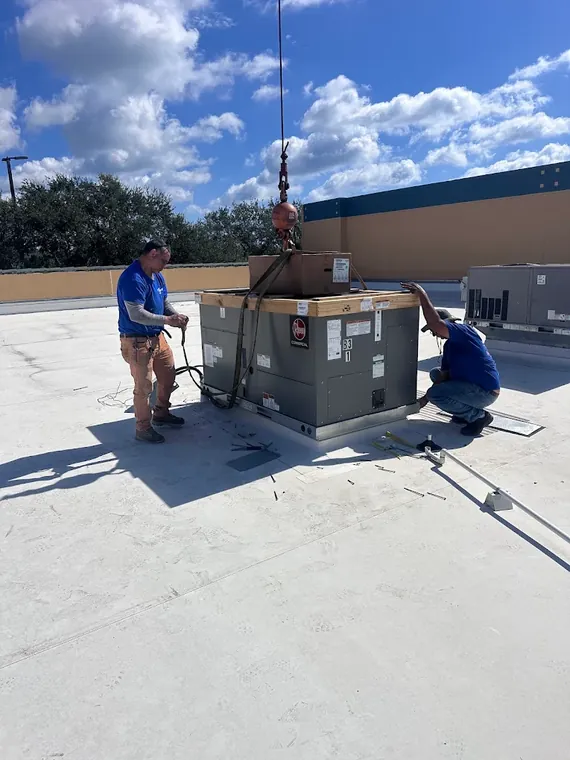
In this climate, many rooftop unit problems start somewhere wet. Summer dew points around West Palm Beach average roughly 72 to 74°F from June through September (NOAA 1991-2020 normals), so a rooftop unit's coil wrings water out of the air almost continuously. That water has to leave through a primed P-trap and a clear drain line, and the drain pan has to stay free of growth. When it does not, the result is a tripped float switch, water through a suspended ceiling, or a coil fouled enough to cut airflow.
The 2023 Florida Mechanical Code addresses this directly. Section 307.2.3 requires backup protection wherever an overflow from the primary condensate drain could damage building components: an auxiliary drain pan with its own drain, a separate overflow drain line, an auxiliary pan with a water-level detection device, or a water-level detection device on the primary drain. On a change-out we confirm the unit has one of those in place and that it works.
Coil fouling is the other humid-climate problem. The 2019 ASHRAE Handbook notes that biofilm on cooling coils can increase pressure drop and reduce airflow and heat exchange, and reports a Tampa air handler where UV surface treatment of the coil reduced air-side pressure drop by 22% in under two months. Whether UV makes sense on a given rooftop unit depends on its condition and access, but keeping the coil and drain pan clean on the Standard 180 schedule is not optional here.
Broward vs Palm Beach: What Changes for Rooftop Equipment
Many owners have buildings on both sides of the county line. These are the differences that affect rooftop equipment.
| Topic | Broward County | Palm Beach County |
|---|---|---|
| High-Velocity Hurricane Zone | Yes. The Florida Building Code defines the HVHZ as Broward and Miami-Dade counties | No |
| Design wind speeds | FBC Section 1620 lists Broward at 156 mph for Risk Category I up to 185 mph for Risk Category IV buildings | Set by the statewide wind maps outside the HVHZ |
| Wind loads on rooftop equipment | FBC 1620.6 refers rooftop equipment to Chapter 29 of ASCE 7 | FMC 301.15 requires exposed equipment and supports to resist the wind pressures in the Florida Building Code |
| Rated curbs and stands | Equipment fastened to the roof on rated stands, platforms or curbs is deemed to comply with the wind-resistance requirements | The Palm Beach County Building Code Advisory Board (2017) treats equipment on rated stands or curbs as compliant, provided it is adequately anchored |
| Who permits the work | The city building department, or Broward County for unincorporated areas | The city building department, or Palm Beach County for unincorporated areas |
The Palm Beach County advisory also cites a 2016 Broward Board of Rules and Appeals interpretation that the equipment itself does not have to demonstrate wind-load compliance. In both counties the anchorage to the curb or stand still has to resist code wind loads.
How a Rooftop Unit Change-Out Runs
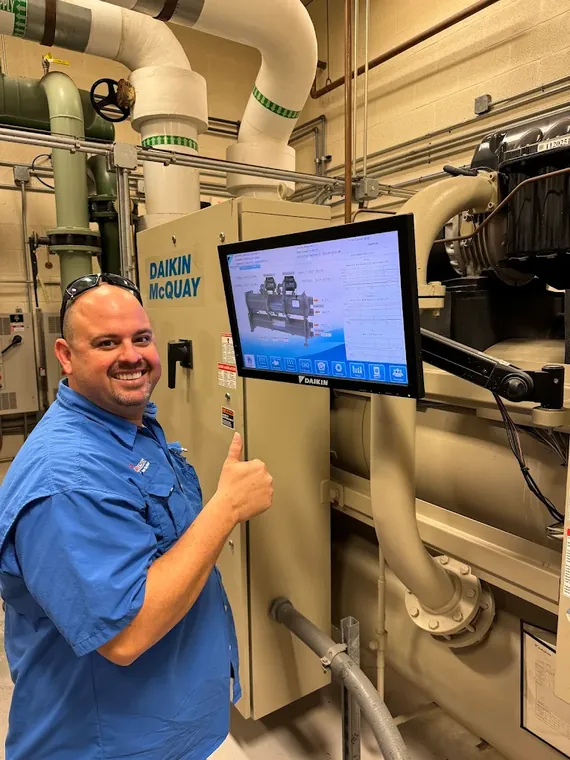
A rooftop replacement touches the roof, the structure, the electrical service and your tenants. This is the sequence we follow so nothing gets missed.
Survey the unit and the roof
Tonnage, curb size and condition, electrical service, condensate routing and roof access. FMC 306.5 requires a permanent means of access when service equipment is more than 16 feet above grade.
Match the replacement
Capacity sized to the space served, curb compatibility or an adapter, and efficiency compared against utility rebate minimums where they apply.
Permit and schedule
We pull the permit as the licensed contractor and coordinate the lift and shutdown around business hours to limit tenant disruption.
Set, anchor and connect
Unit set on the curb and anchored to resist code wind loads, then electrical, condensate and duct connections made and sealed.
Start up and verify
Refrigerant pressures or temperatures, airflow, controls, drain and overflow protection checked before we leave the roof.
Close out
Final inspection, written findings and photos for your records, and the new unit added to the planned maintenance schedule.
Do EPA Refrigerant Leak Rules Apply to Your Building?
Since January 1, 2026, EPA's Emissions Reduction and Reclamation (ER&R) rule requires owners or operators of appliances holding 15 pounds or more of HFC refrigerant (or certain substitutes) to calculate the leak rate each time refrigerant is added, and to repair leaks when the rate exceeds 10% a year for comfort cooling. Repairs are due within 30 days of the refrigerant addition, followed by verification tests and an annual leak inspection until the appliance stays under the threshold for a year. Owners must keep records for three years.
The important exception is size and type. EPA's fact sheet states that equipment in the residential and light commercial air conditioning and heat pump subsector is not covered by these leak repair requirements, and defines that subsector as equipment cooling individual rooms, single-family homes and small commercial buildings. Chillers and certain variable refrigerant flow systems fall into their own subsectors. Many rooftop units on small retail and office buildings will be light commercial equipment, but the classification depends on the equipment, so we confirm it unit by unit before it becomes a compliance question.
On replacements, EPA's May 2026 Technology Transitions rule removed the January 1, 2026 installation deadline for residential and light commercial AC and heat pump systems made or imported before 2025, so that inventory can be installed until supply runs out. New equipment uses lower-GWP refrigerants under the 700 GWP limit. Existing systems can continue to be used and repaired. Our refrigerant guide covers the details.
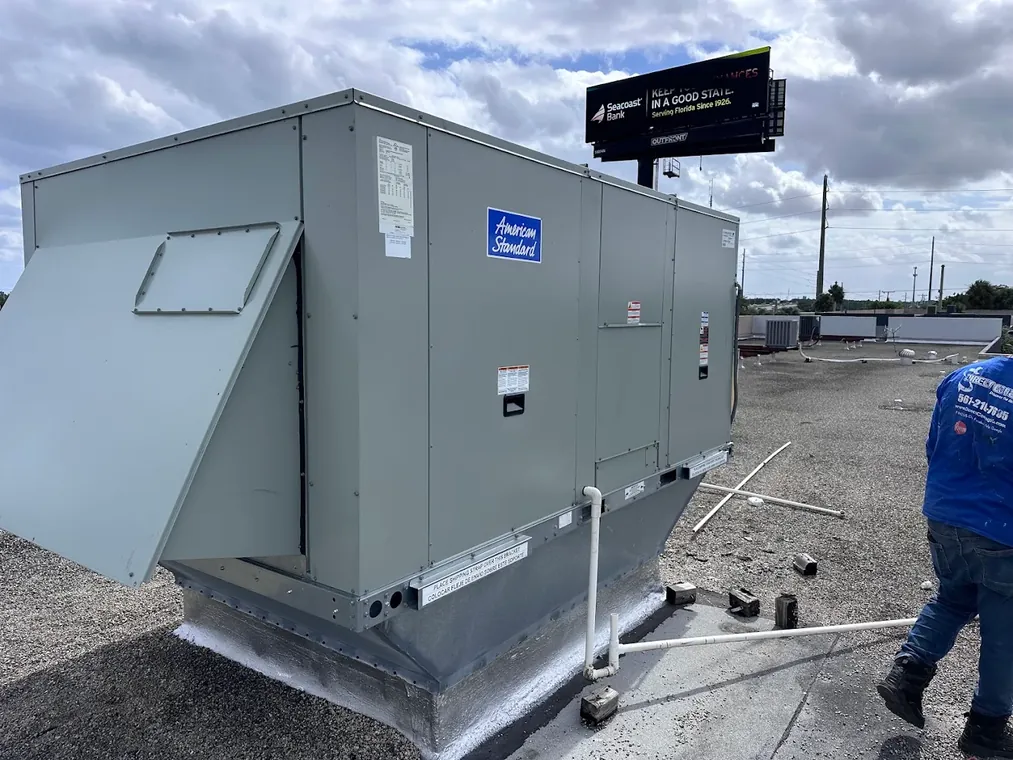
What Property Managers Get From Direct Cooling
The point of a commercial service relationship is fewer surprises. This is how we keep it that way.
- A licensed contractor of recordFlorida certified air conditioning contractor CAC1819111, with insurance documentation available on request for your vendor file.
- One point of contactSomeone who knows your buildings, your units and their history, instead of a different dispatcher every call.
- Written findings and photosAfter every visit, so you can show owners and tenants what was found and what was done.
- Dispatch monitored 24/7Call or text (561) 210-7605 any time. Office hours are Monday to Friday, 8 to 5.
- Certified technicians on refrigerantEPA requires technicians who maintain, service or repair equipment that could release refrigerant to hold Section 608 certification.
- Diagnose first, sell secondEvery technician is trained by Frank to show you the reading behind a recommendation, on a rooftop the same as in a home.
FPL's Business HVAC program sets minimum efficiency by tonnage for direct-expansion units, for example EER 11.98 for 5.42 to 11.25 tons and EER 11.77 for 11.25 to 20 tons on its current rebate certificate. The work must be done by an FPL participating independent contractor, and the certificate is void 90 days after installation. We check current terms for your equipment before you choose a replacement.
Repair or Replace a Rooftop Unit: How We Help You Decide
We do not push replacements. When a unit is worth repairing we say so, and when it is not we show you why.
| Factor | Points toward repair | Points toward replacement |
|---|---|---|
| Failure type | A single component: contactor, capacitor, belt, fan motor, control | Compressor failure on an older unit, or a cracked or corroded coil |
| Refrigerant | Charge holds and leaks are minor and repairable | Repeated leaks; for larger equipment, a leak rate that triggers ER&R repair duties |
| Repair history | First significant repair in years | Multiple major repairs in the last few seasons |
| Curb and cabinet | Panels, curb and fasteners in good shape | Rusted cabinet, failing curb or a unit that no longer seals to the curb |
| Efficiency and rebates | Unit still performs near its rating | A new unit qualifies for FPL business rebate minimums and lowers operating cost |
| Tenant impact | Repair can be done quickly with parts on hand | Repeated outages are costing tenant goodwill or business |
Roof Access, Drains and Other Code Details We Check
These items come up on commercial roofs more than any other, and they are easier to fix during a planned change-out than during an emergency.
Permanent access over 16 feet
FMC 306.5 requires a permanent means of access when equipment needing service is more than 16 feet above grade, with no climbing over obstructions taller than 30 inches.
Sloped roofs
FMC 306.5.1 requires a level working platform at least 30 inches in each dimension, with guards, when equipment sits on a roof sloped 3 in 12 or steeper.
Overflow protection
FMC 307.2.3 requires a backup to the primary condensate drain wherever an overflow could damage the building.
Anchorage
FMC 301.15 requires exposed equipment and its supports to be installed to resist the wind pressures set by the Florida Building Code.
Section 608 certification
Refrigerant work on any unit requires an EPA Section 608 certified technician.
Where We Handle Commercial HVAC
Commercial service across south Palm Beach County and north Broward, dispatched from our office in Boca Commerce Park. Tap a pin for the city.
The interactive map is not loading right now. The areas it covers:
Commercial HVAC Questions From Owners and Managers
 Direct CoolingFL Certified AC Contractor CAC1819111 Dispatch 24/7
 Hi, this is Direct Cooling. Tap a question below for a straight answer.
Tap a question to ask
- Do you work with property managers and HOAs?
- Yes. We work with property managers and associations that handle multiple units and buildings, with licensing and insurance documentation available on request. You get one point of contact, written findings and photos after each visit, and a maintenance schedule built around your equipment. Dispatch is monitored 24/7 by call or text at (561) 210-7605.
- Do you service and replace rooftop units?
- Yes. We install, replace, repair and maintain commercial rooftop units, along with split systems on commercial properties. Change-outs are permitted and coordinated around business hours to limit disruption to tenants. Every replaced unit is set and anchored on its curb, then started up and checked before we leave the roof.
- How often should a rooftop unit be serviced?
- ASHRAE/ACCA Standard 180 sets quarterly, semiannual and annual tasks for rooftop units. Filters and UV lamps are checked quarterly; belts, controls, P-traps and coils semiannually; contactors, refrigerant pressures, drain pans, curbs and condenser coils annually. In South Florida humidity, the condensate and coil tasks are the ones we watch most closely.
- Are rooftop units in Broward held to different rules than in Palm Beach County?
- Yes. Broward is part of the High-Velocity Hurricane Zone under the Florida Building Code, with design wind speeds from 156 to 185 mph depending on the building's risk category, while Palm Beach County is not in the HVHZ. In both counties, equipment fastened on rated curbs or stands is deemed to comply with the wind-resistance requirements when properly anchored.
- Do EPA leak repair rules apply to my building's AC?
- It depends on the equipment. Since January 1, 2026, appliances holding 15 pounds or more of HFC refrigerant must have leaks repaired when the annual leak rate tops 10% for comfort cooling. Residential and light commercial AC and heat pump equipment, which EPA says includes systems for small commercial buildings, is excluded. We confirm which category each unit falls into.
- Can you schedule work around our business hours?
- Yes. Commercial change-outs are coordinated around business hours to limit disruption, and our dispatch line is monitored 24/7 for breakdowns. Tell us your tenants' hours and any access restrictions when you call, and we will plan the lift, the shutdown and the restart around them.
Managing a Building With Rooftop Units?
Tell us what equipment you have and where. We will build a maintenance schedule around it and flag the units that need planning now.
Related Services
Emergency AC Repair
A dispatch line monitored 24/7, plus what to do safely while you wait for the truck.
Learn moreAC Maintenance
Tune-ups that clear drains, clean coils and catch weak parts before July does.
Learn moreAC Replacement
An honest repair-or-replace answer, then a clean change-out when replacement wins.
Learn moreSources · page reviewed 2026-10-06
- ASHRAE, Standard 180 Addendum a (inspection and maintenance of commercial HVAC), read 2026-10-06
- EPA, ER&R leak repair fact sheet (January 2026), read 2026-10-06
- EPA, Technology Transitions final rule fact sheet (May 2026), read 2026-10-06
- EPA, Frequent Questions on the Phasedown of HFCs, read 2026-10-06
- EPA, Section 608 technician certification, read 2026-10-06
- 2023 Florida Mechanical Code, Chapter 3 (301.15, 306.5, 307.2.3), read 2026-10-06
- Florida Building Code, High-Velocity Hurricane Zone definition, read 2026-10-06
- Florida Building Code 2023, Section 1620 HVHZ wind loads, read 2026-10-06
- Palm Beach County BCAB, Wind resistance of exposed mechanical equipment (2017), read 2026-10-06
- FPL, HVAC rebate certificate (Rev. 10/10/2025), read 2026-10-06
- 2019 ASHRAE Handbook, HVAC Applications, Ch. 62, UV air and surface treatment, read 2026-10-06
- NOAA NCEI, 1991-2020 hourly normals, West Palm Beach Intl (dew point), read 2026-10-06
- Florida DBPR, license search (CAC1819111), read 2026-10-06