

AC Maintenance in Boca Raton: What a Real Tune-Up Measures
AC maintenance in Boca Raton is mostly about water, electricity and airflow: a drain line that stays clear through months of humid air, capacitors and contactors that survive the heat, and coils clean enough to move heat. A real tune-up measures each of those and writes down the numbers. A filter swap and a sticker is not maintenance.
- 4.9 on Google, 360+ reviews
- FL license CAC1819111
- BBB A+ accredited
Bills Creeping Up, Water in the Pan and No Tune-Up in Years?
If your AC runs most of the day, the electric bill has climbed for two summers, and you found water sitting in the drain pan or a stain on the ceiling under the air handler, the system is telling you what a skipped tune-up costs. None of those usually means the equipment is finished. They usually mean a slow drain, a dirty coil, a tired capacitor or a restricted filter that nobody measured.
The numbers behind that are not small. The U.S. Department of Energy says routinely replacing or cleaning a dirty, clogged filter can lower an air conditioner's energy use by 5 to 15 percent. ENERGY STAR says airflow problems can cut a system's efficiency by up to 15 percent, and that dirty coils make it run longer, raising energy costs and shortening equipment life. ENERGY STAR also warns that a plugged condensate drain can cause water damage and affect indoor humidity.
A first visit on a neglected system takes longer than a routine one, because there is more to clean and more to test. Every technician on the team is trained by Frank Rey to diagnose first and sell second. On a tune-up that means you see the measurements, hear which parts are wearing toward failure and why, and get the price for anything beyond the visit before any work starts.
What Does an AC Tune-Up Include?
This is the visit, line by line. The items follow ENERGY STAR's maintenance checklist and the U.S. Department of Energy's guidance, with the South Florida reason each one matters.
| Task | What is measured or done | Why it matters here |
|---|---|---|
| Condensate drain and pan | Line cleared and flushed, flow verified, pan and float switch inspected | Humid air fills the pan every hour the system runs; a clogged line is the classic Florida water-damage call |
| Evaporator coil | Inspected for dirt and growth; DOE advises checking it every year | ASHRAE notes growth on continuously wet coils raises airflow resistance and cuts heat transfer |
| Condenser coil | Rinsed with a gentle spray, fins checked and straightened with a fin comb | Grass, dirt and, near the coast, salt deposits reduce the unit's ability to reject heat |
| Capacitors and contactor | Capacitance tested against the rating; contacts checked for pitting | Heat-stressed electrical parts are a leading cause of no-cool calls in July |
| Electrical connections | Connections tightened; voltage and current measured on motors (ENERGY STAR) | Loose connections run hot, reduce component life and can make operation unsafe |
| Refrigerant charge | Pressures and superheat or subcooling compared with the manufacturer chart | Too much or too little refrigerant lowers efficiency (ENERGY STAR); a drop points to a leak worth finding early |
| Airflow and blower | Blower cleaned and adjusted; temperature split across the coil measured | Restricted airflow is a common cause of frozen coils and weak cooling |
| Filter | Size and condition checked; filter changed or a schedule set | A clogged filter starves the coil of air and raises energy use |
| Thermostat and controls | Settings, calibration and start-up and shut-down sequence checked | ENERGY STAR lists checking that the system starts, runs and shuts off properly |
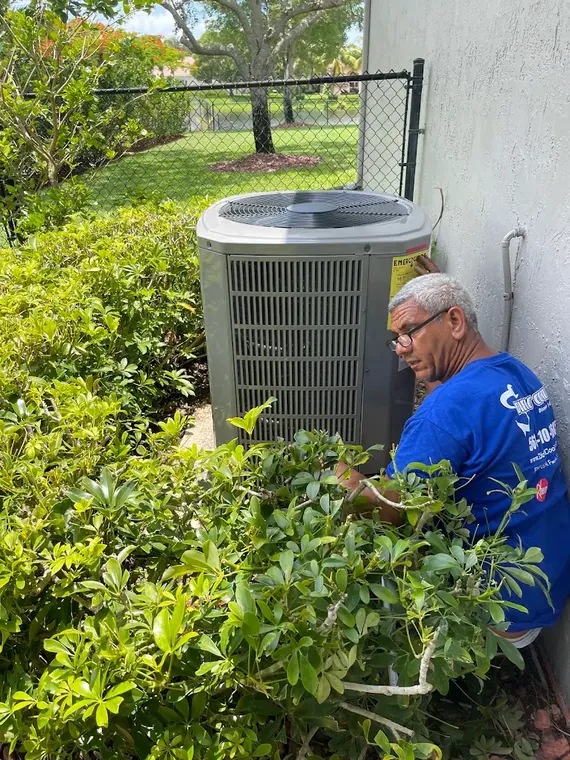
| Outdoor unit clearance | Plants and debris pushed back to 2 feet on all sides | Trane's clearance guidance; a crowded condenser recirculates its own hot air |
Heat pumps get the same list plus a heating-mode check, because a heat pump's reversing valve and defrost controls only show problems when the system switches modes.
How Often Should AC Be Serviced in South Florida?
Manufacturers set the floor. Our climate is why we recommend the higher end of it.
- The manufacturer floorAmerican Standard recommends an air conditioner tune-up each spring before cooling season. ENERGY STAR recommends annual pre-season check-ups, with the cooling system checked in spring.
- Heat pumps: twiceAmerican Standard and Trane both recommend two professional visits a year for heat pumps, one before cooling season and one before heating season. Many Boca homes heat with a heat pump, so they are already on a twice-a-year schedule.
- Our climate adds loadNOAA's 1991-2020 normals for West Palm Beach show average summer dew points of roughly 72 to 74°F. That moisture keeps the coil and drain wet for months, which is when algae and growth take hold.
- Our recommendationTwo visits a year: one in spring before the long cooling season and one in fall. It is the schedule the membership plan is built around.
AC Maintenance You Can Safely Do Between Visits
These come from manufacturer, utility and federal guidance. Each takes minutes and none involves opening a panel.
Safe to do yourself
- Check the filter monthlyENERGY STAR recommends inspecting it every month; Trane suggests changing standard filters every 1 to 3 months. EPA recommends at least MERV 13, or as high as your system can handle. Ask us what your system supports before upgrading.
- Treat the drain lineWith the system off, pour about a cup of distilled vinegar into the indoor drain access point, as Carrier describes, to slow algae buildup.
- Rinse the outdoor coil gentlyUse a garden hose on a gentle spray. Trane says never use a jet setting or a pressure washer, because the fins bend easily.
- Keep 2 feet of clearanceTrim shrubs and move stored items away from the condenser on all sides.
- Use sensible settingsFPL suggests 75 to 78°F when you are home, about 82°F when you are away, and the fan on Auto.
Stop and call a pro
- Indoor coil cleaningTrane recommends leaving evaporator coil cleaning to professionals; the fins and drain pan are easy to damage.
- Refrigerant and electrical checksHandling refrigerant requires EPA Section 608 certification, and capacitors hold a charge even with the power off.
- A drain that keeps cloggingRepeat clogs, standing water or a musty smell point to the pan, trap or slope, not just algae.
Why the Condensate Drain Is the Most Important Line on the Checklist
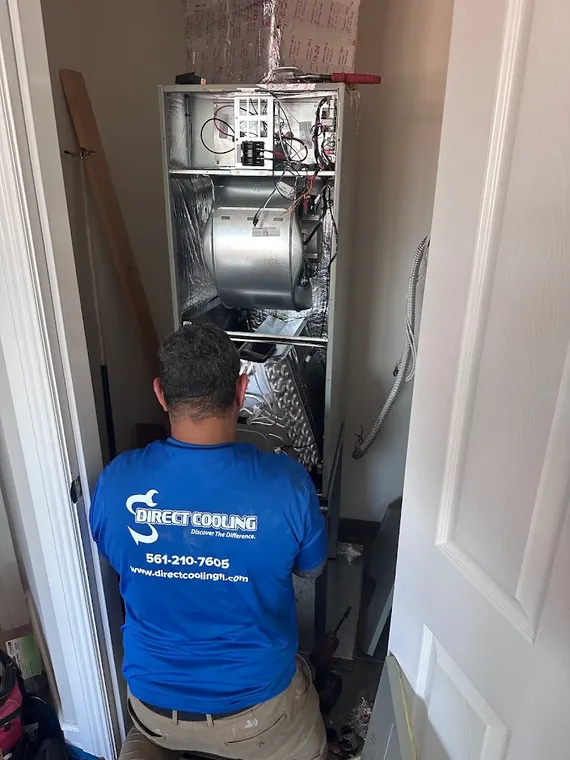
An air conditioner in Palm Beach County is also a dehumidifier. Every hour it runs, it pulls water out of the air across the cold indoor coil, and that water has to leave through a pan and a small drain line, usually PVC, to the outside. When algae, sludge or debris narrows that line, water backs up into the pan. If the system has an overflow float switch, Trane explains, the switch shuts down the compressor and fans to prevent water damage, which is why a perfectly healthy AC can suddenly stop cooling on a hot afternoon.
Systems without a working float switch, or with the switch mounted where it cannot sense the backup, overflow instead. In an attic or a hall closet that means wet drywall, stained ceilings and, if it is not dried quickly, mold. EPA advises drying wet materials within 24 to 48 hours to prevent mold growth, and it lists keeping AC drip pans clean among its prevention steps.
That is why the tune-up checklist above flushes the drain and verifies its flow instead of glancing at it, tests the float switch, looks for rust or cracks in the pan, and checks how the line is sloped and trapped. Between visits, the vinegar treatment above slows the growth. A line that keeps clogging despite both usually has a slope or trap problem that a technician can correct.
A South Florida AC Maintenance Calendar
Built around hurricane season, which runs June 1 to November 30 (National Hurricane Center), and the seasonal-resident calendar.
Spring tune-up before the long cooling season: drain cleared, coils cleaned, electrical parts tested under load.
Pre-storm check: equipment anchoring, surge protection discussed, outdoor area cleared of anything that can become debris.
Monthly filter checks. After any storm, have a flooded outdoor unit inspected before restarting it, as Goodman advises.
Fall tune-up, including heat mode on heat pumps. Seasonal residents book service about three weeks before leaving, as UF/IFAS suggests.
Leaving Boca for the Summer, or Coming Back for the Season?
A home that sits empty for months is the hardest test an AC faces here, and our area has a lot of them. Census American Community Survey figures (2020-2024) show that 16.0 percent of all housing units in ZIP 33434 in west Boca, 9.1 percent in 33496, and 16.8 percent in Delray Beach's 33484 sit vacant for seasonal, recreational or occasional use.
UF/IFAS Extension's guide to preparing a Florida home for seasonal absence recommends having the system serviced before you leave, about three weeks ahead so there is time for any repair, and cleaning the condensate line, because summer heat and humidity feed mildew growth in an empty house. UF/IFAS also advises keeping the AC set no higher than 85°F in an unoccupied home so it keeps removing moisture. Turning it off entirely is how many owners come back to musty rooms and growth on furniture.
A pre-departure visit covers the full tune-up checklist, with the drain flushed and treated, the float switch tested and the thermostat away setting confirmed. When you return, a second visit catches anything that changed while the system ran unwatched: a slow drain, a weak capacitor, a coil that iced up. If a neighbor or property manager checks the house while you are away, a quick look at the drain pan is the most useful thing they can do.
How Much Efficiency a Neglected AC Loses
These are the published figures on what common maintenance problems cost. Each one is something a tune-up finds.
| Problem | Documented effect | Source |
|---|---|---|
| Dirty, clogged filter | Replacing or cleaning it can lower AC energy use by 5 to 15 percent | U.S. DOE, Home Cooling 101 |
| Airflow problems | Can reduce system efficiency by up to 15 percent | ENERGY STAR maintenance checklist |
| Dirty evaporator or condenser coils | System runs longer, raising energy costs and shortening equipment life | ENERGY STAR maintenance checklist |
| Refrigerant charge off | Too much or too little makes the system less efficient and shortens its life | ENERGY STAR maintenance checklist |
| Return duct leak pulling hot attic air | A return leak drawing 15 percent of its air from a hot attic can cut capacity and efficiency by about half | Florida Solar Energy Center (Cummings and Withers) |
A tune-up does not fix a leaking duct, but it is often where one is found. If the readings point to the ducts, we will say so and explain what our duct repair and sealing work involves.
How the Direct Cooling Maintenance Plan Works
The membership plan turns the two-visit schedule into something you do not have to remember. Here is what it includes.
Two tune-ups a year
Scheduled before the cooling season and again before winter use, with the full checklist above on each visit.
10% off additional AC services
Applies to repairs and other AC service all year, not only at the scheduled visits.
10% off refrigerant
On any service that needs it during the membership year.
Priority scheduling
Priority scheduling with the same team that already knows your system.
Every system covered
Homes with more than one system add each additional unit to the same plan. Pricing is on the membership page.
Questions to Ask Before You Book Any AC Tune-Up
Tune-up prices and checklists vary widely. These questions separate a measured visit from a quick look.
- Will the technician measure refrigerant pressures and the temperature split, or only look at the unit?
- Is the condensate line flushed and its flow verified, and is the float switch tested?
- Are capacitors tested against their rated microfarads, or replaced on sight?
- Is the indoor coil inspected, not just the outdoor unit?
- Will you get the readings in writing, so the next visit can be compared against them?
- Is the technician working under a Florida certified or registered contractor license you can look up?
- Does the plan, if there is one, cover repairs and refrigerant between visits, or only the visits themselves?
A pressure washer or a jet nozzle flattens the thin aluminum fins on the outdoor coil, which blocks airflow and can do more harm than the dirt did. Trane advises a gentle garden-hose spray only.
Where We Handle AC Maintenance
Tune-up routes run from our office in Boca Commerce Park across south Palm Beach County and north Broward. Tap a pin for local details.
The interactive map is not loading right now. The areas it covers:
AC Maintenance Questions We Get Asked
 Direct CoolingFL Certified AC Contractor CAC1819111 Dispatch 24/7
 Hi, this is Direct Cooling. Tap a question below for a straight answer.
Tap a question to ask
- How often should AC be serviced in Florida?
- Twice a year is the practical standard in South Florida: once in spring before the long cooling season and once in fall. American Standard recommends a spring tune-up for air conditioners and two visits a year for heat pumps, and our systems run most months in humid air that loads the drain and coil year round.
- How often should I change my AC filter?
- Check it every month, as ENERGY STAR recommends, and change standard filters every 1 to 3 months, as Trane suggests. Homes with pets, allergies, construction dust or a system that runs constantly land at the short end. A thicker or higher-MERV filter may last longer, but ask whether your system can handle it first.
- What does an AC tune-up include?
- A full tune-up covers the condensate drain and float switch, the indoor and outdoor coils, capacitors and contactor, electrical connections, refrigerant pressures, airflow and the blower, the filter, the thermostat and the outdoor clearance. The important part is measurement: readings are recorded so problems show up as numbers that change between visits, not guesses.
- Can I clean my own AC drain line?
- Yes, for routine care. With the system off, Carrier describes pouring about a cup of distilled vinegar into the indoor drain access point to slow algae, and a wet/dry vacuum at the outdoor end can pull out a clog. If the line clogs again within weeks, or water reaches the floor or ceiling, call for service.
- Does skipping maintenance void my AC warranty?
- It depends on the manufacturer and model, so read the warranty certificate for your equipment and keep your service invoices. Under Florida Statute 559.957, a warranty on equipment installed by a licensed contractor runs its full term from installation without depending on registration, but manufacturers can still exclude damage caused by neglect.
- Should I turn off my AC when I leave for the summer?
- No. UF/IFAS Extension advises keeping the AC set no higher than 85 degrees in an unoccupied Florida home so it keeps removing moisture, and having it serviced, including the condensate line, before you leave. A home closed up with the AC off is how many owners return to musty air and mildew.
- Is an AC maintenance plan worth it?
- For most homes here, yes. A plan puts both yearly visits on the calendar so they actually happen, and the Direct Cooling membership adds 10 percent off repairs and refrigerant between visits plus priority scheduling. The real savings come from catching a weak capacitor or a slow drain in April instead of during a July breakdown.
Book Your Tune-Up
Spring and fall slots fill first. Call or text (561) 210-7605 to book a visit, or join the membership plan and we will schedule both.
Sources · page reviewed 2026-10-06
- ENERGY STAR, Maintenance checklist, read 2026-10-06
- U.S. DOE, Energy Saver 101: Home Cooling infographic, read 2026-10-06
- American Standard, Heat pump vs air conditioner (maintenance schedules), read 2026-10-06
- Trane, How do I know if I have a heat pump? (fall and spring service), read 2026-10-06
- 2019 ASHRAE Handbook, HVAC Applications, Ch. 62, UV air and surface treatment, read 2026-10-06
- NOAA NCEI, 1991-2020 hourly normals, West Palm Beach Intl (dew point), read 2026-10-06
- EPA, What is a MERV rating?, read 2026-10-06
- Trane, How to clean heat pump coils, read 2026-10-06
- Trane, Air conditioner maintenance tips, read 2026-10-06
- Trane, Air handler overflow switch, read 2026-10-06
- Carrier, How to clean an AC drain line, read 2026-10-06
- EPA, A brief guide to mold, moisture and your home, read 2026-10-06
- EPA, Section 608 technician certification, read 2026-10-06
- FPL, Ask the expert: AC settings, read 2026-10-06
- NOAA National Hurricane Center, Tropical cyclone climatology, read 2026-10-06
- Goodman, HVAC equipment after a flood, read 2026-10-06
- UF/IFAS Extension, Preparing your home for seasonal absence (HE887), read 2026-10-06
- Census ACS 2020-2024, seasonal vacancy B25004 and housing units B25001, ZIP 33434 (Census Reporter), read 2026-10-06
- Census ACS 2020-2024, seasonal vacancy B25004 and housing units B25001, ZIP 33496 (Census Reporter), read 2026-10-06
- Census ACS 2020-2024, seasonal vacancy B25004 and housing units B25001, ZIP 33484 (Census Reporter), read 2026-10-06
- Cummings and Withers, FSEC, return leaks from hot attics (ASHRAE Journal, 2008), read 2026-10-06
- Florida Statutes 559.957, warranties on HVAC equipment, read 2026-10-06