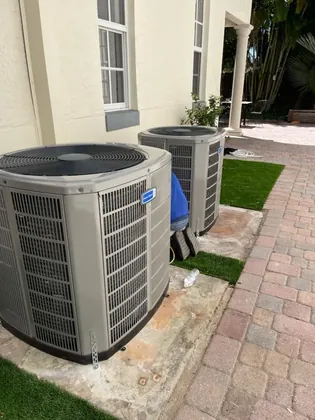

Most of the confusion starts with one statute. Section 718.113 is often quoted as if it settles condo AC disputes. Its first sentence reads: "Maintenance of the common elements is the responsibility of the association, except for any maintenance responsibility for limited common elements assigned to the unit owner by the declaration." [1] That is the whole rule. The words air conditioning do not appear anywhere in the section as published for 2025.
That gap matters in Boca Raton, where buildings are old enough that many original systems have been replaced at least once. The U.S. Census Bureau's 2024 American Community Survey puts the median year built for housing in the city of Boca Raton at 1983 [2]. A condo of that age has been through several air conditioners, and nobody wants to argue about the next one with water in the hallway.
This guide walks through the three questions in order: who is responsible, what the association asks for, and which office issues the permit. It summarizes Florida statutes as published, and it is not legal advice. Your declaration and your association's rules control.
Key takeaways
- Florida's condo statute does not mention air conditioning. Your declaration decides who owns the condenser, the air handler and the line set [1].
- Expect the association to ask for the contractor's certificate of insurance before work starts.
- Replacing the system needs a permit. A repair that does not change the system usually does not [3].
- Many condos with a Boca Raton mailing address sit outside city limits, so Palm Beach County, not the city, issues the permit.
- Replacing a condo AC? Call or text Direct Cooling at (561) 210-7605.
Who Is Responsible: What Florida Law Says and Does Not Say
A common element is property the whole condominium shares. A limited common element is a common element reserved for one or more units, as the declaration specifies. Florida law makes the association responsible for common elements and lets the declaration hand limited common elements to an owner. Because the statute never names air conditioning, the declaration is where the answer lives.
Section 718.103 defines limited common elements as "those common elements which are reserved for the use of a certain unit or units to the exclusion of all other units, as specified in the declaration." [4] An outdoor condenser serving one unit is the kind of item a declaration may treat that way, but only the declaration can say so.
A second section covers repairs that are not caused by an insurable event such as a storm. Section 718.111 says: "In the absence of an insurable event, the association or the unit owners shall be responsible for the reconstruction, repair, or replacement as determined by the maintenance provisions of the declaration or bylaws." [5] Again, the statute points back to your documents.
| Question | Where the answer comes from |
|---|---|
| Who owns the condenser, air handler and line set? | Your declaration of condominium |
| Who pays when the system fails from age? | The declaration's maintenance provisions [5] |
| Who maintains shared roofs and walls? | The association, unless the declaration assigns it [1] |
| Who must do the work? | A licensed contractor [6] |
| Who issues the permit? | The city or the county, by the address |
The table is ours: it lines up the statutes with the documents they defer to. Florida also says who can do the work: "A person must be certified or registered in order to engage in the business of contracting in this state." [6]
Replacing a condo AC in Boca Raton? Call or text Direct Cooling at (561) 210-7605, or see how we approach AC replacement.
What an Association Usually Asks For Before Work Starts
Expect the association to ask for the contractor's certificate of insurance before work starts, and to approve anything that touches the building's exterior: the location of a new outdoor unit, a roof penetration, or a new wall opening. Each building sets its own rules, so ask the manager what yours requires before any equipment is ordered.

Frank Rey, Direct Cooling's owner, says the main thing associations ask for is a certificate of insurance from the contractor, often called a COI. In his experience the approval itself usually takes about 20 to 40 minutes once the paperwork is in.
Local communities add their own steps. Century Village, for example, has 16 separate associations, each with its own board and declaration. Our page on AC repair in Century Village explains how contractor access works at the village gates and why the gate pass should be arranged before the appointment. In Boca West, each condominium has its own declaration and management, and our page on AC repair in Boca West lists the questions to settle first, including who owns the condenser, the line set and any roof penetration.
A practical approval packet has four parts: the contractor's license number, the certificate of insurance, the equipment and where it will sit, and the dates. If you are out of state, add the name of the person who will meet the technician.
The Permit Path: City of Boca Raton or Palm Beach County
Replacing a condo air conditioner needs a building permit, pulled by the licensed contractor before the old system comes out. The office depends on the address. Inside city limits, the City of Boca Raton issues it through its online system. Many condo communities with a Boca Raton mailing address are outside the city, and Palm Beach County issues those permits.
Florida law is plain about the permit itself. It is "unlawful for any person, firm, corporation, or governmental entity to construct, erect, alter, modify, repair, or demolish any building within this state without first obtaining a permit therefor from the appropriate enforcing agency" [7]. Palm Beach County's list of work that needs no permit includes "Repair of existing system and/or replacement of any part that does not alter the system listing or make it unsafe", and it does not list replacing the system [3].
Inside the city, the permit runs through Boca eHub, which the city calls its "online Planning and Permitting System" [8]. The city's mechanical HVAC checklist names a mechanical application, an electrical application and an authorized agent form, and it says "A certified NOC is required on Building permits with a value greater than $5,000 and Mechanical AC Changeout Permits greater than $15,000." [9] That checklist is published for single-family homes, so ask whether your building needs anything more. See HVAC service in the City of Boca Raton for the city side.
Outside the city, the county issues the permit. Century Village, Boca West and the Polo Club are all unincorporated, and our page on AC repair at the Polo Club notes that a change-out there is a county permit. State law sets the $15,000 line for the notice of commencement: the requirement "does not apply to a direct contract to repair or replace an existing heating or air-conditioning system in an amount less than $15,000." [10]
Roof Units, Cranes and Anchoring
In a mid-rise condo the indoor air handler is usually inside the unit, but the outdoor condenser may sit on the roof or at ground level well away from it, connected by a refrigerant line set that runs through the building. A roof unit adds access steps, sometimes a crane, and an anchoring requirement for wind.
Palm Beach County's Building Code Advisory Board is specific about anchoring. Its advisory says "the equipment must be adequately anchored to the rated stand, slab, or other approved means so as to resist the wind loads required by the latest Florida Building Code." [11] On an older roof, the stand under the old condenser may not meet that, which is why it belongs in the quote.
The line set is the part owners rarely think about. A new system has to be matched to the line set it will use, and the newer refrigerants change the question of whether the old copper can be flushed and reused or should be replaced. EPA's approved list for home air conditioning includes R-454B and R-32, both in the A2L safety class and both "Acceptable with Use Conditions" [12]. Ask any contractor which refrigerant the new system uses and what they plan for the line set.
Access is the other cost driver. Roof hatches, elevators, building rules on work hours and parking all affect how long the job takes. Frank says the hardest buildings to work in are the ones with all of these at once: tight access, roof units, small closets, limited parking and strict association rules.
The Replacement Timeline From Failure to Final Inspection
A condo AC replacement runs in six steps: a diagnosis, a check of the declaration, association approval, the permit, the installation, and the final inspection. The paperwork steps can overlap. The installation cannot start until the permit is issued, and the permit is not closed until an inspector has seen the finished work.
- Diagnose first. Confirm the system needs replacing. A repair that does not change the system usually needs no permit [3].
- Read the declaration. Find out who owns the condenser, the air handler and the line set [1] [4].
- Get association approval. Send the certificate of insurance, the license number, the equipment and the dates. Frank puts the approval at about 20 to 40 minutes once the paperwork is in.
- Pull the permit. The contractor applies to the city or the county, and records a notice of commencement if the job is $15,000 or more [10].
- Install. Swap the equipment, address the line set, anchor the outdoor unit and set up the drain protection.
- Pass the final inspection. The permit closes, so the record is clean when you sell.
The order is ours, built from the statutes and permit rules above. Frank says the one thing he wants every new customer to know is that his team checks everything to make sure the system is set up correctly.
Protecting the Unit Below: Drain Lines in Stacked Condos
In a stacked condo, an overflowing air conditioner drain becomes the downstairs neighbor's problem. Florida's mechanical code requires a backup protection on every cooling coil where an overflow could damage the building, such as a secondary drain pan or a switch that shuts the system off when the drain is blocked.
The code section reads: "where damage to any building components could occur as a result of overflow from the equipment primary condensate removal system, one of the following auxiliary protection methods shall be provided for each cooling coil" [13]. One of the options is a water-level device that "will shut off the equipment served in the event that the primary drain is blocked." [13]
Drain lines are also the most common call. Frank Rey says drain line cleaning is the repair his team does most often, and that drain lines and new units are what the phones ring about most. Asked what he sees in Century Village, Kings Point and Boca West that he does not see elsewhere, Frank named pancake air handlers: low, flat units mounted horizontally. With one of those, the drain pan and its protection are worth checking on every visit. A replacement is the right time to make sure that protection is in place and working.
Questions About Condo AC Replacement
 Direct CoolingFL Certified AC Contractor CAC1819111 Dispatch 24/7
 Hi, this is Direct Cooling. Tap a question below for a straight answer.
Tap a question to ask
- Who is responsible for the AC in a condo?
- Your declaration of condominium decides. Florida's statute makes the association responsible for common elements and lets the declaration assign limited common elements to owners, but it does not mention air conditioning. Ask your manager who owns the condenser, the air handler and the line set.
- What is the best AC unit for a condo?
- The one that fits the space, the electrical circuit and the drain location, sized with a load calculation. In a condo the closet size often decides which models fit. Ask for the model numbers of both halves of the system on the quote.
- Is a permit required to replace an air conditioner in Florida?
- Yes. Florida law requires a permit before altering a building, and Palm Beach County's list of work that needs no permit covers repairs, not replacing the system. Depending on the address, the city or the county issues it.
Before You Order Equipment
Get three answers before anything is ordered: what your declaration says, what your association needs from the contractor, and which office permits your address. With those in hand, a condo replacement is a scheduling job, not a dispute.
Direct Cooling is a Florida Certified Air Conditioning Contractor, license CAC1819111, with our shop in West Boca Raton. We provide the certificate of insurance associations ask for, and we pull the permit in our own name.
Call or text (561) 210-7605 to plan a condo AC replacement in Boca Raton.
References
- Florida Legislature. Florida Statutes section 718.113. 2025 Florida Statutes. flsenate.gov/Laws/Statutes/2025/718.113
- U.S. Census Bureau. American Community Survey 2024 1-year estimates, table B25035 (Boca Raton city), via Census Reporter. 2024 release. api.censusreporter.org/1.0/data/show/latest?table_ids=B25035&geo_i...
- Palm Beach County Building Division. Items Not Requiring a Permit. Revision April 12, 2013. discover.pbc.gov/pzb/PDF/whennotrequired.pdf
- Florida Legislature. Florida Statutes section 718.103. 2026 Florida Statutes. leg.state.fl.us/statutes/index.cfm?App_mode=Display_Statute&URL=07...
- Florida Legislature. Florida Statutes section 718.111. 2025 Florida Statutes. flsenate.gov/Laws/Statutes/2025/718.111
- Florida Legislature. Florida Statutes section 489.113. 2026 Florida Statutes. leg.state.fl.us/statutes/index.cfm?App_mode=Display_Statute&URL=04...
- Florida Legislature. Florida Statutes section 553.79. 2026 Florida Statutes. leg.state.fl.us/statutes/index.cfm?App_mode=Display_Statute&URL=05...
- City of Boca Raton. Boca eHub. No date shown. myboca.us/2235/Boca-eHub
- City of Boca Raton. Permit Submittal Checklist: Mechanical HVAC for Single Family Home. No date shown. myboca.us/DocumentCenter/View/251/Mechanical-HVAC-PDF
- Florida Legislature. Florida Statutes section 713.135. 2026 Florida Statutes. leg.state.fl.us/statutes/index.cfm?App_mode=Display_Statute&URL=07...
- Palm Beach County Building Code Advisory Board. Technical Advisory: Wind Resistance of Exposed Mechanical Equipment or Appliances. March 15, 2017. discover.pbc.gov/pzb/building/BCAB/Wind_Resistance_of_Exposed_Mechanic...
- U.S. Environmental Protection Agency. SNAP Substitutes in Residential and Light Commercial Air Conditioning and Heat Pumps. Updated March 19, 2026. epa.gov/snap/substitutes-residential-and-light-commercial-air-conditio...
- Florida Building Commission. Florida Building Code, Mechanical, 8th Edition (2023), section 307.2.3. 2023. Read on UpCodes. up.codes/viewer/florida/fl-mechanical-code-2023/chapter/3/general-regu...