
Trane names the usual cause plainly: "Your AC drainpipe can become clogged with mold and mildew that forms in standing water within the AC condensate drain pan." [1] It is also clear about what is at stake: "If your AC drain line is clogged the issue is water leaking and potentially causing water damage to the home, the efficiency of the system is not affected." [1] So a clog is a water problem first and a cooling problem second.
Florida puts the overflow in its mechanical code. Where an overflow could damage the building, section 307.2.3 of the 2023 Florida Building Code, Mechanical requires a backup for each cooling coil: a second pan, an overflow line, or a water-level detection device that shuts the equipment off [2]. ENERGY STAR names the second cost: "A plugged drain can cause water damage in the house and affect indoor humidity levels." [3]
Direct Cooling, a licensed Florida AC contractor in West Boca Raton, wrote this guide. It also puts what Carrier, Trane and Lennox each publish about vinegar and bleach side by side, which we could not find anywhere else.
Key takeaways
- A clogged drain line is a water problem. Trane says the system's efficiency is not affected [1].
- If the AC shut itself off and the drain pan is full, a float switch most likely did its job. Florida code requires a backup like it wherever an overflow could damage the building [2].
- We compared Carrier, Trane and Lennox: all three name vinegar, none of the three recommends bleach, and Carrier says neither may fully prevent clogs [4].
- EPA says to dry water-damaged areas within 24 to 48 hours to prevent mold [5].
- Water at the air handler? Call or text Direct Cooling at (561) 210-7605.
Where the Water Comes From and Where It Should Go
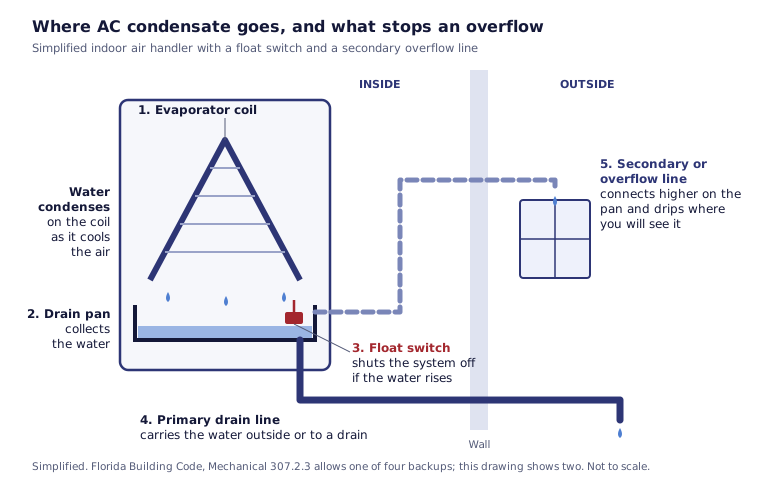
An air conditioner pulls moisture out of indoor air as it cools. That water condenses on the indoor coil, drips into a drain pan under the coil, and leaves the house through a condensate drain line, usually PVC, to an outdoor exit or a plumbing drain. Water inside the house means that path is blocked, cracked or overflowing.
Lennox describes the route this way: the water "flows into the drain line, a small pipe made of PVC or metal, that moves the water from the drain pan to a drain or outside the home." [6] Lennox also describes a secondary drain pan at the indoor unit, connected to a secondary drain line [6].
South Florida keeps that pipe busy. From June through September, average dew points at West Palm Beach run about 72 to 74 degrees F (NOAA 1991 to 2020 normals, cited on our AC repair in Kings Point page), so the line carries water every hour the system runs.
Where the water shows up tells you what failed. Water on the closet floor or dripping from the ceiling below an attic unit means the pan overflowed. Water dripping from a pipe above a window or door outside usually means the secondary line is doing its job. Florida code sends that line to "a conspicuous point of disposal to alert occupants in the event of a stoppage of the primary drain." [2] That drip is the warning. If you see it, the main drain line is already blocked.
Trane says a technician will "start by checking the drip pan for any excess water build-up, and clean it out with a towel or wet vac." [1]
What Clogs a Drain Line
Most AC drain line clogs are a slime of mold, mildew and algae mixed with the dust the indoor coil catches from the air. Trane names mold and mildew from standing water in the drain pan, plus dust, dirt, dander and debris entering the line [1]. Carrier describes what comes out as "A dark mass of sludge (algae, dust, and mold)" [4].

Carrier explains how the dust gets there. As air passes over the evaporator coil, the coil collects dust and airborne particles, and "Over time, this debris can travel into your condensate drain line, causing a blockage." [4] Standing water feeds the growth; the dust gives it something to hold.
Frank Rey, Direct Cooling's owner, has a one-word name for what his technicians pull out of clogged lines: jelly. He names drain line cleaning as his crews' most common repair, and drain lines as one of the two call types that fill the busy season. Those are field observations, not a measured count.
Frank links two conditions to drains that back up: a system too big for the space, and a seasonal owner who sets the thermostat so high the system barely runs, after which the drain backs up. Lennox makes a related point from the manufacturer side, recommending a programmable thermostat to help "prevent issues like condensate buildup or clogged drain lines" [6].
The pattern is sharpest in older condos that sit closed for months. Century Village in West Boca Raton has 5,712 condos built between 1979 and 1985, and only 37 percent are homesteaded, so many systems sit idle through the most humid months (see AC repair in Century Village). Kings Point, west of Delray Beach, has 8,087 condos with a median build year of 1974. Hunters Run in Boynton Beach has 1,512 condo units with a median build year of 1982 (see AC repair in Hunters Run). Asked about these communities, Frank answered "pancake air handlers." Those are low, flat indoor units that fit tight condo closets. In a stacked building, a drain line that backs up while the owner is away can leak into the unit below. Weighing a new system instead? See replacing the AC in a Boca Raton condo.
Water at the air handler, or an AC that shut itself off? Call or text Direct Cooling at (561) 210-7605. Our AC repair technicians clear the line, clean the pan and test the switch.
What a Float Switch Does and Why It Stops the System
A float switch is a small water-level sensor in the drain pan, the drain line or an auxiliary pan under the unit. When a blocked drain makes the water rise, the float lifts and cuts power to the system so the pan does not overflow. The Florida mechanical code calls it a water-level detection device and requires one that conforms to UL 508 [2].
Trane describes the same device from the homeowner's side: "Some homes may have a drain pan condensate safety switch that will automatically shut down the indoor unit if the water level inside the drain pan begins to rise, to help prevent water damage from a clog." [1] The next line matters more: "But, if your system doesn't have this safety switch, it will continue running with a clogged drain line." [1]
Florida does not leave it to chance. Section 307.2.3 of the 2023 Florida Building Code, Mechanical requires one of four backups for each cooling coil wherever an overflow from the primary drain could damage building components [2]:
| Code option (FBC Mechanical 307.2.3) | What the code requires | What you notice when the main drain blocks |
|---|---|---|
| 1. Auxiliary pan with its own drain | A pan under the coil at least 1 1/2 inches deep and 3 inches larger than the unit, draining to a conspicuous point | Water dripping where the auxiliary drain exits |
| 2. Overflow line on the equipment pan | A separate line connected higher than the primary drain, ending at a conspicuous point | Water dripping where the overflow line exits |
| 3. Auxiliary pan with a water-level device | A pan with no separate drain, fitted with a UL 508 device that shuts off the equipment before the pan overflows | The AC shuts itself off |
| 4. Water-level device | A UL 508 device in the primary drain line, the overflow line or the equipment pan, set above the primary drain connection | The AC shuts itself off |
Downflow units get a stricter rule. On downflow units and coils with no secondary drain or provision to install one, section 307.2.3.1 requires the water-level device inside the primary drain pan, and says: "Devices installed in the drain line shall not be permitted." [2]
Our position is simple. An AC that shut itself off with a full pan is a working safety system, not a broken air conditioner. Inconvenient, yes. Cheaper than a ceiling. Never bypass the switch to get the cooling back. Clear the cause, then ask the technician to show you the switch working before they leave.
Vinegar, Bleach and What Manufacturers Actually Say
We read the drain line pages Carrier, Trane and Lennox publish for homeowners on October 20, 2026. All three name vinegar for drain line upkeep. None of the three recommends bleach. Carrier goes further and says vinegar or bleach may not fully prevent blockages, because many clogs are debris that is not organic material [4].
Here is what each page says, side by side:
| Carrier [4] | Trane [1] | Lennox [6] | |
|---|---|---|---|
| What it names | A cup of distilled vinegar | A cup of distilled vinegar; says technicians use PVC pipe cleaner on visits | Diluted vinegar or an approved cleaner designed for use on PVC |
| How to use it | Ask your technician to show you how to pour it down the line | Ask your technician to show you how, if the line keeps clogging | Pour it in and let it sit 30 minutes or longer |
| How often | Not stated | Not stated | Flush the line every few months |
| Bleach | Mentioned only to say it may not fully prevent blockages | Not mentioned | Not mentioned |
| Who should clear a clog | Recommends contacting a local Carrier dealer | An HVAC technician | A technician when it is beyond a simple fix |
Carrier's wording is direct: "While homeowners sometimes use vinegar or bleach in the drain line, those products may not fully prevent blockages because many clogs are caused by debris or buildup that is not organic material." [4] Trane's advice is a supervised habit, not a home remedy: "If your AC drain line keeps clogging, ask your HVAC technician to show you how to pour a cup of distilled vinegar down the AC drain line to help prevent clogs." [1]
Our count across the three pages: vinegar named by 3 of 3, bleach recommended by 0 of 3. One caution on our own finding. None of the three pages says bleach damages anything. The case against bleach is that no manufacturer we read recommends it, not that one warns against it.
Frank goes further than the manufacturers. He does not tell customers to pour anything in. At every maintenance visit his technicians spray the evaporator coil with cleaner, and that cleaner runs down into the drain line on its own. Lennox puts the limit of home treatment well: "If you are needing to clean the drain line often, there may be a deeper problem." [6] We agree. A line that needs a monthly dose needs a technician, not a stronger chemical.
When a Clog Becomes a Water Damage Problem
A clog becomes a water damage problem when the pan overflows, or the backup fails, and water reaches drywall, flooring, cabinets or the unit below. EPA's guidance is to dry water-damaged areas and items within 24 to 48 hours to prevent mold growth [5]. How fast you dry things matters more than the clog itself.
If you find water, do these things, in this order:
- Turn the system off at the thermostat. Lennox says to turn off the AC first because "working with water and electricity can be dangerous." [6]
- Soak up the standing water in the pan and on the floor with towels or a wet/dry vacuum.
- Take photos of the pan, the floor and any stains before you clean further.
- Leave the system off. Restarting it makes more water with nowhere to go.
- Call or text a licensed contractor to clear the line, clean the pan and test the float switch.
- Dry the area with fans or a dehumidifier. EPA says to keep indoor humidity below 60 percent, ideally between 30 and 50 percent [5].
In a condo, tell the neighbor below and your association the same day.
Insurance is where a slow drip and a sudden overflow part ways. Citizens Property Insurance's 2021 form changes bulletin lists an "Exclusion for the constant or repeated seepage or leakage of water or steam" and, for HO-3 and DP-3 policies, a $10,000 limit on coverage regarding accidental discharge of water or steam [7]. We are a contractor, not an insurer, and your own policy controls. The practical point: a drain that leaks a little for months is the kind of damage that language describes. Insurers also see the drain: the Citizens 4-point inspection form asks whether the air handler, condensate line or drain pan shows "any signs of blockage or leakage, including water damage to the surrounding area" [8]. See our guide to Florida 4-point inspections and your AC.
What drives the repair bill is how far the water traveled, whether the pan or the switch needs replacing, and how hard the line is to reach. The clog itself is usually the small part.
Questions About AC Drain Lines and Maintenance
 Direct CoolingFL Certified AC Contractor CAC1819111 Dispatch 24/7
Hi, this is Direct Cooling. Tap a question below for a straight answer.
Tap a question to ask
- How do I know if my AC needs a tune-up?
- ENERGY STAR recommends a contractor check-up once a year before the season, with the condensate drain on the list: "Check and inspect the condensate drain in your central air conditioner, furnace and/or heat pump (when in cooling mode)." Between visits, watch for the drain symptoms Carrier lists: musty smells from the vents, water near the indoor unit, and a system that turns off or refuses to turn on.
- What does a full AC maintenance include?
- ENERGY STAR's checklist covers thermostat settings, electrical connections, moving parts, the condensate drain, system controls, the coils, the refrigerant level and blower airflow, plus a monthly filter check you do yourself. Frank Rey says a Direct Cooling visit checks the temperature difference across the unit, the thermostat reading, the refrigerant level and the outdoor unit, and cleans the drain line and pan every time, with the outdoor unit washed once a year.
Before the Next Drain Call
Most drain line clogs warn you first: a musty smell, a drip from the secondary pipe outside, or an AC that shuts itself off. Treat each one as a reason to call, not a reason to reach for the bleach.
If your home sits empty part of the year, ask for a drain check before you leave and again before you come back. If a storm knocked the power out, the restart steps in our guide for after a storm or flood come first. Regular AC maintenance keeps the line clear, and emergency AC repair is there when the water is already on the floor.
Direct Cooling is a Florida Certified Air Conditioning Contractor, license CAC1819111. Call or text (561) 210-7605.
References
- Trane. AC Condensate Drain Line Clogged? No date captured. trane.com/residential/en/resources/troubleshooting/air-conditioners/ac...
- Florida Building Commission (ICC). Florida Building Code, Mechanical, 8th Edition (2023), sections 307.2.3 and 307.2.3.1. 2023 edition. codes.iccsafe.org/content/FLMC2023P1/chapter-3-general-regulations
- ENERGY STAR. Maintenance Checklist. No date shown. energystar.gov/saveathome/heating-cooling/maintenance-checklist
- Carrier. How to Clean an AC Drain Line. No date captured. carrier.com/residential/en/us/products/air-conditioners/air-conditione...
- U.S. Environmental Protection Agency. A Brief Guide to Mold, Moisture and Your Home. Updated February 18, 2026. epa.gov/mold/brief-guide-mold-moisture-and-your-home
- Lennox. AC Drain Line Clogged? No date captured. lennox.com/residential/lennox-life/consumer/ac-drain-line-clogged
- Citizens Property Insurance Corporation. 2021 Form Changes. Dated 2020-12-10. citizensfla.com/-/20201210-2021-form-changes
- Citizens Property Insurance Corporation. 4-Point Inspection Form (Sample Form Insp4pt 03 25). Edition 03/25. citizensfla.com/documents/20702/48575/4-Point+Inspection+Form.pdf/e8c4...