Those three numbers come from different kinds of sources. The Department of Energy figure is a national average for central air conditioners [1]. The InterNACHI chart is written for Florida home inspectors and splits the outdoor condenser by location [2]. The FEMA figure is about metal building parts, not air conditioners, but it shows how far salt can travel [3].
The ranges also disagree with each other, and the post shows where. The same InterNACHI Florida chart that gives an inland condenser 15 to 20 years gives a central air conditioner 5 to 12 [2]. No single number covers every South Florida home.
Direct Cooling, a licensed Florida AC contractor in West Boca Raton, wrote this guide to put the published ranges side by side, mark how far salt reaches from the beach in Boca Raton, Delray Beach and Boynton Beach, and show what manufacturer warranties say about salt.
Key takeaways
- DOE: central air conditioners last 15 to 20 years [1]. InterNACHI's Florida chart: condenser 5 to 7 years coastal, 15 to 20 inland [2].
- Carrier says salt water can be carried as far as two miles inland [4]. FEMA reports accelerated corrosion of metal building parts as far as 5 to 10 miles inland, with salt spray falling off sharply in the first 300 to 3,000 feet [3].
- Trane's base limited warranty, also posted on American Standard's warranty page, excludes damage from "a corrosive atmosphere" including salt [5].
- ENERGY STAR suggests considering replacement once a system is more than 10 years old [6].
- Not sure how your outdoor unit is holding up? Call or text Direct Cooling at (561) 210-7605.
Published Lifespan Ranges, Side by Side
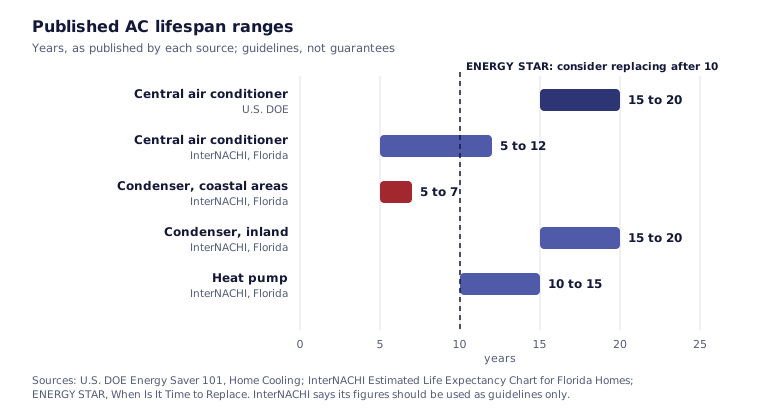
Published lifespans for a central air conditioner run from 5 to 20 years, depending on the source and the location. The Department of Energy says 15 to 20 years nationally. InterNACHI's Florida chart says 5 to 12 for a central air conditioner, and 5 to 7 for a coastal condenser against 15 to 20 inland. ENERGY STAR treats 10 years as the point to consider replacing.
| Source | What it rates | Range |
|---|---|---|
| U.S. Department of Energy | Central air conditioner, national | 15 to 20 years [1] |
| InterNACHI, Florida chart | Central air conditioner | 5 to 12 years [2] |
| InterNACHI, Florida chart | Condenser, coastal areas | 5 to 7 years [2] |
| InterNACHI, Florida chart | Condenser, inland | 15 to 20 years [2] |
| InterNACHI, Florida chart | Heat pump | 10 to 15 years [2] |
| ENERGY STAR | Point to consider replacing | More than 10 years [6] |
Service life is how long equipment is expected to keep working with normal maintenance. InterNACHI says its figures assume "regular recommended maintenance and conditions of normal wear and tear," and that they "should be used as guidelines only, and not relied upon as guarantees or warranties." [2]
The table has a gap you should notice. InterNACHI's chart does not explain how a central air conditioner can be rated 5 to 12 years while an inland condenser, its outdoor half, is rated 15 to 20 [2]. We read it this way: the coastal condenser number is the one that pulls the whole-system figure down, and an inland home has a better shot at the top of the range.
Frank Rey, Direct Cooling's owner, puts coastal systems at 5 to 8 years, close to the inspectors' chart. He also says systems here run year round, so they wear faster than the national averages suggest. Those are his field observations, not a measured count.
How Far Inland Salt Air Reaches
Salt air does most of its damage close to the water, but it travels. Carrier says salt water can be carried as far as two miles inland. FEMA, writing about metal building connectors, says salt spray falls off sharply in the first 300 to 3,000 feet from the shoreline, yet studies have found accelerated corrosion as far as 5 to 10 miles inland.
FEMA's wording is worth reading in full: "The amount of salt spray in the air is greatest near breaking waves and declines rapidly in the first 300 to 3,000 feet landward of the shoreline. Despite the inland reduction, studies have shown accelerated corrosion rates as far inland as 5 to 10 miles" [3]. FEMA adds that farther inland, "corrosion can be similar to the rates that occur in milder, inland conditions." [3]
Two cautions keep these figures honest. FEMA's bulletin is about the metal connectors and fasteners that hold a building together, not air conditioners, so it describes the air, not the equipment [3]. And Carrier's two miles is a manufacturer's description of HVAC exposure, not a measured line [4].
Here is where some of the communities we serve sit, measured on our area guides:
| Location | Distance from the beach | Inside Carrier's 2 miles? |
|---|---|---|
| East of the Intracoastal, including the Ocean Boulevard (A1A) condos, Boca Raton | Under 2 miles | Yes |
| Mizner Park, downtown Boca Raton | About 1.1 miles | Yes |
| Hunters Run, Boynton Beach | 3.1 to 4.4 miles | No |
| Kings Point, west of Delray Beach | 4.0 to 5.8 miles | No |
| Valencia communities, west of Boynton Beach | 5.7 to 9.8 miles | No |
Our HVAC service in the City of Boca Raton page notes that everything east of the Intracoastal, and much of downtown, sits inside Carrier's distance. The inland rows come from our guides to Hunters Run, Kings Point and Valencia.
Not sure how your outdoor unit is holding up? Call or text Direct Cooling at (561) 210-7605, or see our AC maintenance page.
What Salt Does to an Outdoor Unit
Salt attacks the outdoor coil first. Carrier explains that standard copper-aluminum coils can suffer galvanic corrosion, the corrosion that happens where two different metals touch, which can lead to refrigerant leaks and system failure. Corroded fins also lose heat transfer long before the unit stops running, as our City of Boca Raton guide notes.
Carrier's wording: "Without specialized protection, standard copper-aluminum coils can suffer from galvanic corrosion, leading to refrigerant leaks and system failure." [4] FEMA describes the same chemistry for building metal: ocean salts "accumulate on metal surfaces and accelerate the electrochemical reactions that cause rusting and other forms of corrosion." [3]
Frank names corroded outdoor coils, along with a failed compressor, as the signs that a system is done. A corroded coil is usually where a coastal repair turns into a replacement conversation, because the coil is the part salt reaches first.
Manufacturers have changed coil design in response. Carrier says that before 2023 many coastal models relied on copper tubes with aluminum fins, and that it moved all of its coastal models to welded aluminum coils to avoid galvanic corrosion between different metals [4]. That is one manufacturer's description of its own product; we have not tested it, and it does not mean an older copper-aluminum coil near the beach is defective.
What Manufacturer Warranties Say About Salt
Manufacturer warranties generally cover defects, not the environment. Trane's base limited warranty, which is also posted on American Standard's warranty page, lists "a corrosive atmosphere or contact with corrosive material" including salt among the causes of damage it does not cover. Read your own warranty for its exact terms.
The exclusion sits in the warranty's list of "Failures, defects or damage" it does not cover, and the full item reads: "A corrosive atmosphere or contact with corrosive material such as, but not limited to, chlorine, fluorine, salt, sulfur, recycled waste water, urine, fertilizers, rust, or other damaging substances or chemicals." [5] That warranty applies to products made on or after January 1, 2022, covers parts and not labor, and says it can be found on both the Trane and the American Standard warranty pages [5].
Florida law adds two protections that matter when a coastal home changes hands. For homes conveyed on or after July 1, 2024, a manufacturer's HVAC warranty "Is automatically transferred to the new owner" [7]. And when a licensed contractor installed the system, the warranty "may not be in any way conditioned upon the product registration." [8] Neither changes what the warranty excludes. They change who holds it.
If you are buying, our guide to what a 4-point inspection asks about your AC covers the insurer's form, which records the system's age [9].
What Extends the Life of a Coastal System
Keeping the outdoor coil clean is the main lever. ENERGY STAR lists cleaning the evaporator and condenser coils as part of a maintenance check-up, and says dirty coils make a system run longer, raise energy costs and shorten the life of the equipment. Near the coast, salt is part of what builds up on that coil.
ENERGY STAR's maintenance checklist includes "Clean evaporator and condenser air conditioning coils" and explains that dirty coils cause "the system to run longer, increasing energy costs and reducing the life of the equipment." [10]
Frank says Direct Cooling cleans the outdoor unit with water once a year as part of maintenance, and offers a coastal coating for outdoor units near the water. Coatings and rinsing make the most sense inside Carrier's two-mile band [4]. Farther out, our Kings Point guide puts it plainly: at four miles and more, they are rarely the deciding factor, and a quote that leans on salt air there deserves a second question.
Our view on replacement timing: a coastal system past ten years with corroded coil fins is a reasonable candidate for AC replacement, and an inland system the same age in good condition often is not. Age alone does not decide it. Our guide to comparing replacement quotes covers what to ask for when you get there.
Questions About AC Lifespan in Florida
 Direct CoolingFL Certified AC Contractor CAC1819111 Dispatch 24/7
Hi, this is Direct Cooling. Tap a question below for a straight answer.
Tap a question to ask
- What is the average lifespan of an AC unit in Florida?
- There is no single Florida number. The Department of Energy's national figure for a central air conditioner is 15 to 20 years. InterNACHI's Florida chart gives a central air conditioner 5 to 12 years and a condenser 5 to 7 years in coastal areas or 15 to 20 inland, as guidelines only. Distance from the beach and maintenance move a system within those ranges.
- How do I know if my AC needs a tune-up?
- ENERGY STAR recommends a contractor check-up every year before the cooling season, including cleaning the coils. Near the coast, visible corrosion or flaking on the outdoor coil fins is a reason not to wait for the next scheduled visit.
Where Your Home Sits Decides the Range
A beachfront condo on A1A and a Valencia home nine miles inland can install the same air conditioner in the same year and get very different service lives. The published ranges explain why: 5 to 7 years for a coastal condenser, 15 to 20 inland [2].
Start with your distance from the beach, then look at the outdoor coil. If you are inside about two miles, plan on yearly coil cleaning and expect the shorter end of the range [4]. If you are well inland, a well-maintained system has a better chance of approaching the national figure [1].
Direct Cooling is a Florida Certified Air Conditioning Contractor, license CAC1819111. To have your outdoor unit checked, call or text (561) 210-7605.
References
- U.S. Department of Energy. Energy Saver 101 Infographic: Home Cooling. No date on page (URL path 2016). energy.gov/sites/prod/files/2016/11/f34/Energy%20Saver%20101%20Infogra...
- InterNACHI. Estimated Life Expectancy Chart for Florida Homes. No date shown. nachi.org/florida-life-expectancy.htm
- FEMA. Corrosion Protection for Metal Connectors and Fasteners in Coastal Areas, NFIP Technical Bulletin 8. June 2019. fema.gov/sites/default/files/2020-07/tb8-corrosion_protection_metal_co...
- Carrier. Coastal Heating and Air. No date shown. carrier.com/us/en/residential/hvac-resources/coastal-heating-and-air/...
- Trane. Base Limited Warranty, products manufactured on or after January 1, 2022. trane.com/pdf/coils-warranty.pdf
- ENERGY STAR. When Is It Time to Replace? No date shown. energystar.gov/saveathome/heating-cooling/replace
- Florida Legislature. Florida Statutes section 559.956. 2026 Florida Statutes. leg.state.fl.us/statutes/index.cfm?App_mode=Display_Statute&URL=05...
- Florida Legislature. Florida Statutes section 559.957. 2026 Florida Statutes. leg.state.fl.us/statutes/index.cfm?App_mode=Display_Statute&URL=05...
- Citizens Property Insurance Corporation. 4-Point Inspection Form (Sample Form Insp4pt 03 25). Edition 03/25. citizensfla.com/documents/20702/48575/4-Point+Inspection+Form.pdf/e8c4...
- ENERGY STAR. Maintenance Checklist. No date shown. energystar.gov/saveathome/heating-cooling/maintenance-checklist