
Most of the answers already sit in Florida law, the building code and the association's own documents. When the association itself is buying, Florida Statutes section 718.3026 requires competitive bids for a contract that costs more than 5 percent of the association's total annual budget, including reserves [1]. When an owner is buying, the board's job is narrower: confirm the work is legal, safe for the building and on the owner's side of the declaration.
Florida licenses air-conditioning contractors by class. A Class B contractor is limited to 25 tons of cooling and 500,000 Btu of heating in any one system, while a Class A contractor is unlimited [2]. In Palm Beach County, the building code advisory board says exposed equipment, including rooftop units, must be anchored to resist the wind loads in the Florida Building Code [3].
Direct Cooling, a Florida Certified Air Conditioning Contractor (license CAC1819111) in West Boca Raton, wrote this list from the contractor's side of an approval. It is a working checklist, not legal advice. Your declaration, and your association's attorney, control.
| Question for the board | Why it matters | What a good answer looks like |
|---|---|---|
| 1. Who owns and maintains this equipment? | Florida makes the association maintain the common elements, except limited common elements whose maintenance the declaration assigns to the owner [4] | The declaration section that names the condenser, air handler and line set |
| 2. Is the contractor licensed and insured? | Contracting without a certificate or registration is a first-degree misdemeanor [5] | A certified or registered air-conditioning or mechanical contractor license number, and a certificate of insurance |
| 3. Who pulls the permit, and from whom? | Work that needs a permit may not start until the permit is in effect [5] | A permit number, from the city or county where the building sits |
| 4. Has a notice of commencement been recorded? | By price, Florida's lien law exempts jobs of $2,500 or less [6] [7]; the permit office's notice checks skip HVAC replacement contracts under $15,000 [8] | A recorded notice for any contract over $2,500; at $15,000 or more, also a copy filed with the permit office before the first inspection [7] [8] |
| 5. How will rooftop equipment be anchored? | Exposed equipment must be anchored so as to resist Florida Building Code wind loads [3] | The stand or curb, the fastening, and how the unit reaches the roof |
| 6. What refrigerant does the new system use? | EPA lists R-32 and R-454B in safety class A2L, acceptable with use conditions [9] | The refrigerant named on the quote, and whether the old line set is reused |
| 7. How is condensate overflow handled? | The Florida mechanical code requires backup protection where an overflow could damage the building [10] | A secondary pan, an overflow line or a float switch that shuts the system off |
| 8. When and how will the work happen? | Roof hatches, elevators, parking and gates are shared | A date, a time window, a parking plan and a contact on site |
| 9. Who is paying? | Association contracts over 5 percent of the annual budget need competitive bids [1] | Owner-paid, or bids on file when the association pays |
Key takeaways
- Section 718.113 of Florida's condominium act puts maintenance of the common elements on the association, except maintenance of limited common elements the declaration assigns to the owner. The section never names air conditioners, so the declaration decides [4].
- A Florida air-conditioning contractor must be certified or registered. Contracting without either is a first-degree misdemeanor [11] [5].
- Palm Beach County's code advisory board: exposed equipment, on a roof or on the ground, "must be adequately anchored" to resist Florida Building Code wind loads [3].
- An association buying AC work over 5 percent of its annual budget, reserves included, needs competitive bids, and the lowest bid is not required [1].
- Managing a building in Palm Beach or Broward County? Call or text Direct Cooling at (561) 210-7605.
Start With the Declaration
The declaration of condominium decides who maintains the air conditioner. Section 718.113 of Florida's condominium act makes the association responsible for maintaining the common elements, except for maintenance of limited common elements the declaration assigns to the unit owner. The section does not name air conditioners, so the answer for a condenser, an air handler or a line set comes from each building's own documents.
The statute's wording is short: "Maintenance of the common elements is the responsibility of the association, except for any maintenance responsibility for limited common elements assigned to the unit owner by the declaration." [4] The phrase "air condition" appears nowhere in section 718.113 as published in the 2026 Florida Statutes.
That is why a board should answer question one in writing, with the section number, before an owner orders equipment. In older buildings the condenser may sit on a shared roof and the line set may run through common walls, so ownership is rarely obvious.
Large communities show how much this varies. Century Village in West Boca Raton has 16 associations, each with its own board, and our guide to AC repair in Century Village notes that ownership is set by each association's declaration, not by the village. Our page on AC repair in Boca West says the same of that club's condominiums: each has its own declaration and management.
When owners and the board read the documents differently, the Florida DBPR's Condominium Ombudsman describes itself as "a neutral resource" for owners, boards and associations, to help them "understand their rights and responsibilities under Florida law." [12]
Questions for the Owner's Contractor
A board can fairly ask an owner's contractor for three things: a Florida air-conditioning license, proof of insurance, and a technician certified to handle refrigerant. Florida requires anyone in the business of contracting to be certified or registered, and an unlicensed person who contracts commits a first-degree misdemeanor.
Florida Statutes section 489.113 puts it in one line: "A person must be certified or registered in order to engage in the business of contracting in this state." [11] Under section 489.127, an unlicensed person who violates the contracting rules "commits a misdemeanor of the first degree." [5]
The license terms a board will see are defined in section 489.105 [2]:
| License term | What Florida Statutes 489.105 says |
|---|---|
| Class A air-conditioning contractor | Services are unlimited in size |
| Class B air-conditioning contractor | Limited to 25 tons of cooling and 500,000 Btu of heating in any one system |
| Class C air-conditioning contractor | Limited to servicing, and only for licenses valid on October 1, 1988 |
| Mechanical contractor | Services are unlimited, and include central air-conditioning systems |
| Certified contractor | Can contract in any jurisdiction in Florida |
| Registered contractor | Can contract only in the jurisdictions where it registered |
Our view: for a single condo unit's split system, Class A or Class B both work, and the class matters more when the job is a building's central plant. A Class C license, which covers servicing, is not one to accept for a replacement.
Insurance is the other half. Asked about condo associations, Frank Rey, Direct Cooling's owner, answered: "COI is needed. takes about 20-40 mins." A COI is a certificate of insurance.
Ask about refrigerant handling, too. EPA rules under Section 608 of the Clean Air Act require that technicians who service or dispose of equipment that could release ozone-depleting refrigerants "must be certified" [13]. EPA says it "does not issue certification cards" [13], so ask to see the technician's proof of certification.
Managing a building in Palm Beach or Broward County? Call or text Direct Cooling at (561) 210-7605, or see our commercial HVAC service page.
Roof Access, Anchoring and Cranes
Rooftop AC equipment has to be anchored to resist Florida wind loads, and getting it onto the roof is the board's business too. Palm Beach County's Building Code Advisory Board says exposed equipment on rated stands, curbs or slabs complies when it is adequately anchored. Ask how the new unit will be fastened, and how it will reach the roof.
The advisory board's technical advisory, issued March 15, 2017, says "the equipment must be adequately anchored to the rated stand, slab, or other approved means so as to resist the wind loads required by the latest Florida Building Code." [3] Our Boca West guide adds the practical rule: anchoring has to be addressed in any rooftop replacement, not left as it was.
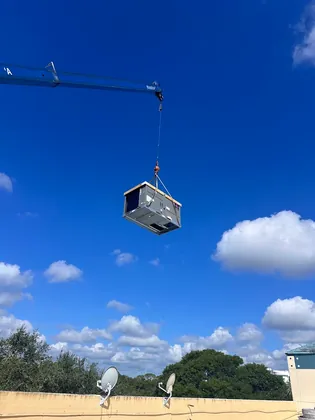
Mid-rise buildings make access a scheduling question. In Boca West's Lakewood, Willow Wood and Bridgewood, 815 mid-rise units were built between 1974 and 1981, and the outdoor equipment may sit on the roof or at ground level well away from the unit, joined by a line set that runs through the building. Roof hatches, elevators or a crane come into the plan.
Asked whether access, roof units, closets, parking and association rules make some buildings hard, Frank answered: "yes all of those." A board that settles them at approval time saves the owner a second trip.
A good answer to question five names the stand or curb, the fastening method, the route to the roof, the date, and who holds the roof key. Our view: a rooftop change-out that reuses old anchors without saying so is not a complete answer.
Refrigerant and Drain Protection in a Shared Building
A replacement system may use an A2L refrigerant such as R-32 or R-454B, and in a condo the air handler usually sits above or beside someone else's home. EPA's SNAP list shows both refrigerants in ASHRAE safety class A2L, acceptable with use conditions. Florida's mechanical code requires backup overflow protection for each cooling coil where an overflow could damage the building.
EPA's list of substitutes for residential and light commercial air conditioning, last updated March 19, 2026, marks HFC-32 and R-454B as A2L and "Acceptable with Use Conditions" [9]. For a board, the practical questions are which refrigerant the quote names, and whether the old copper line set will be reused. Our Boca West guide notes that new refrigerants change whether old copper can be flushed and reused or should be replaced.
Drain protection matters more in a stacked building, because an overflow lands in the unit below. Section 307.2.3 of the 2023 Florida Building Code, Mechanical requires one of four backups wherever an overflow could damage building components: a secondary pan with its own drain, an overflow line, a secondary pan with a water-level switch, or a water-level switch in the primary drain or pan [10]. On downflow units the switch belongs inside the primary pan, and the code says: "Devices installed in the drain line shall not be permitted." [10]
Asked about Century Village, Kings Point and Boca West, Frank named pancake air handlers, the low, flat units mounted horizontally. With those, ask the contractor to show where the backup sits. Our guide to what a float switch does explains the options in plain terms.
When the Association Is the One Buying
When the association pays for AC work, Florida Statutes section 718.3026 decides whether it needs competitive bids. A contract over 5 percent of the association's total annual budget, including reserves, requires bids, and the board is not required to accept the lowest. The section does not limit buying needed products and services in an emergency.
The statute is direct: "Nothing contained herein shall be construed to require the association to accept the lowest bid." [1] And on emergencies: "Nothing contained herein is intended to limit the ability of an association to obtain needed products and services in an emergency." [1] The same section says these contracts must be in writing, and an association with 10 or fewer units may opt out by a two-thirds vote of the owners [1].
The 5 percent line is easy to compute. Here is our arithmetic for three sample budgets, reserves included:
| Total annual budget, reserves included | 5 percent bid threshold |
|---|---|
| $250,000 | $12,500 |
| $500,000 | $25,000 |
| $1,000,000 | $50,000 |
The statute measures payment "in the aggregate" on behalf of the condominiums the association operates [1]. How that applies to a project spread over several units or contracts is a question for the association's attorney. Our view: in communities built in waves, like Kings Point's twelve condo sections from 1973 to 1980 or the Hunters Run condo groups built from 1979 to 1991, equipment of the same age can come due together, and that is when the aggregate question comes up.
For the owner-paid version of the same project, see our guide to the owner's side of a condo AC replacement.
Questions About Condo AC Approvals in Florida
Who is responsible for the AC in a condo?
The declaration decides. Section 718.113 of Florida's condominium act makes the association responsible for maintaining the common elements, except limited common elements whose maintenance the declaration assigns to the unit owner, and the section never names air conditioners [4]. Read your building's declaration for the condenser, the air handler and the line set, because buildings differ.
Can you do HVAC work without a license in Florida?
Not as a contractor. Florida requires a person to be certified or registered to engage in the business of contracting [11], and an unlicensed person who violates the contracting rules commits a first-degree misdemeanor [5]. The narrow exception for supervised subcontractors in section 489.113 does not reach work that needs an air-conditioning contractor license [11] [2].
A One-Page Review Your Board Can Adopt
A board that keeps the nine questions on one page can answer most owners the same day. The table at the top of this guide is that page: the declaration first, then license and insurance, permit, notice of commencement, anchoring, refrigerant, drain protection, schedule and payment.
Two of the nine carry hard numbers. By price, Florida's lien law exempts improvements of $2,500 or less from the notice of commencement [6] [7], while the permit office's own notice checks skip an HVAC repair or replacement contract under $15,000 [8]. And an association's own purchase needs competitive bids above 5 percent of its annual budget [1]. The rest are yes-or-no checks a manager can make from a contractor's paperwork.
This guide summarizes Florida law and code as published in the editions cited. It is not legal advice.
To learn more about Direct Cooling, or to plan an AC replacement in your building, call or text (561) 210-7605. Direct Cooling is a Florida Certified Air Conditioning Contractor, license CAC1819111.
References
- Florida Legislature. Florida Statutes section 718.3026, Contracts for products and services. 2026 Florida Statutes. leg.state.fl.us/statutes/index.cfm?App_mode=Display_Statute&URL=07...
- Florida Legislature. Florida Statutes section 489.105, Definitions. 2026 Florida Statutes. leg.state.fl.us/statutes/index.cfm?App_mode=Display_Statute&URL=04...
- Building Code Advisory Board of Palm Beach County. Technical Advisory: Wind Resistance of Exposed Mechanical Equipment or Appliances. March 15, 2017. discover.pbc.gov/pzb/building/BCAB/Wind_Resistance_of_Exposed_Mechanic...
- Florida Legislature. Florida Statutes section 718.113, Maintenance; limitation upon improvement. 2026 Florida Statutes. leg.state.fl.us/statutes/index.cfm?App_mode=Display_Statute&URL=07...
- Florida Legislature. Florida Statutes section 489.127, Prohibitions; penalties. 2026 Florida Statutes. leg.state.fl.us/statutes/index.cfm?App_mode=Display_Statute&URL=04...
- Florida Legislature. Florida Statutes section 713.02, Types of lienors and exemptions. 2026 Florida Statutes. leg.state.fl.us/statutes/index.cfm?App_mode=Display_Statute&URL=07...
- Florida Legislature. Florida Statutes section 713.13, Notice of commencement. 2026 Florida Statutes. leg.state.fl.us/statutes/index.cfm?App_mode=Display_Statute&URL=07...
- Florida Legislature. Florida Statutes section 713.135, Notice of commencement and applicability of lien. 2026 Florida Statutes. leg.state.fl.us/statutes/index.cfm?App_mode=Display_Statute&URL=07...
- U.S. Environmental Protection Agency. Substitutes in Residential and Light Commercial Air Conditioning and Heat Pumps (SNAP). Last updated March 19, 2026. epa.gov/snap/substitutes-residential-and-light-commercial-air-conditio...
- International Code Council, online edition. Florida Building Code, Mechanical, 8th Edition (2023), sections 307.2.3 and 307.2.3.1, adopted by the Florida Building Commission. 2023 edition. codes.iccsafe.org/content/FLMC2023P1/chapter-3-general-regulations
- Florida Legislature. Florida Statutes section 489.113, Qualifications for practice; restrictions. 2026 Florida Statutes. leg.state.fl.us/statutes/index.cfm?App_mode=Display_Statute&URL=04...
- Florida Department of Business and Professional Regulation. Office of the Condominium Ombudsman. No date shown. www2.myfloridalicense.com/condos-timeshares-mobile-homes/condominium-o...
- U.S. Environmental Protection Agency. Section 608 Technician Certification. Last updated March 3, 2026. epa.gov/section608/section-608-technician-certification-0