
Florida's energy code sets the limit. A cooling-only system must be no smaller than the calculated load and "not more than 1.15 times greater than the total load", or the closest size the manufacturer makes [2]. In plain terms, about 15 percent over the load calculation is the ceiling.
The stakes in South Florida are comfort and mold. The U.S. EPA says to keep indoor humidity below 60 percent, ideally between 30 and 50 percent [3]. An air conditioner removes moisture only while it runs, so a unit that cools the house in a few minutes and shuts off can leave the air cool and clammy at the same time.
This guide gives you a 90-minute test you can run with a stopwatch and a humidity meter, a table to read the result, and what the Manual J and Manual S calculations on a quote actually mean. Most short cycling turns out to have a cause other than size, and the test is built to show which one you have.
Key takeaways
- Time the AC on a hot afternoon. Ten minutes or less per cycle, with humidity over 60 percent, points to oversizing [4].
- In an FSEC field study, 53 percent of 368 Florida homes had systems more than 20 percent oversized [1].
- Florida's energy code caps cooling-only equipment at 1.15 times the calculated load [2].
- Duct leakage, refrigerant charge and airflow can also cause poor dehumidification, so rule them out first [1] [11].
- Short cycles and sticky air? Call or text Direct Cooling at (561) 210-7605.
What Oversizing Does in a Humid Climate
An oversized air conditioner reaches the thermostat setting quickly and shuts off before it has run long enough to pull much moisture out of the air. The house feels cool but damp. FSEC researchers also measured more cooling electricity at the utility's peak hour in homes with systems over 120 percent of the calculated load.
The Florida Solar Energy Center put it in one sentence: "occupant comfort may be reduced if air conditioner run" times are shortened "and less moisture is removed from the air" [1]. Its 1995 contractor survey added that moisture removal and interior air mixing "are also reduced during short run times" [5].
The FSEC field study is the best Florida data on how common the problem is. Researchers compared the installed cooling capacity in 368 recently built Florida homes with a Manual J load calculated from an audit of each house [1].
| What FSEC measured in 368 Florida homes (published July 1997) | Result |
|---|---|
| Average installed capacity versus the Manual J load | 23 percent larger [1] |
| Homes with systems over 120 percent of Manual J | 194 of 368, or 53 percent [1] |
| Peak-hour cooling load, homes over 120 percent versus the rest | About 13 percent (0.3 kWh) higher [1] |
| Extra cooling energy a season, system 20 percent over Manual J | About 174 kWh (3.7 percent) [1] |
| Extra cooling energy a season, system 50 percent over Manual J | About 435 kWh (9.3 percent) [1] |
For more on why a house is humid even when the AC runs, see our humidity guide. The homes in the study were audited in the mid-1990s, so treat the share as a measured pattern, not a count of homes today. The same survey found that "38.5% of respondents indicated that they have at times purposely oversized units", most often because a customer asked [5].
The Run-Time Test, Step by Step
Pick a hot, sunny afternoon, put a humidity meter in the main living area and leave the thermostat at your usual setting. For 90 minutes, write down the time each cooling cycle starts and stops. Then note the humidity at the start and the end. The length of the cycles and the humidity reading together tell you what you are looking at.
- Pick a hot afternoon. Equipment is sized for hot weather. NOAA's engineering weather data for West Palm Beach puts the 0.4 percent cooling design condition at 91 F with a mean coincident wet bulb of 78 F [6]. The closer your test day is to that, the more the result means.
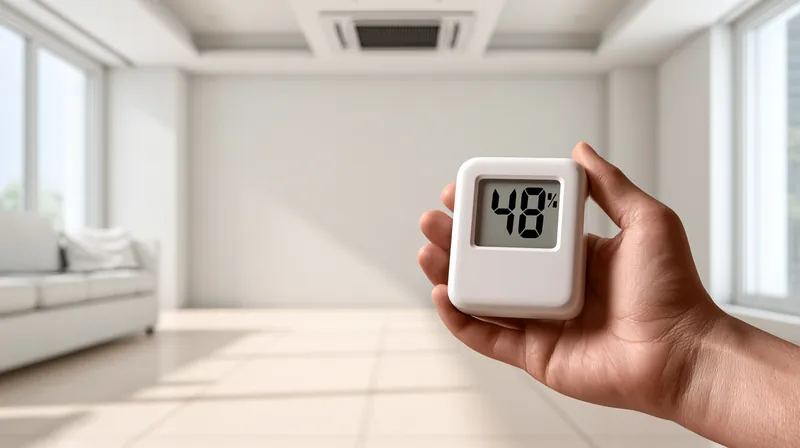
- Place a humidity meter. Set it in the main living area, away from supply vents, the kitchen and bathrooms. The EPA describes these meters as small and inexpensive, about $10 to $50 at hardware stores [3].
- Leave the settings alone. Keep your normal cooling setpoint and leave the fan on Auto, so the blower stops when the cooling stops.
- Log every cycle for 90 minutes. Write the clock time when the outdoor unit starts and when it stops. A phone stopwatch works.
- Read the humidity twice. Note the reading at the start and at the end of the 90 minutes.
- Count and compare. Work out the average minutes per cycle and the number of cycles in the 90 minutes, then read the result in the table below.
The thresholds come from Allison Bailes of Energy Vanguard, a building science practitioner, who wrote in 2010: "Ten minutes or less, and it's definitely oversized. Twenty minutes would be OK." [4] He adds that it "takes about 15 minutes of runtime before you start getting serious dehumidification of the air" [4]. These are a practitioner's rules of thumb, not a code or a federal standard.
Short cycles and a sticky house? Call or text Direct Cooling at (561) 210-7605 to book a diagnostic visit that measures run time and humidity, or see our AC repair in Boca Raton service.
Reading the Result: Cycle Length, Humidity and Short Cycling
Short cycling means the compressor turns on and off over short periods. Read your test as two numbers: average minutes per cycle and the indoor humidity at the end. Short cycles with humidity over 60 percent point to oversizing. Long cycles with humidity over 60 percent point somewhere else, such as duct leakage, refrigerant charge or airflow, and those get checked before size.

| Average cycle on a hot afternoon | Humidity under 50 percent | Humidity 50 to 60 percent | Humidity over 60 percent |
|---|---|---|---|
| 10 minutes or less | The house is dry enough; repeat the test on a hotter day | Borderline; repeat on a hotter, more humid day | Likely oversized; have a Manual J run before any replacement |
| 10 to 20 minutes | Normal | Normal | Not a size problem by this test; check ducts, refrigerant charge and airflow |
| Over 20 minutes | Normal | Normal | Long cycles that still leave the air damp: check ducts, refrigerant charge and airflow |
The table is ours. It combines the Energy Vanguard run-time thresholds [4] with the EPA humidity targets [3].
Size is not the only reason for poor dehumidification. FSEC advises that if comfort is not achieved, "extensive duct leakage or other home and occupant characteristics should be examined prior to increasing the unit capacity" [1]. A second FSEC report lists "improper refrigerant charge, excessive system airflow rates, or large return duct leakage" as reasons a system can produce warmer than normal supply air [11]. Those are technician checks, not homeowner ones.
Some shutoffs are not cycles at all. A float switch can stop the system when the drain line backs up, as our post on AC drain line clogs and float switches explains. ACCA notes that Manual S size limits help prevent "short cycling or safety switch triggers in the units" [7].
What Manual J and Manual S Actually Require
Manual J is the industry calculation of how much heating and cooling a specific house needs, room by room, from its walls, windows, insulation, duct location and local weather. Manual S is the companion procedure for picking equipment that matches that load. The latent load is the moisture part of the cooling load. Florida's code requires both calculations.
ACCA, the Air Conditioning Contractors of America, publishes both manuals. It says a load calculation done to the Manual J 8th Edition procedure "is required by national building codes and most state and local jurisdictions" [8]. It describes Manual S as the guide for selecting and sizing residential equipment and says it "provides size limits to ensure that properly installed equipment can deliver optimal comfort" [7].
ENERGY STAR gives homeowners the short version: "Your contractor should verify the proper size system for your home using a tool called" Manual J [9]. The U.S. Department of Energy says an oversized air conditioner performs less efficiently and effectively than a smaller, properly sized unit, and tells homeowners to work with their contractor on the correct size [12].
The old unit's label is not a load calculation. Neither is a rule of thumb by square feet. Ask for the Manual J report itself. Our AC installation page explains what a Manual J load calculation should show. FSEC's sizing advice for humid climates was to choose the closest capacity at or just above the Manual J result and to "Do not oversize any more than this procedure." [1]
What Florida's Energy Code Allows: The 1.15 Limit
Florida's energy code requires heating and cooling equipment to be sized with Manual S from loads calculated with Manual J or another approved method. For cooling-only equipment, total capacity must be at least the calculated load and no more than 1.15 times it, or the closest size available. The equipment's moisture capacity must also cover the calculated latent load.
The rule is in the Florida Building Code, Energy Conservation, 8th Edition (2023), section R403.7.1. It says equipment "shall be sized in accordance with ACCA Manual S based on the equipment loads calculated in accordance with ACCA Manual J or other approved heating and cooling calculation methodologies" [2].
The code closes the usual loopholes. It says: "This Code does not allow designer safety factors, provisions for future expansion or other factors that affect equipment sizing." [2] It also rules out sizing from the nameplate: the published AHRI total capacity "is a nominal, rating-test value and shall not be used for equipment sizing" [2]. Instead the contractor uses the manufacturer's expanded performance data at the local design conditions.
The 1.15 limit has a practical edge. Systems come in fixed sizes, so the code allows "the closest available size provided by the manufacturer's product lines" [2]. That is why a quote should show the load number and the chosen size side by side. ENERGY STAR adds that "improper installation can reduce system efficiency by up to 30 percent" [10], so the size on paper is only half of it.
Fixes Short of Replacement, and When Replacement Is the Fix
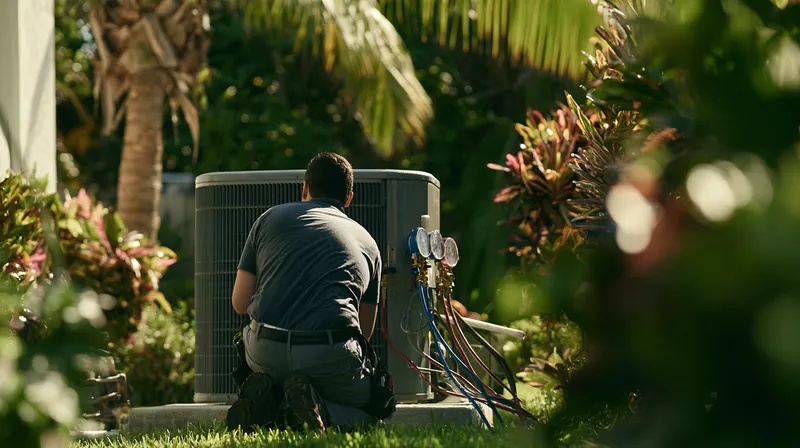
Start with the causes that are not size: duct leakage, refrigerant charge, airflow and a backed-up drain. A technician can measure each one. If the system really is too big, the lasting fix is a replacement sized to a Manual J and the 1.15 limit. Replacing a working system only because it short cycles is a decision to make with the numbers in hand.

Frank Rey, Direct Cooling's owner, named units that are too big alongside drain line cleaning when asked about the most common repair calls he sees and their causes. He also said the most common mistake by other installers is a system "Not set up correctly by installer for our weather."
The local housing stock shapes what a technician looks at first. In Sandalfoot Cove, most single-family sections went up between 1971 and 1987, so the condenser may be the third on its pad while the ducts are original; our page on AC repair in Sandalfoot Cove covers that. In Royal Palm Yacht and Country Club, 58 percent of homes on record were built in 2000 or later, a different starting point; see HVAC service in the City of Boca Raton.
Seasonal homes add a twist. In Hunters Run, most homes are condos built from 1979 to 1991 and many owners split the year; see AC repair in Hunters Run. Frank says the most common seasonal mistake is turning the thermostat up so far that the unit does not run enough and the drain backs up. FSEC found the same thing in vacant Florida homes: an 85 F setting "yielded generally poor results because the AC run time was too small to ensure adequate moisture removal" [11]. In Mission Bay, by contrast, few owners live out of state and those systems rarely get a summer off; see AC repair in Mission Bay.
Questions About Oversized Air Conditioners
 Direct CoolingFL Certified AC Contractor CAC1819111 Dispatch 24/7
Hi, this is Direct Cooling. Tap a question below for a straight answer.
Tap a question to ask
- How many times an hour should an AC cycle?
- No federal standard sets a number. On a hot afternoon, cycles of about 15 to 20 minutes or longer give the coil time to remove moisture, by Energy Vanguard's rule of thumb [4]. Many cycles of ten minutes or less, with humidity over 60 percent, point to a system that is too big.
- Can an oversized AC cause high humidity?
- Yes. A system that reaches the setpoint quickly runs too briefly to remove much moisture, and FSEC reports that comfort may be reduced when run times are shortened and less moisture is removed [1]. EPA's target is below 60 percent indoor humidity [3].
- Does a bigger AC cool a house better?
- No. It cools the air faster but dries it less. The Department of Energy says an oversized unit performs less efficiently and effectively than a properly sized one [12], and Florida's code caps cooling-only equipment at 1.15 times the calculated load [2].
Run the Test Before Anyone Quotes a Bigger Unit
A fast-cooling air conditioner is not proof of a good one. On a hot afternoon, time the cycles for 90 minutes and read the humidity. Short cycles with damp air point to a system that is too big. Long cycles with damp air point to ducts, charge or airflow.
Either way, the numbers give you a better conversation with the next technician. Ask for the measurements, and if replacement comes up, ask for the Manual J report and the size it supports under Florida's 1.15 limit.
Direct Cooling is a Florida Certified Air Conditioning Contractor, license CAC1819111, with our shop in West Boca Raton. Call or text (561) 210-7605 to book a diagnostic visit.
References
- Florida Solar Energy Center. FSEC-PF-328-97, The Effect of Residential Equipment Capacity on Energy Use, Demand, and Run-Time (James, Cummings, Sonne, Vieira, Klongerbo; ASHRAE Transactions). July 1997. publications.energyresearch.ucf.edu/wp-content/uploads/2018/06/FSEC-PF...
- Florida Building Commission. Florida Building Code, Energy Conservation, 8th Edition (2023), section R403.7.1. 2023. Read on UpCodes. up.codes/viewer/florida/fl-energy-conservation-code-2023/chapter/RE_4/...
- U.S. Environmental Protection Agency. A Brief Guide to Mold, Moisture and Your Home. Updated February 18, 2026. epa.gov/mold/brief-guide-mold-moisture-and-your-home
- Allison Bailes, Energy Vanguard. How to Tell If You Have an Oversized Air Conditioner. June 14, 2010. energyvanguard.com/blog/how-to-tell-if-you-have-an-oversized-air-condi...
- Florida Solar Energy Center. FSEC-PF-289-95, residential HVAC sizing survey. 1995. publications.energyresearch.ucf.edu/wp-content/uploads/2018/06/FSEC-PF...
- NOAA National Centers for Environmental Information. Engineering Weather Data, West Palm Beach, FL. Period of record 1973 to 1996. ncei.noaa.gov/pub/data/EngineeringWeatherData_CDROM/engwx/west_palm_be...
- Air Conditioning Contractors of America. Manual S, Residential Equipment Selection. No date shown. acca.org/standards/technical-manuals/manual-s
- Air Conditioning Contractors of America. Manual J, Residential Load Calculation. No date shown. acca.org/standards/technical-manuals/manual-j
- ENERGY STAR. Air Source Heat Pumps. No date shown. energystar.gov/products/air_source_heat_pumps
- ENERGY STAR. Heating and Cooling. No date shown. energystar.gov/saveathome/heating-cooling
- Florida Solar Energy Center. FSEC-CR-1487-04, Evaluation of the Impact of Vacant Home Space Conditioning Strategies on Summer Relative Humidity, Energy, and Peak Load (Cummings, Withers, Parker, for FPL). January 31, 2005. publications.energyresearch.ucf.edu//wp-content/uploads/2018/06/FSEC-C...
- U.S. Department of Energy. Energy Saver: Tips on Saving Money and Energy in Your Home, p. 17. August 2022. energy.gov/sites/default/files/2022-08/energy-saver-guide-2022.pdf