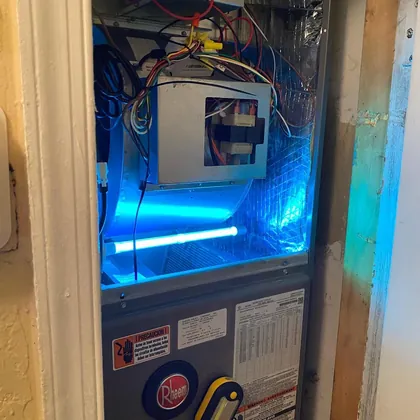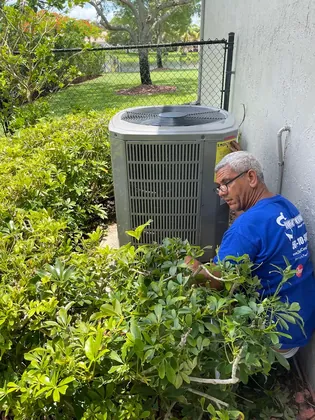

The cost to run a whole house dehumidifier depends on three numbers: its wattage, the hours it runs and your electric rate. The capacity depends on how damp the house is and how big it is. Both are easier to pin down than the marketing suggests.
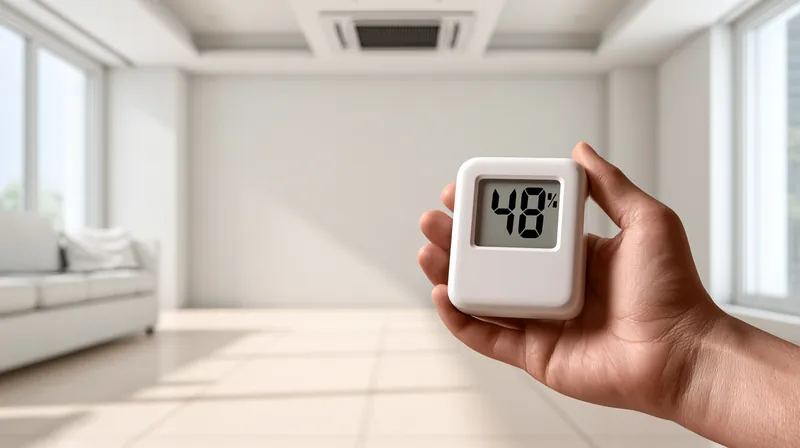
The target comes first. The U.S. EPA says to keep indoor humidity below 60 percent, ideally between 30 and 50 percent [4]. In a tight, well-run Florida home the air conditioner does most of that work. When it cannot, a dedicated dehumidifier picks up the moisture the AC leaves behind.
This guide covers when the AC alone falls short, how dehumidifiers are rated and why the numbers changed, how to size one, what it costs to run, where it is installed, and when fixing the air conditioner comes first. Direct Cooling installs whole-house dehumidifiers, but the numbers here come from federal sources and a manufacturer's published spec, not from us.
Key takeaways
- Whole-house units are rated at 73 F and 60 percent humidity; a unit sold as 100 pints at the old 80 F point removes about 71 pints at 73 F [1] [2].
- A 672-watt unit running 8 hours a day costs roughly $20 a month at FPL's October 2026 first-tier charges, by our arithmetic [2] [3].
- EPA's target is below 60 percent indoor humidity, ideally 30 to 50 percent [4].
- If the AC short cycles, fix or resize it first; a dehumidifier treats the symptom.
- Damp house even with the AC running? Call or text Direct Cooling at (561) 210-7605.
When Central AC Alone Cannot Hold 50 Percent
An air conditioner removes moisture only while it runs, and it runs to meet a temperature, not a humidity number. On mild, humid days, in an oversized system, or in a home closed up for the summer, it can reach the thermostat setting while the air stays damp. That gap is what a whole-house dehumidifier fills, working through the home's ducts.
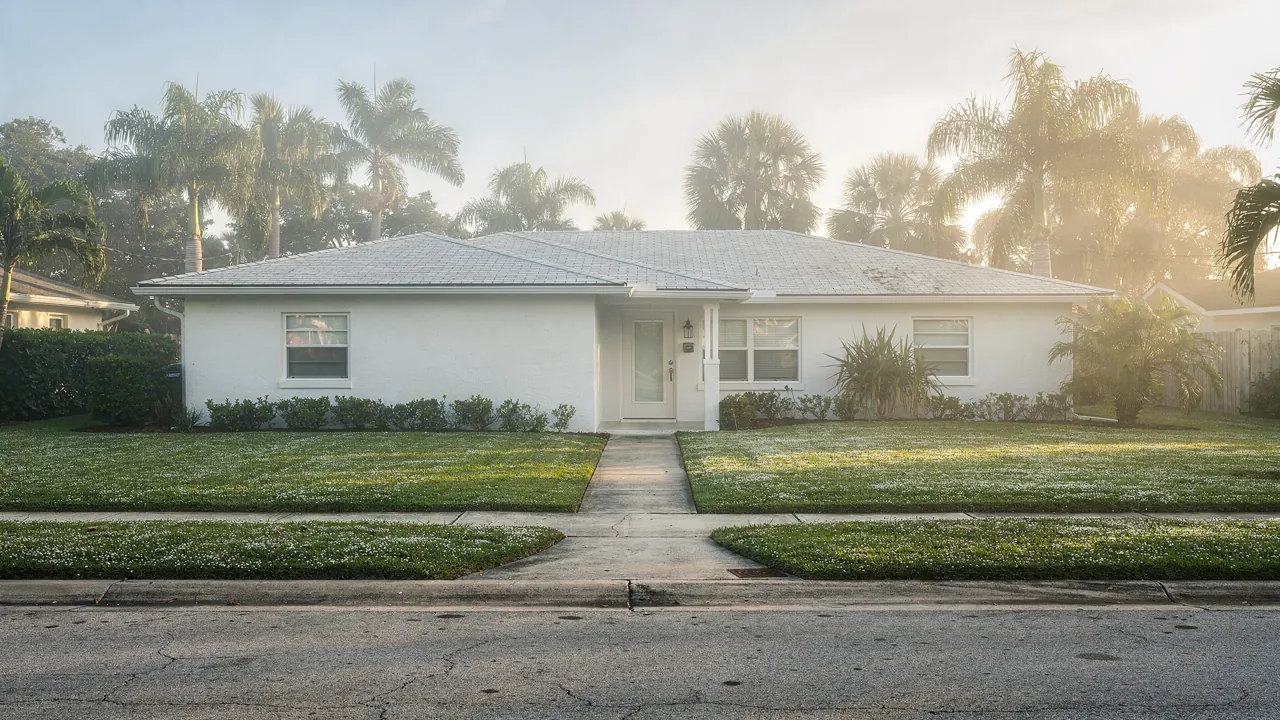
The load: humid air outside
FSEC measured outdoor humidity averaging about 77 percent from June through October in its Florida test houses [6].
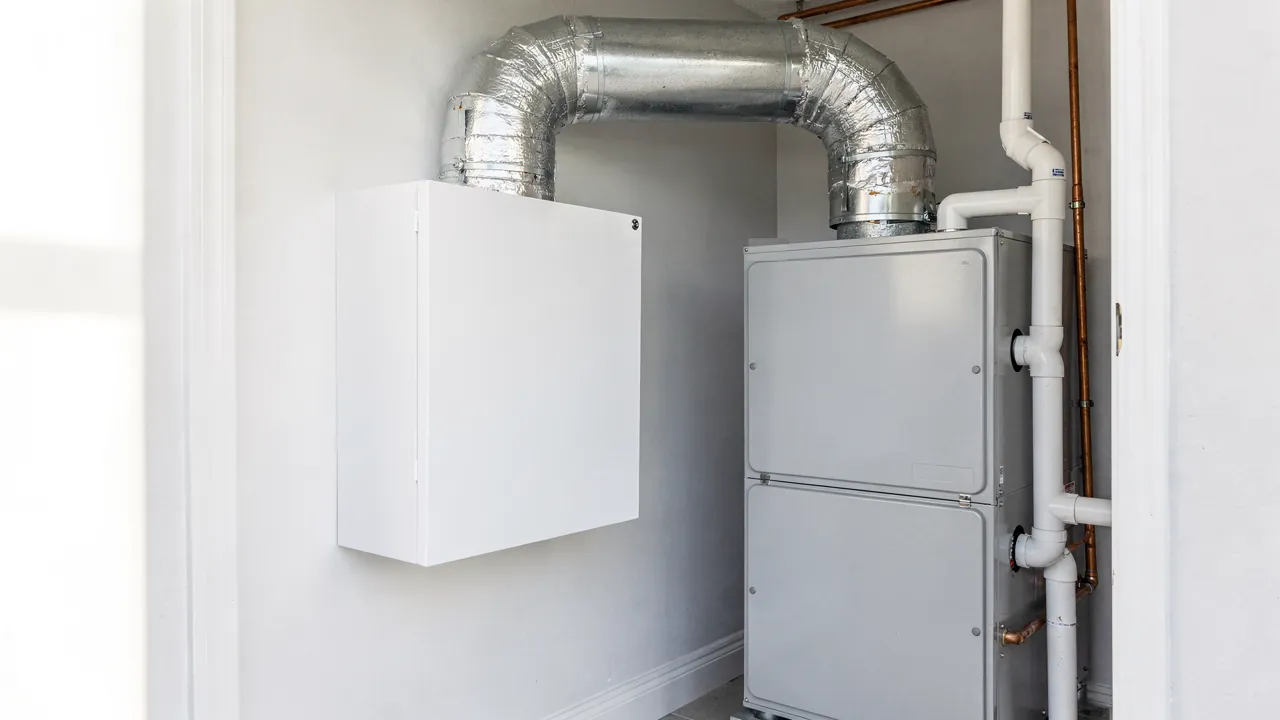
The machine: beside the air handler
A whole-house unit is installed to work through the home's air ducts, so it dries every room, not one [7].

The target: below 60 percent
EPA's guidance is to keep indoor humidity below 60 percent, ideally between 30 and 50 percent [4].
Most Florida homes already have central air. The U.S. Energy Information Administration counts 7.29 million Florida homes, 90 percent, with a central AC unit, and 0.68 million, 8 percent, that use a dehumidifier [5].
The outdoor air is the load. In a Florida Solar Energy Center study of closed-up homes, "outdoor RH averages about 77% from June through October" [6]. With no conditioning at all, indoor humidity in the three test houses averaged 62, 69 and 73 percent [6]. FSEC also notes that mold and mildew grow when humidity is high, "say over 70%, for extended periods of time" [6].
ENERGY STAR describes the whole-home type plainly: "Whole-home dehumidifiers are typically installed to use your home's air ducts" [7]. That is the difference from a portable unit in one room. For more on what indoor humidity level is healthy, see our humidity guide.
How Dehumidifiers Are Rated: Pints Per Day and the Test Conditions
Capacity is the pints of water a dehumidifier removes in 24 hours at a fixed test condition. Under the federal test procedure, portable units are rated at 65 F and 60 percent humidity and whole-home units at 73 F and 60 percent. Efficiency is the integrated energy factor, in liters of water per kWh. Older ratings used 80 F, so the numbers shrank.
The federal procedure lives in 10 CFR Part 430, Appendix X1. It corrects portable capacity "to standard rating conditions of 65 °F dry-bulb temperature and 60 percent relative humidity" and whole-home capacity "to standard rating conditions of 73 °F dry-bulb temperature and 60 percent relative humidity" [1].
ENERGY STAR explains why shoppers see two numbers for one machine. The newer procedure tests portable units at 65 F rather than 80 F, and "a dehumidifier tested to the new procedure will likely report a smaller capacity than when tested to the old procedure" [8]. The standards that use it "took effect in June 2019" [8].
One manufacturer's spec sheet shows the gap on a single whole-house unit. Santa Fe lists its Ultra98 at 100 pints a day at 80 F and 60 percent humidity, and 71.4 pints a day at 73 F and 60 percent [2].
| Santa Fe Ultra98, as published by the manufacturer | At 80 F, 60 percent humidity | At 73 F, 60 percent humidity |
|---|---|---|
| Water removed per day | 100 pints [2] | 71.4 pints [2] |
| Efficiency | 6.12 pints per kWh [2] | 4.68 pints per kWh [2] |
| Power draw | Not listed | 672 watts, 5.6 amps [2] |
When you compare quotes, compare pints at the same test point. A box number at 80 F against a spec at 73 F is not a like-for-like comparison.
Want the humidity measured before anyone sells you a box? Call or text Direct Cooling at (561) 210-7605, or see our service for indoor air quality in Boca Raton.
Sizing: From the ENERGY STAR Chart to a Whole-House Unit
Start with how damp the space is and how big it is. ENERGY STAR's chart puts a slightly to moderately damp large space at 30 pints a day or more, and a very damp large space at 40 or more. That chart is written for portable units, so a whole-house unit is chosen on the manufacturer's coverage rating and the home's moisture load.
The ENERGY STAR chart, for a portable dehumidifier [7]:
| Condition without dehumidification | Small to medium room, under 2,000 sq. ft. | Large room, over 2,000 sq. ft. |
|---|---|---|
| Slightly to moderately damp, 50 to 75 percent humidity | 20 to 30 pints a day | 30 or more |
| Very damp, 75 to 90 percent humidity | 25 to 40 pints a day | 40 or more |
| Wet, 90 to 100 percent humidity | 30 to 50 pints a day | 50 or more |
ENERGY STAR adds: "it's better to oversize than undersize!" [7] For a whole-house unit, it points buyers to separate whole-home guidance rather than this chart. Manufacturers publish a coverage figure instead; Santa Fe rates the Ultra98 for spaces up to 2,300 square feet [2].
ENERGY STAR also says a certified model "uses 20% less energy" than a similarly sized conventional unit [7]. That matters more than a few pints of capacity, because the machine may run for hours every day.
The building changes the answer. In Boca West, most homes are condominiums built in the 1970s and early 1980s, and in a condo the air handler often sits in a closet beside living space; our page on AC repair in Boca West covers that layout. A closet that small limits what fits beside the air handler, which is a question for the site visit, not the chart.
What It Uses: A Worked Running Cost
Running cost is watts times hours times your rate. A 672-watt whole-house unit running 8 hours a day uses about 5.4 kWh a day, about 160 kWh a month. FPL's October 2026 charges add up to about 12.26 cents per kWh for the first 1,000 kWh, and the table below prices each case before taxes.
The rate comes from FPL's residential rate insert effective October 2026. For the first 1,000 kWh a month, the per-kWh charges are a base energy charge of 7.865 cents, a fuel charge of 2.893 cents and four clauses totaling 1.540 cents, less a 0.040 cent credit [3]. That sums to about 12.26 cents. Above 1,000 kWh, the base and fuel charges are 8.865 and 3.893 cents, for about 14.26 cents in all [3].
Most Florida homes with central air pass 1,000 kWh in a summer month, so the higher tier often applies to the extra kWh. Here is the arithmetic both ways for the 672-watt unit [2] [3]:
| Hours a day | kWh a month (30 days) | At 12.26 cents per kWh | At 14.26 cents per kWh |
|---|---|---|---|
| 8 | About 161 | About $20 [3] | About $23 [3] |
| 12 | About 242 | About $30 [3] | About $34 [3] |
| 24 | About 484 | About $59 [3] | About $69 [3] |
The table is ours. A unit on a humidistat runs only as needed, so most homes land between the first two rows, not the last. Gross receipts tax and local taxes are extra.
FSEC measured something close to this in the field. In closed-up Florida homes, keeping humidity at or below 65 percent with a dehumidifier on a timer averaged $14.54 a month at the study's price of 8.5 cents per kWh [6]. That is about 171 kWh, or roughly $21 a month at today's first-tier charges, by our arithmetic [3] [6].
Where It Goes and What It Needs: Drain, Duct and Control
A whole-house dehumidifier usually sits beside the air handler, in a closet, attic or garage, and connects to the ductwork so dried air reaches every room. It needs a condensate drain, a power circuit and a humidistat or control. In a condo or a closet next to living space, the drain and its backup protection matter most.
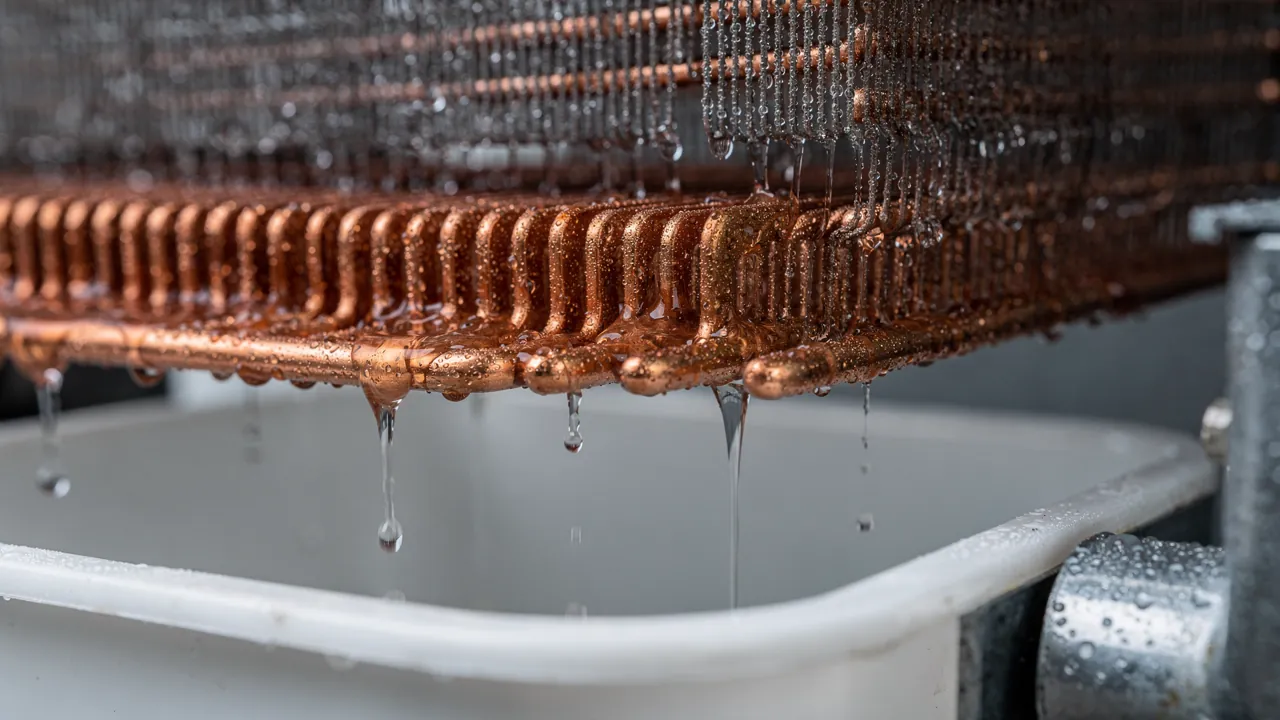
Water condenses on the cold coil
The moisture pulled from the air collects on the coil and drips into a drain pan, so every dehumidifier needs a drain.
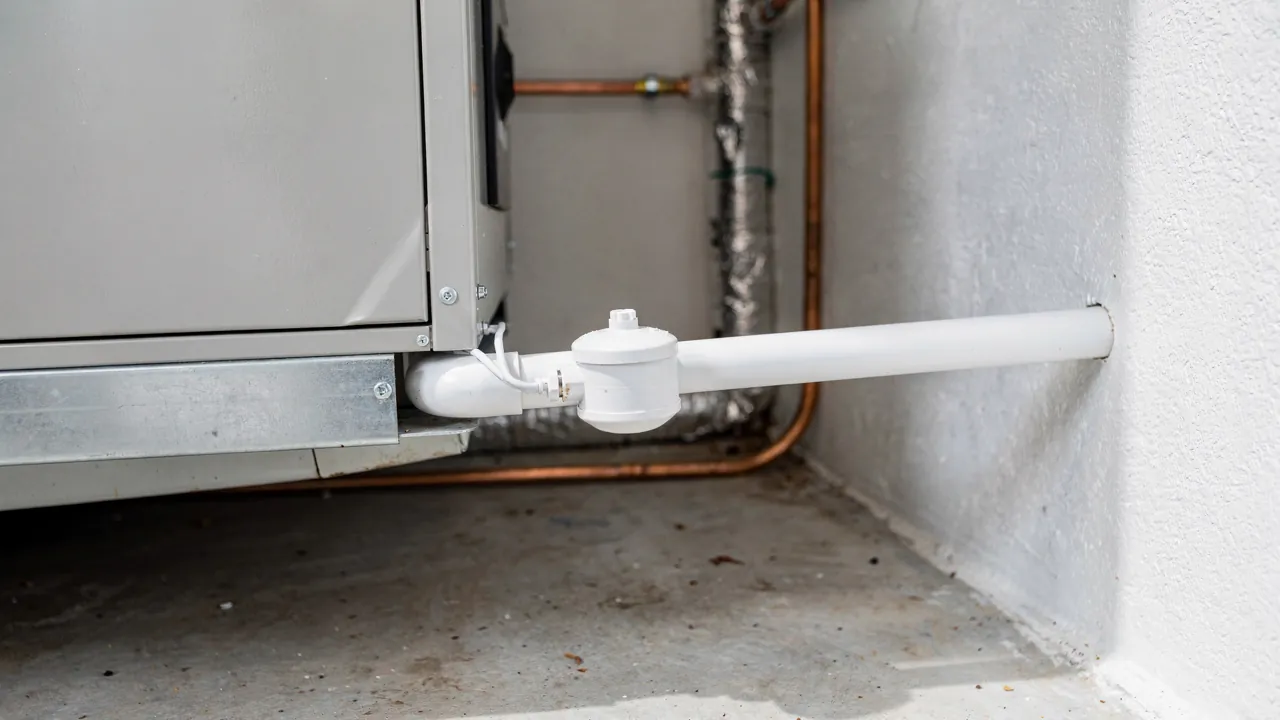
A backup guards the drain line
Florida's mechanical code requires backup protection on cooling coils where an overflow could damage the building, such as a switch that shuts the equipment off [9].
The water it removes has to go somewhere. Florida's mechanical code requires backup protection on cooling coils: "where damage to any building components could occur as a result of overflow from the equipment primary condensate removal system, one of the following auxiliary protection methods shall be provided for each cooling coil or fuel-fired appliance that produces condensate" [9]. The options include an auxiliary drain pan and a water-level switch that shuts the equipment off.
Stacked buildings raise the stakes. In Deerfield Beach, more than half of the housing sits in buildings of five or more units, and in stacked condos a clogged condensate line becomes the downstairs neighbor's problem; our page on AC repair in Deerfield Beach covers it. Kings Point is a 1970s condo community of 8,087 condo units where most calls involve closet air handlers; see AC repair in Kings Point. Around Lake Worth, the spring tune-up pays special attention to the condensate drain in closet air handlers; see AC repair in Lake Worth.
Frank Rey, Direct Cooling's owner, confirmed that the team installs dehumidifiers. He also said the most common seasonal mistake is turning the thermostat up so far that the unit does not run enough and the drain backs up. That is a reason to put a dehumidifier on a humidistat rather than switching it off for the summer.
When It Pays and When the AC Fix Comes First
A dehumidifier pays when the air conditioner is sized and working but the house still sits above 60 percent humidity, or when a home is closed up for months. When the AC short cycles, has a dirty coil or leaks air through the ducts, fix that first. A dehumidifier on top of a failing system adds a second bill to the first problem.
Building America research for NREL compared supplemental dehumidification options for warm, humid climates. Armin Rudd of Building Science Corporation concluded: "The best performing option is one that avoids overcooling and avoids adding unnecessary heat to the space" [10].
For closed-up homes, FSEC found a dehumidifier on a humidistat or timer was one of three effective approaches, alongside running the AC briefly in the early morning and space heating [6]. Its cost figures for the three were close, so the choice comes down to the home and how it is left.
Check the air conditioner before you buy a second machine. Our run-time test shows whether the AC itself is oversized, and a technician can measure airflow, charge and duct leakage. If the AC checks out and the house is still damp, a whole-house dehumidifier is the next step.
Questions About Whole-House Dehumidifiers
 Direct CoolingFL Certified AC Contractor CAC1819111 Dispatch 24/7
Hi, this is Direct Cooling. Tap a question below for a straight answer.
Tap a question to ask
- What is a whole house dehumidifier?
- A dehumidifier installed beside the air handler and connected to the home's ducts, so it dries the air in every room instead of one. ENERGY STAR describes whole-home units as "typically installed to use your home's air ducts" [7]. It drains to the condensate system and runs on a humidistat.
- Do whole house dehumidifiers use a lot of electricity?
- Less than the AC, but not nothing. A 672-watt unit running 8 hours a day uses about 160 kWh a month, roughly $20 at FPL's October 2026 first-tier charges, by our arithmetic [2] [3]. A humidistat keeps it from running longer than it needs to.
- Can a dehumidifier replace running the AC?
- Not for cooling. In an empty home, FSEC found a dehumidifier on a timer held humidity down for about the same cost as brief early-morning AC runs [6]. In an occupied home in a Florida summer, you still need the air conditioner.
The Short Answer Before Anyone Quotes One
Get two numbers before you buy: the pints at 73 F, and the watts. The first tells you whether the unit fits your home's moisture load. The second, times your hours and FPL's rate, tells you the monthly cost. A 672-watt unit on a humidistat costs roughly $20 to $30 a month at today's first-tier charges, by our arithmetic [2] [3].
Then check the air conditioner. If it short cycles or the ducts leak, fix that first. If it is sound and the house still sits above 60 percent, a whole-house dehumidifier is the tool built for the job.
Direct Cooling is a Florida Certified Air Conditioning Contractor, license CAC1819111, with our shop in West Boca Raton. Call or text (561) 210-7605 to measure your home's humidity and talk through the options.
References
- U.S. Department of Energy. 10 CFR Part 430, Subpart B, Appendix X1, Uniform Test Method for Measuring the Energy Consumption of Dehumidifiers. Current eCFR text, read October 30, 2026. ecfr.gov/current/title-10/chapter-II/subchapter-D/part-430/subpart-B/a...
- Santa Fe Products. Ultra98 Dehumidifier, product specifications. No date shown; read November 5, 2026. santa-fe-products.com/product/ultra98-dehumidifier/
- FPL. Residential Rates and Clauses, effective October 2026 (form 26-3817). Effective October 2026. fpl.com/content/dam/fplgp/us/en/rates/pdf/residential-rates-oct2026.pd...
- U.S. Environmental Protection Agency. A Brief Guide to Mold, Moisture and Your Home. Updated February 18, 2026. epa.gov/mold/brief-guide-mold-moisture-and-your-home
- U.S. Energy Information Administration. Residential Energy Consumption Survey 2020, Highlights for air conditioning in U.S. homes by state. Final data release March 2023. eia.gov/consumption/residential/data/2020/state/pdf/State%20Air%20Cond...
- Florida Solar Energy Center. FSEC-CR-1487-04, Evaluation of the Impact of Vacant Home Space Conditioning Strategies on Summer Relative Humidity, Energy, and Peak Load (Cummings, Withers, Parker, for FPL). January 31, 2005. publications.energyresearch.ucf.edu//wp-content/uploads/2018/06/FSEC-C...
- ENERGY STAR. Dehumidifiers. No date shown; read November 5, 2026. energystar.gov/products/dehumidifiers
- ENERGY STAR. Dehumidifier Testing and Capacity. No date shown; read November 5, 2026. energystar.gov/products/dehumidifier_testing_and_capacity
- Florida Building Commission. Florida Building Code, Mechanical, 8th Edition (2023), section 307.2.3. 2023. Read on UpCodes. up.codes/viewer/florida/fl-mechanical-code-2023/chapter/3/general-regu...
- Armin Rudd, Building Science Corporation, for NREL. Measure Guideline: Supplemental Dehumidification in Warm-Humid Climates (DOE/GO-102014-4502). October 1, 2014. osti.gov/biblio/1160177