
The cost to leave the AC on while away in Florida comes down to one number on the thermostat. Over the six warm months, May through October, the setpoint decides most of the bill. The trouble is that the official advice does not agree. FPL says 78 to 82 [2]. UF/IFAS Extension says no higher than 85 [3]. FSEC tested 85 and 83 in empty homes and found neither reliably kept the air dry [1].
Each degree saves money, but the two published estimates differ. FPL says each degree above 75 can save up to 5 percent of monthly cooling costs [4]. An older FSEC calculation puts it at almost 10 to 15 percent per degree [5]. So 82 costs about 20 percent less than 78 on FPL's rule, and 40 to 60 percent less on FSEC's, by our arithmetic [4] [5].
The cheapest setting is not the safest one. In the same FSEC test, a short run of cooling in the early morning, or a dehumidifier on a timer, held humidity for about $21 to $23 a month at FPL's October 2026 first-tier charges, by our arithmetic on the study's costs [1] [6].
This guide prices 78, 82 and 85 over a summer on the FPL rate, explains why the sources disagree, and covers what to check from a thousand miles away. Direct Cooling services homes across Boca Raton, but the numbers here come from FPL, FSEC, NOAA and the EIA, not from us.
Key takeaways
- FSEC found 85 F gave "generally poor results" in empty Florida homes because the AC barely ran [1].
- On FPL's rule, 82 costs about 20 percent less to cool than 78; on FSEC's older estimate, 40 to 60 percent less [4] [5].
- An average Florida AC home at 78 uses about 3,600 kWh of cooling from May to October, roughly $445 at FPL's first-tier charges, by our arithmetic [6] [7] [8].
- A short early-morning cooling run, or a dehumidifier on a timer, held humidity for about $21 to $23 a month at today's rate [1] [6].
- Leaving for the summer? Call or text Direct Cooling at (561) 210-7605 for a pre-departure check.
Three Official Answers, and Why They Differ
FPL tells seasonal residents to keep the AC around 78 to 82 F. UF/IFAS Extension says no higher than 85 F so the system still cycles. FSEC, in a field test it ran for FPL, found 85 and even 83 left too little run time to dry the air. They differ because two give a rule of thumb and one measured empty houses.
FPL's advice for owners leaving for months is direct: keep the AC set around 78 to 82 F, and "consider using a dehumidifier or a smart thermostat for remote adjustments" [2]. It adds a humidity rule, "Set the A/C to cycle periodically to keep humidity levels below 60%" [2], and suggests 82 for trips of a few weeks.
UF/IFAS Extension's publication on closing a seasonal home, revised April 2026, tells owners to leave the air conditioner at no higher than 85 F so it cycles off and on [3]. Its reason is humidity: above 85, it says, indoor humidity rises past 55 to 60 percent, which can lead to mold [3]. It also says to have the humidistat calibrated by your air conditioning company [3].
The Florida Solar Energy Center, a University of Central Florida research institute, put the settings to the test. In a 2005 study for FPL, it monitored three empty homes in Brevard County through humid summer and fall weather and tried five approaches: no cooling at all, an AC at 85 or 83, morning cooling at 74, a dehumidifier and space heating [1].
| Source | What it says for a home left empty | Basis |
|---|---|---|
| FPL, Ask the Energy Expert | 78 to 82 F; humidity below 60 percent [2] | Utility guidance |
| UF/IFAS Extension, FCS3154, revised April 2026 | No higher than 85 F, so the AC cycles [3] | Extension guidance |
| FSEC, FSEC-CR-1487-04, 2005 | 85 F gave "generally poor results"; 83 F did not ensure good performance [1] | Field test of three empty homes |
The two rules of thumb agree on one point: the system has to run enough to pull water out of the air. FSEC measured how often a high setting fails to do that.
What Each Setting Costs: A Worked Season on the FPL Rate
An average Florida home with central air uses about 5,100 kWh a year to cool, and about 72 percent of the year's cooling degree days fall from May through October. That puts a summer away at 78 F near 3,600 kWh of cooling, about 600 kWh a month, inside FPL's lower price tier. Each degree higher cuts that by 5 to 15 percent, depending on whose estimate you use.
Three published numbers build the estimate, and the arithmetic is ours. The EIA's 2020 survey puts Florida's home air conditioning at 33.8 billion kWh, plus 5.4 billion kWh for the air handler fans used for cooling [8]. Spread over the 7.72 million Florida homes with air conditioning [9], that is about 5,100 kWh a home each year.
Cooling degree days measure how much cooling the weather calls for. NOAA's 1991 to 2020 normals for West Palm Beach total 4,166 a year, and May through October hold 2,979 of them, about 72 percent [7]. So a home cooled at a typical setting uses about 3,600 kWh in those six months. We treat that as the 78 F starting point.
FPL's October 2026 rate insert gives the price. For the first 1,000 kWh a month, the base energy charge is 7.865 cents, fuel is 2.893 cents and four clauses add 1.540 cents, less a 0.040 cent credit, about 12.26 cents per kWh in all [6]. A closed-up home cooling about 600 kWh a month stays in that first tier.
| Away setting | FPL rule: up to 5 percent a degree [4] | FSEC estimate: 10 to 15 percent a degree [5] | What FSEC measured in empty homes [1] |
|---|---|---|---|
| 78 F | About 3,600 kWh, about $445 [6] | About 3,600 kWh, about $445 [6] | Not tested; inside FPL's 78 to 82 range [2] |
| 82 F | About 2,900 kWh, about $355 [6] | About 1,450 to 2,180 kWh, about $180 to $265 [6] | Not tested; inside FPL's 78 to 82 range [2] |
| 85 F | About 2,360 kWh, about $290 [6] | The rule runs out: from near zero to about 1,090 kWh, under about $135 [6] | Generally poor results; at times the AC did not run at all |
The table is our arithmetic, and it is a ceiling. The EIA figure comes from occupied homes, where people, cooking and showers add heat and moisture. An empty home needs less. The fixed $10.52 monthly base charge [6], taxes and the refrigerator are extra.
At 85, FSEC's per-degree estimate implies the air conditioner almost stops. That is what the field test saw.
Want the system checked before you lock the door? Call or text Direct Cooling at (561) 210-7605, or see our page on AC maintenance in Boca Raton.
What the FSEC Test Found About 85 Degrees
In FSEC's test of empty Florida homes, an AC set at 85 F with the fan on AUTO ran too little to remove enough moisture. It worked on hotter-than-average days but not on cooler, cloudier ones. Even 83 F did not ensure good performance, and at times neither setting made the AC run at all.
The study's words are plain. The 85 F approach "yielded generally poor results because the AC run time was too small to ensure adequate moisture removal" [1]. On cooler and cloudier days, "little or no AC run time lead to little or no moisture removal" [1].
Lowering it two degrees did not fix it. FSEC reported: "Even setting the thermostat to 83oF did not ensure good performance, especially during the cooler months." During some test periods, "neither AC at 85oF nor AC at 83oF caused the AC system to run at all" [1].
FSEC also set the targets it judged the methods by. Humidity "should stay below 70% essentially all of the time" and below 65 percent most of the time [1]. Mold and mildew grow when humidity is high, "say over 70%, for extended periods of time" [1]. The U.S. EPA's target for any home is lower: below 60 percent, ideally between 30 and 50 percent [10].
Frank Rey, Direct Cooling's owner, sees the result in drain lines. Asked about seasonal owners' most common mistake, he named "turning it up to much and unit does not run enough then drain backs up." A system that barely runs leaves water in the pan and the line to stagnate.
The Cheaper Methods That Worked: Morning Cooling and a Dehumidifier
FSEC found three methods held humidity in empty homes: running the AC at 74 F in the early morning, a dehumidifier on a humidistat or timer, and space heating to 88 to 90 F. The first two used less electricity than holding 82 F all summer, on either per-degree estimate, by our arithmetic.
Before you leave
Set the fan to AUTO and open the interior doors, as FSEC advises for a home left empty [1].
While the house is empty
FSEC's targets: humidity below 70 percent essentially all of the time and below 65 percent most of the time [1].
When you come back
A dry house on the first day back is the result you are paying for. Run the return checklist before you run the system hard.
The costs come from FSEC's comparison of the methods it found promising, priced at 8.5 cents per kWh. Averaged across the three houses, holding humidity at 65 percent or lower cost $16.15 a month for AC at 74 F in the early morning, $14.54 for a dehumidifier on a timer and $20.83 for space heating [1]. The study priced the morning AC at 1 to 4 hours a day, depending on the house [1].
Restated at FPL's October 2026 first-tier charges, $16.15 is about 190 kWh, or roughly $23 a month, and $14.54 is about 171 kWh, or roughly $21, by our arithmetic [1] [6]. Over six months that is roughly $125 to $140, below the 82 F estimates in the table above [1] [6].
| Method in FSEC's test | Monthly cost at 8.5 cents (2005) | Energy | At 12.26 cents per kWh (October 2026) |
|---|---|---|---|
| AC at 74 F in the early morning | $16.15 [1] | About 190 kWh | About $23 [6] |
| Dehumidifier on a timer | $14.54 [1] | About 171 kWh | About $21 [6] |
| Space heating, 88 to 90 F | $20.83 [1] | About 245 kWh | About $30 [6] |
The results varied by house. In the larger, leakier house, two hours of morning cooling left humidity mostly at 65 to 70 percent; four hours a day brought it to an average of 59 percent [1]. Both cheaper methods need a working thermostat schedule or a properly drained dehumidifier, so they are a setup job, not a guess. Our guide to sizing a whole-house dehumidifier covers that option.
Remote Monitoring and Who Checks the House
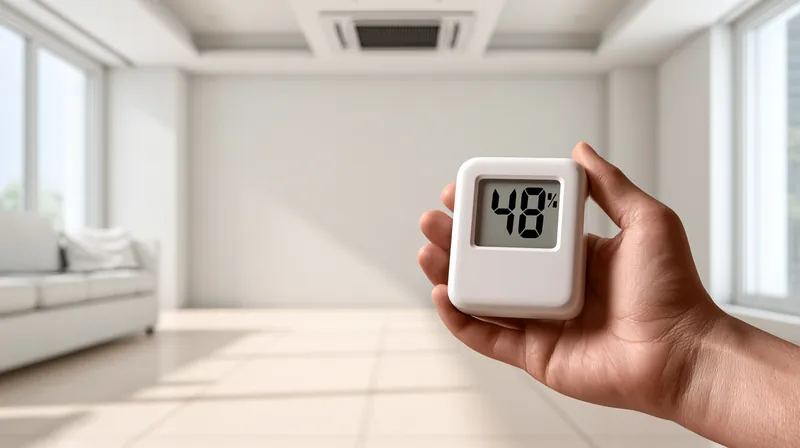
Whatever the setting, check the humidity, not just the temperature. A Wi-Fi thermostat lets you change the setting from anywhere with an internet connection, and a humidity reading tells you whether the plan is working. Someone local should still look in, because a clogged drain or a tripped switch does not show up on a phone.

ENERGY STAR says certified smart thermostats are "independently certified, based on actual field data, to deliver energy savings." With one, you "can adjust the temperature in your home from anywhere with an internet connection" [11]. FPL suggests a smart thermostat for the same reason [2].
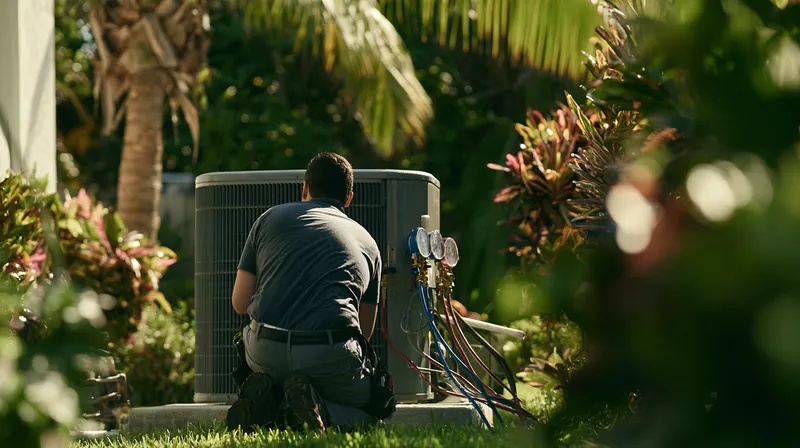
Before you leave, do five things. Book a check-up and have the drain line and pan cleaned. Set the fan to AUTO, which FSEC says saves energy and avoids drawing humid air in [1]. Open all interior doors, as FSEC advises [1]. Set the away setting or the morning schedule. Leave a key with someone who can check the air handler closet once a month.
This matters across the communities we serve. Boca Raton has 4,679 homes held for seasonal or occasional use, and Palm Beach County has 68,613 [12]. In Century Village, 37 percent of the 5,712 condominiums carry a homestead exemption, so most owners do not live there full time; see AC repair in Century Village. In Kings Point, 45 percent of homes are homesteaded; see AC repair in Kings Point. In ZIP 33434, home to Boca West, 2,175 of 2,930 vacant homes were held for seasonal use; see AC repair in Boca West. Delray Beach counts 4,374 seasonal homes [12]; see AC repair in Delray Beach.
When you come back, follow the return checklist before you run the system hard.
Questions About Leaving the AC On While Away
 Direct CoolingFL Certified AC Contractor CAC1819111 Dispatch 24/7
Hi, this is Direct Cooling. Tap a question below for a straight answer.
Tap a question to ask
- Should I turn my AC off when I leave Florida for the summer?
- No. FPL answers that question with a plain no [2]. In FSEC's test, empty homes with no conditioning averaged 62, 69 and 73 percent indoor humidity, while outdoor humidity averaged about 77 percent from June through October [1].
- What humidity should an empty house be kept at?
- FSEC's targets for empty Florida homes are below 70 percent essentially all of the time and below 65 percent most of the time [1]. The EPA's general target for homes is below 60 percent, ideally 30 to 50 percent [10]. FPL tells seasonal residents to keep it below 60 percent [2].
- Does FPL have a program for homes that are empty part of the year?
- Not On Call. FPL's Residential On Call terms say the home "must be occupied for at least 9 months of the year." FPL also will not install the equipment where it cannot be justified, "including vacation or other limited occupancy residences" [13].
Pick a Setting, Then Check the Humidity
For a Boca Raton home left empty from May to October, set the AC between 78 and 82, or use a morning cooling schedule or a dehumidifier on a timer. Do not count on 85. It is the cheapest line in the table and the one that failed FSEC's field test [1].
The money is real but smaller than the risk. On our arithmetic, 82 instead of 78 saves roughly $90 to $265 over the summer, depending on whose per-degree estimate holds [4] [5] [6]. A damp house in October costs more than that.
Direct Cooling is a Florida Certified Air Conditioning Contractor, license CAC1819111, with our shop in West Boca Raton. Book a pre-departure check, and a visit while you are away, by calling or texting (561) 210-7605, or ask about our maintenance plan.
References
- Florida Solar Energy Center. FSEC-CR-1487-04, Evaluation of the Impact of Vacant Home Space Conditioning Strategies on Summer Relative Humidity, Energy, and Peak Load (Cummings, Withers, Parker, for FPL). January 31, 2005. publications.energyresearch.ucf.edu//wp-content/uploads/2018/06/FSEC-C...
- FPL. Ask the Energy Expert: Going away? What's the right setting for your A/C? No date shown; read October 30, 2026. fpl.com/blog/ask-the-expert/ac-tips.html
- UF/IFAS Extension. Closing Your Seasonal Home (FCS3154). Original January 1990; revised April 2026. ask.ifas.ufl.edu/publication/HE887
- FPL. Ask the Energy Expert: AC settings. No date shown; read October 30, 2026. fpl.com/blog/ask-the-expert/ac-settings.html
- Florida Solar Energy Center. FSEC-PF-306-96, Are Energy Savings Due to Ceiling Fans Just Hot Air? (James, Sonne, Vieira, Parker, Anello). 1996, citing Fairey et al. 1986. publications.energyresearch.ucf.edu/wp-content/uploads/2018/06/FSEC-PF...
- FPL. Residential Rates and Clauses, effective October 2026 (form 26-3817). Effective October 2026. fpl.com/content/dam/fplgp/us/en/rates/pdf/residential-rates-oct2026.pd...
- NOAA National Centers for Environmental Information. 1991-2020 monthly climate normals, West Palm Beach (station USW00012844), cooling degree days. Read October 30, 2026. ncei.noaa.gov/access/services/data/v1?dataset=normals-monthly-1991-202...
- U.S. Energy Information Administration. Residential Energy Consumption Survey 2020, Table CE5.1.ST, household site electricity end-use consumption by state. Data release June 2023. eia.gov/consumption/residential/data/2020/state/pdf/ce5.1.st.pdf
- U.S. Energy Information Administration. Residential Energy Consumption Survey 2020, Highlights for air conditioning in U.S. homes by state. Final data release March 2023. eia.gov/consumption/residential/data/2020/state/pdf/State%20Air%20Cond...
- U.S. Environmental Protection Agency. A Brief Guide to Mold, Moisture and Your Home. Updated February 18, 2026. epa.gov/mold/brief-guide-mold-moisture-and-your-home
- ENERGY STAR. Smart Thermostats. No date shown; read October 30, 2026. energystar.gov/products/smart_thermostats
- U.S. Census Bureau. American Community Survey 2020-2024 5-year, tables B25004 and B25001 (via Census Reporter). ACS 2024 5-year. api.censusreporter.org/1.0/data/show/latest?table_ids=B25004,B25001&am...
- FPL. Residential On Call Program Terms and Conditions. PDF created January 25, 2022; no revision date printed. fpl.com/content/dam/fplgp/us/en/save/pdf/ROC%20Terms%20and%20Condition...