
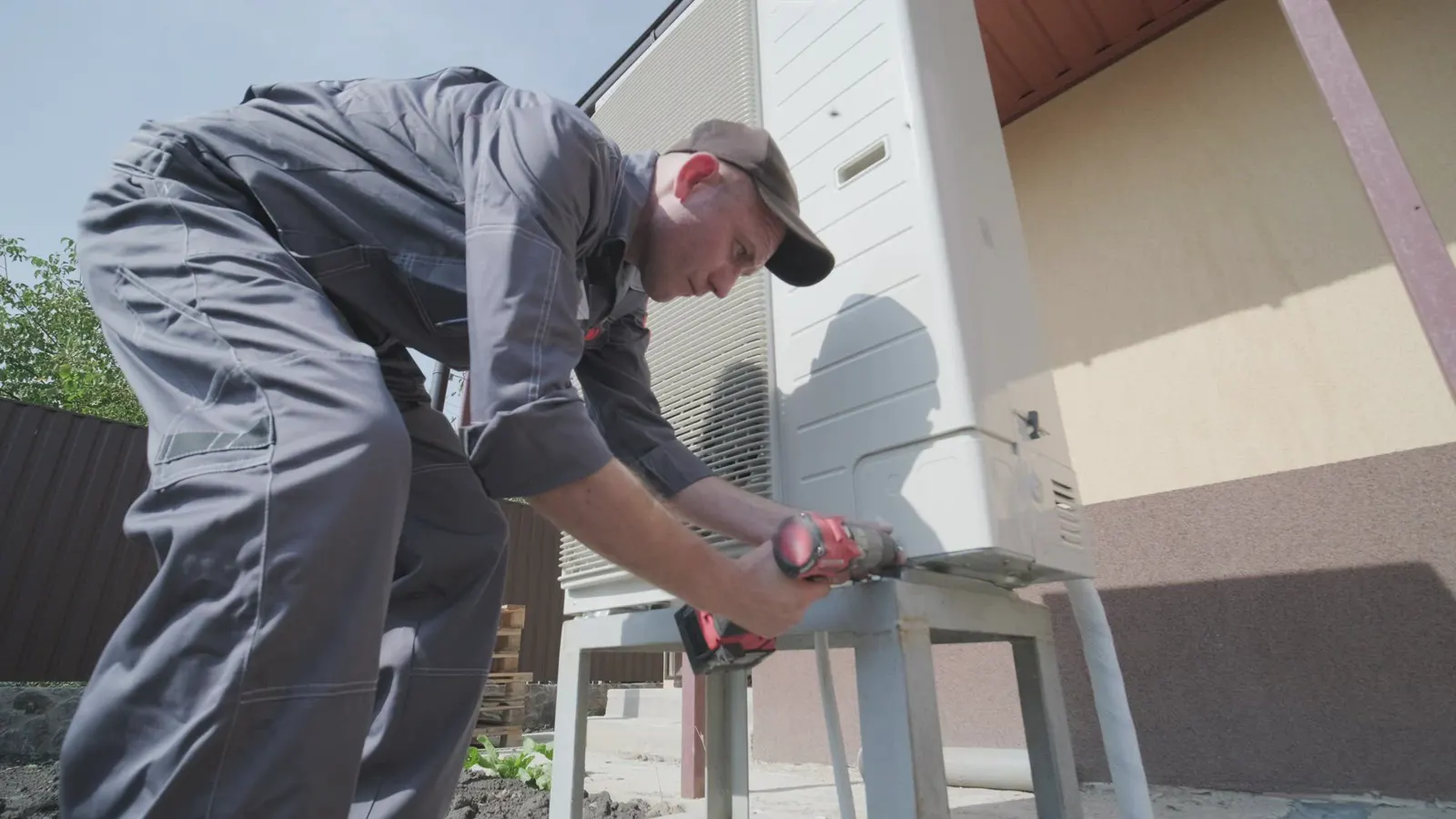
AC Repair in Coral Springs, Done to Broward's Stricter Rules
Direct Cooling handles AC repair, replacement and maintenance in Coral Springs, 9.3 miles from our west Boca office. Coral Springs is in Broward County, inside Florida's High-Velocity Hurricane Zone, so a replacement here follows Broward paperwork, HVHZ tie-down rules and the city's own code for where a condenser can sit.
- 4.9 on Google, 360+ reviews
- FL license CAC1819111
- BBB A+ accredited
Our Work in Coral Springs
The City of Coral Springs permit portal could not be searched by contractor on our research date, so this count comes from a third-party permit aggregator. We will replace it with city or job-system records.
BuildZoom is a third-party aggregator, not the city record. Read October 6, 2026. Repairs that need no permit never appear in any permit count.
AC Repair in Coral Springs Runs on Broward County Rules
Coral Springs is the one city on our list across the county line, and that changes the paperwork more than the work. Broward and Miami-Dade make up Florida's High-Velocity Hurricane Zone, the strictest wind region in the Florida Building Code, so every outdoor unit we set in Coral Springs is installed and documented to HVHZ rules. Palm Beach County, where our office is, is not in the HVHZ.
Repairs work the same on both sides of the line: we diagnose first and fix what failed. A replacement is where Coral Springs differs. The city Building Department at 9500 W. Sample Road requires a mechanical permit with a full replacement packet, including Broward's uniform Air Conditioning Replacement Data form, and since January 1, 2026 it no longer processes paper submittals. The packet is electronic only.
The trip matters too. The Building Department is 9.3 miles from our office in west Boca, Heron Bay South 8.3 miles and Coral Square 11.4 miles.
What a Coral Springs AC Replacement Permit Needs
From the City of Coral Springs air conditioning replacement checklist, Form 032.0, revised February 5, 2026. We assemble every item before the old unit comes out. The city also allows the final A/C inspection to be done virtually.
- A mechanical permit application with the job value and dedicated mechanical plans, plus an electrical application when electrical work applies. Applications and inspections run through the city eTRAKiT portal.
- Broward's uniform Air Conditioning Replacement Data form (Board of Rules and Appeals Policy 19-02), one per system, listing the old and new equipment, tonnage, efficiency, strip heat and circuit sizes, and whether the stand, location, duct smoke detector or line-side electrical work changes, or the unit is being replaced because of a flood.
- Equipment tie-down specifications showing how the condenser is anchored for HVHZ wind loads.
- The AHRI certificate for the matched indoor and outdoor system, which documents the rated efficiency of that exact pairing.
- A recorded Notice of Commencement when the job is over $15,000, before the first inspection.
- A rooftop mounted equipment affidavit when the unit sits on a roof, as on some condo and commercial buildings.
Where an AC Condenser Can Sit in Coral Springs
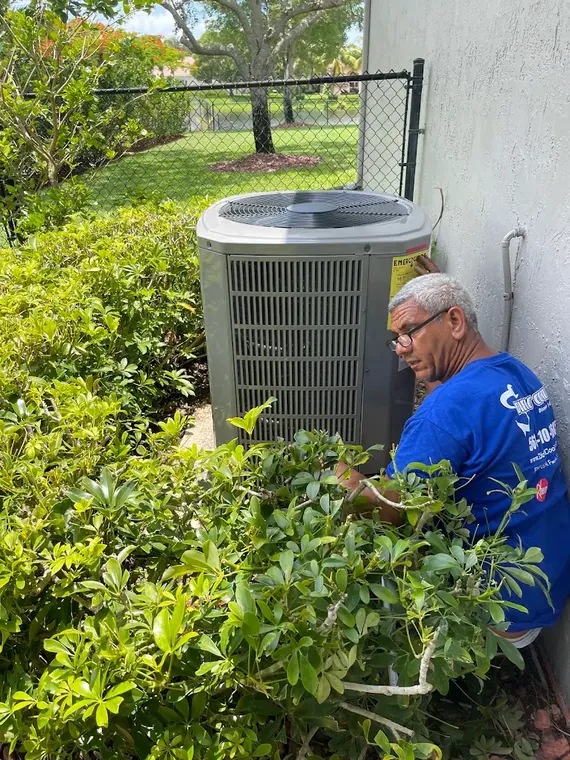
Coral Springs regulates where outdoor AC equipment goes, under Land Development Code Section 250129. A like-for-like swap on the existing pad usually stays compliant; moving the unit has to meet all of this.
- Side yards only, 4 feet backA/C compressors may sit in a side yard no closer than 4 feet to the side property line, and never forward of the front wall of the house.
- Same color as the houseUnits and their conduits must be enclosed or painted to match the house.
- Screened from viewThe compressor area must be screened by a hedge, wall or fence, and roof-mounted units must be screened as well.
- What it means on a replacementIf a new, larger condenser will not fit the old screened pad with service clearance, we plan the relocation within these rules before the permit is filed, not after the inspector sees it.
Coral Springs ZIP Codes: Home Ages and Housing Types
The east side is older and more mixed; the west side is newer and mostly single-family. Single-family medians come from the state parcel roll; the rest from Census estimates. ZIPs 33067 and 33076 also take in parts of Parkland.
| ZIP | Single-family median year built | All housing median year built | Detached homes | Owner-occupied | Median age |
|---|---|---|---|---|---|
| 33065 | 1979 | 1981 | 33.6% | 49.3% | 36.2 |
| 33071 | 1983 | 1987 | 57.3% | 64.6% | 37.9 |
| 33067 | 1988 | 1993 | 72.6% | 73.9% | 42.2 |
| 33076 | 1997 | 2003 | 77.6% | 84.2% | 37.3 |
City of Coral Springs overall: median year built 1987, median age 37.5, 60.3% owner-occupied, 0.8% of housing seasonal. 43% of homes in 33065 are in buildings of five or more units.
Coral Springs Neighborhoods: Build Years and House Sizes
Grouped by plat name on the state parcel roll, Coral Springs neighborhoods fall into clear generations. House size matters as much as age: a 3,597 square foot Eagle Trace home and a 2,119 square foot home in The Windings need very different systems.
| Neighborhood | Single-family homes | Median year built | Median living area | ZIP |
|---|---|---|---|---|
| The Windings | 237 | 1972 | 2,119 sq ft | 33065 |
| Forest Hills | 477 | 1973 | 2,232 sq ft | 33065 |
| Country Club area | 1,160 | 1975 | 2,544 sq ft | 33065 |
| Ramblewood | 1,563 | 1976 | 2,334 sq ft | 33071 |
| Maplewood | 620 | 1978 | 2,823 sq ft | 33071 |
| Shadow Wood | 622 | 1978 | 2,631 sq ft | 33071 |
| Cypress Run | 1,060 | 1981 | 2,630 sq ft | 33071 |
| Pine Ridge | 1,038 | 1987 | 2,864 sq ft | 33067 |
| Eagle Trace | 435 | 1991 | 3,597 sq ft | 33071 |
| Turtle Run | 532 | 1995 | 2,875 sq ft | 33067 |
| Kensington | 1,267 | 1996 | 2,940 sq ft | 33076 |
| Wyndham Lakes | 1,831 | 1999 | 2,428 sq ft | 33076 |
| Heron Bay (Coral Springs side) | 909 | 2000 | 2,385 sq ft | 33076 |
Citywide, 27.0% of single-family homes predate 1980, 29.1% date from the 1980s, 34.1% from the 1990s and 9.8% from 2000 on. Condos are a separate story: 12,092 units with a median of 1983 and 1,000 square feet, only 31.2% homesteaded, led by the roughly 1,020-unit Ramblewood East condominium.
Coral Springs Was Built in Waves, and So Were Its AC Systems
Coral Springs began as a plan. Coral Ridge Properties bought 3,869 acres from the Lyons family on December 14, 1961, the city was chartered on July 10, 1963, the first 536 building lots sold in July 1964 and the covered bridge went up the same year to promote the town. Westinghouse acquired the developer in 1966. The city added more than 35,000 residents in each of the 1970s, 1980s and 1990s, Coral Square opened in 1984, the Sawgrass Expressway arrived in 1986, and residential build-out came in 2003.
That timeline is still visible in the equipment. The state parcel roll puts the median single-family home at 1979 in ZIP 33065 on the east side, 1983 in 33071, 1988 in 33067 and 1997 in 33076 out west by Heron Bay. A 1979 house has been through several systems and may still have original ductwork in a hot attic; a 1997 house is far past the 10-year mark ENERGY STAR uses for considering replacement; a 2003 house is past it too, and the question is whether repairs are piling up.
Across the city, the roll lists 24,786 single-family homes with a median build year of 1987 and a median of 2,511 square feet, and 12,092 condominiums with a median of 1983. At that size, load calculations and duct condition deserve as much attention as the condenser. The city has long kept strict building codes aimed at its appearance, and as the placement rules above show, they reach the AC equipment too.
What Year-Round Family Households Mean for a Coral Springs AC
Coral Springs is the youngest and least seasonal of our four area guides. That changes how hard the equipment works.
Full houses, all year
Median age is 37.5 and only 0.8% of housing is seasonal (Census ACS), against 11.7% in Delray Beach. Systems here rarely get a summer off with the thermostat set high.
Run hours add up
More occupied hours mean more cooling hours, so wear tracks use more than age. Twice-yearly maintenance, the rhythm of our membership, matters more here than in a snowbird condo.
Drains under constant load
A system running daily through a South Florida summer moves water through the condensate line every hour. Carrier recommends keeping that line clear, and Trane notes a clogged line can trip the overflow switch and shut the system down.
Heat pump households
Electricity heats 92.3% of occupied homes in the city, so the AC is usually the heater too. A heat pump can cut heating electricity use by about 50% compared with resistance strips (DOE).
Broward heat alerts
Broward County is in the National Weather Service Miami pilot that issues heat advisories at a heat index of 105°F for two hours, lower than the 108°F used in Palm Beach County.
NOAA 1991-2020 normals for the Coral Springs station show 91.8 days a year at 90°F or above, July and August highs near 91°F, and 4,256 cooling degree days against 138 heating degree days. Cooling demand outweighs heating about 30 to 1, which is why the AC, not the heat, sets the replacement schedule here.
Inland Coral Springs: No Salt Air, but Wind and Shaded Flood Zones
Coral Square sits about 10.5 miles from the ocean at Hillsboro Inlet, far beyond the 2-mile band in which Carrier says salt carries. Coastal corrosion that shortens condenser life in Deerfield Beach or east Delray is rarely the story here. The Sawgrass Expressway borders the city on its northern and western edges, which puts Coral Springs among the most inland areas we serve.
Flood exposure is moderate rather than absent. We sampled eight points across the city on the FEMA National Flood Hazard Layer: five, including the Building Department, Mullins Park, the Sportsplex area and Heron Bay South, read shaded Zone X, the 0.2% annual chance floodplain; two read Zone X minimal hazard; and the point at the covered bridge, which crosses a canal, read Zone AE. Shaded Zone X carries no elevation mandate, but a condenser pad that sits low in a yard that ponds after a summer storm is worth raising during a replacement.
Wind is the bigger design issue. Every Broward installation is in the High-Velocity Hurricane Zone, so the stand, the anchors and the screening around the unit are all part of the job, whether the house is a 1979 ranch in 33065 or a 2003 house near Heron Bay.
Coral Springs vs Palm Beach County: How an AC Replacement Differs
We work on both sides of the Broward line. These are the differences that change a Coral Springs job.
| Item | Coral Springs (Broward) | Unincorporated Palm Beach County |
|---|---|---|
| Wind region | High-Velocity Hurricane Zone | Not HVHZ; wind-borne debris region |
| Replacement data form | Broward A/C Replacement Data form (BORA Policy 19-02) | Florida HVAC Efficiency Card (form PB-O-021) |
| Tie-down documentation | Tie-down specifications in the permit packet | Anchoring required under FMC 301.15; rated stands comply when adequately anchored |
| Efficiency proof | AHRI certificate in the packet | Efficiency card available to the inspector |
| Notice of Commencement | Over $15,000, before first inspection | $15,000 or more, before first inspection |
| Where the unit may sit | City code 250129: side yard, 4 feet back, screened, matching color | Association and zoning rules where they apply |
| Submittal | Electronic only since January 1, 2026 | Online through the ePZB portal |
Getting a Coral Springs AC Ready for Hurricane Season
Hurricane season runs June 1 to November 30. In the High-Velocity Hurricane Zone, the anchoring is the part that decides whether a condenser is still on its pad after the storm. Coral Springs knows the stakes: after the 2004 and 2005 storms, including Wilma, whose eye passed directly over the city, its tree canopy was reduced by about one third.
Check the anchoring in May
Outdoor units must resist wind loads under Florida Mechanical Code 301.15. In the HVHZ, units on rated stands, slabs or curbs are deemed compliant only when properly installed, so loose or rusted tie-downs get replaced.
Mind the screening
The hedge, wall or fence that city code requires around the compressor should not crowd the coil. Trim it back so the unit can breathe and so debris has less to throw.
Before the storm
Follow FPL and turn off and unplug non-essential electrical equipment, and clear loose patio items away from the condenser.
After the power returns
Many systems hold the compressor off for 3 to 5 minutes when power is restored, which protects it (FPL). Give it that time before calling.
If water reached the unit
Do not start a condenser or air handler that sat in floodwater. Goodman advises a qualified inspection first, and replacement may be the better choice.
Replacing after a storm
A storm replacement still needs the full Broward packet, including tie-down specifications and the replacement data form. We prepare it so the new unit is anchored to HVHZ rules from day one.
Coral Springs Areas We Serve
Pins mark corridors, landmarks and neighborhoods, never customer homes.
The interactive map is not loading right now. The areas it covers:
- Direct Cooling office (Boca Commerce Park): 10058 Spanish Isles Blvd, Boca Raton.
- Wiles Road corridor (Change-outs, 2023): Three AC change-outs listed in 2023 in the Wiles Road area.
- University Drive corridor (Mechanical, 2023): Mechanical permit listed in 2023 near University Drive.
- Coral Springs Building Department (9500 W. Sample Rd): Replacement packets are electronic only since January 1, 2026.
- Covered Bridge (Built 1964): Built the year after the city charter to promote the new town; Florida's only covered bridge.
- Coral Square (Opened 1984): About 10.5 miles from the coast at Hillsboro Inlet.
- Mullins Park (Central Coral Springs): City park in central Coral Springs.
- Heron Bay South (West side): In ZIP 33076, where the median single-family home was built in 1997; 8.3 miles from our office.
Coral Springs AC Questions We Hear
 Direct CoolingFL Certified AC Contractor CAC1819111 Dispatch 24/7
 Hi, this is Direct Cooling. Tap a question below for a straight answer.
Tap a question to ask
- Is Coral Springs in the High-Velocity Hurricane Zone?
- Yes. The HVHZ covers Broward and Miami-Dade counties, and Coral Springs is in Broward. That is why the city replacement packet asks for tie-down specifications, and why we treat anchoring as part of every condenser replacement, not an extra.
- Can I move my AC condenser to the front of my house in Coral Springs?
- No. Land Development Code Section 250129 keeps compressors out of the area forward of the front wall, at least 4 feet from the side property line, painted or enclosed to match the house and screened by a hedge, wall or fence.
- Why is my air conditioner leaking water inside the house?
- Usually the condensate drain. A clogged line backs water into the pan, and Trane notes it can trip the overflow switch and shut the system down. A frozen coil can also drip as it thaws; American Standard advises switching from Cool to Off with the fan On, and never chipping the ice.
- Is it worth repairing an AC that is over ten years old?
- Sometimes. ENERGY STAR suggests considering replacement once a system is more than 10 years old, especially with frequent repairs or comfort problems. We diagnose first, then price the repair next to the replacement so the decision is yours.
- How do the refrigerant rule changes affect my Coral Springs home?
- If you have an R-410A system, EPA rules still allow it to be used and repaired. New residential systems use A2L refrigerants such as R-454B, and a May 2026 EPA rule removed the January 1, 2026 installation deadline for remaining residential split equipment made before 2025.
- What efficiency rating should I choose for a new system?
- The federal minimum for a new split air conditioner in Florida is 14.3 SEER2 below 45,000 Btu/h. American Standard models range up to 23.6 SEER2. With year-round family use and large homes, the payback on higher efficiency depends on your run hours, so we compare options on your actual load.
Coral Springs Homeowners, We Handle the Broward Packet
Call or text (561) 210-7605. We prepare the replacement data form, tie-down specifications and AHRI certificate so your permit is complete the first time.
Sources · page reviewed 2026-10-06
- BuildZoom, Direct Cooling permit history (third-party aggregator), read 2026-10-06
- City of Coral Springs, air conditioning replacement permit checklist (Form 032.0, rev. 2/5/2026), read 2026-10-06
- Coral Springs Land Development Code, Section 250129, read 2026-10-06
- Broward County Board of Rules and Appeals, A/C replacement data form (Policy 19-02), read 2026-10-06
- Florida Building Code, High-Velocity Hurricane Zone definition, read 2026-10-06
- Florida Building Code 2023, Section 1620 HVHZ wind loads, read 2026-10-06
- Florida Department of Revenue, statewide cadastral parcels (2026 roll), read 2026-10-06
- Wikipedia, Coral Springs, Florida, read 2026-10-06
- FEMA National Flood Hazard Layer, read 2026-10-06
- Palm Beach County, ultimate design wind speed map (Risk Category II), read 2026-10-06
- Carrier, coastal heating and air conditioning, read 2026-10-06
- NOAA NCEI 1991-2020 normals, Coral Springs station (USC00081858), annual and monthly, read 2026-10-06
- City of Coral Springs, Building inspections (Virtual Final A/C), read 2026-10-06
- City of Coral Springs, apply for an online permit (eTRAKiT), read 2026-10-06
- Trane, Air handler overflow switch, read 2026-10-06
- Palm Beach County, Florida HVAC Efficiency Card (form PB-O-021), read 2026-10-06
- Palm Beach County BCAB, wind resistance of exposed mechanical equipment (2017), read 2026-10-06
- US Census ACS 2020-2024 5-year, Coral Springs city and ZIPs 33065, 33067, 33071, 33076 (B25035, B01002, B25003, B25004, B25024, B25040), via Census Reporter, read 2026-10-06
- 2023 Florida Mechanical Code, Chapter 3 (301.15 wind, 301.16 flood), read 2026-10-06
- FPL, Power outage guide, read 2026-10-06
- FPL, Storm preparation guide, read 2026-10-06
- Goodman, HVAC equipment after a flood, read 2026-10-06
- National Weather Service Miami, 2024 heat criteria change (Broward pilot), read 2026-10-06
- ENERGY STAR, When to replace heating and cooling equipment, read 2026-10-06
- U.S. DOE, Energy Saver Guide (2022), read 2026-10-06
- NOAA National Hurricane Center, Tropical cyclone climatology, read 2026-10-06
- Direct Cooling, maintenance membership, read 2026-10-06
- Carrier, How to clean an AC drain line, read 2026-10-06
- Palm Beach County Building Division, owner-builder guidelines (permit types), read 2026-10-06
- American Standard, Frozen evaporator coil, read 2026-10-06
- EPA, Technology Transitions final rule fact sheet (May 2026), read 2026-10-06
- EPA, Frequent Questions on the Phasedown of HFCs, read 2026-10-06
- U.S. DOE, 2023 central air conditioner and heat pump standards FAQ, read 2026-10-06
- American Standard, Best air conditioners (June 2025), read 2026-10-06