
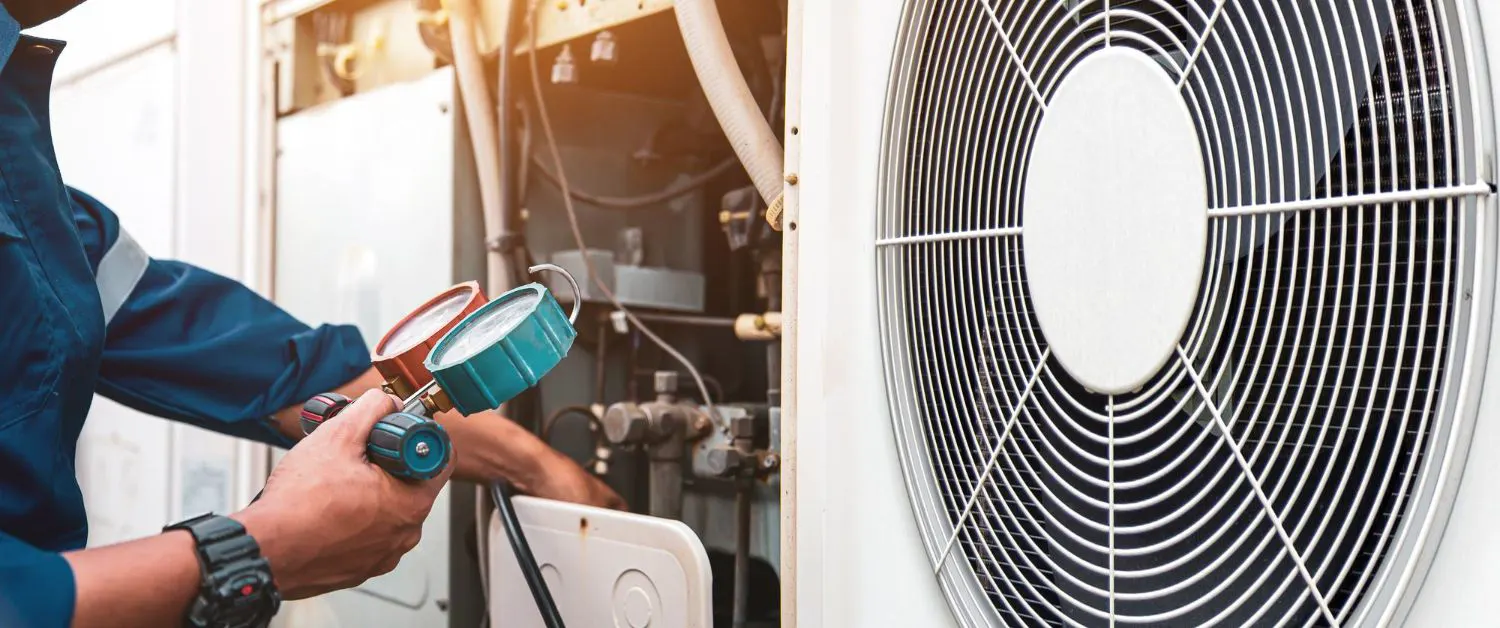
AC Repair in Sandalfoot Cove, Where West Boca's Older Homes Are
Sandalfoot Cove is one of the older parts of unincorporated west Boca: most of its single-family sections went up between 1971 and 1987, and its first condo buildings in 1972. That age decides what an AC repair or replacement here involves, from original duct runs to outdoor units sitting in shallow flood pockets. Our office in Boca Commerce Park is about 4.5 miles away, and Palm Beach County, not the City of Boca Raton, permits the work.
- 4.9 on Google, 360+ reviews
- FL license CAC1819111
- BBB A+ accredited
What We Can Show in Sandalfoot Cove
Palm Beach County records every permit pulled under our license, CAC1819111. One of them sits inside the boundary the Census Bureau drew for Sandalfoot Cove in 2000. The other two figures come from county parcel records we pulled for this guide.
Sources: Palm Beach County ePZB permit search for contractor CAC1819111 and the Property Appraiser parcel layer, both read October 6, 2026; Census 2000 place boundary from Census TIGERweb. Repairs that need no permit never appear on the county record, so this is a floor, not a job count. We publish the plat name only, never an address.
If Your Sandalfoot Cove AC Is Running Constantly and Losing Ground
If your system runs all afternoon, the house never quite gets to the setpoint, and the last technician just added refrigerant and left, you are describing the most common call in an older west Boca neighborhood. In a Sandalfoot Cove home built in the early 1970s, the condenser may be the third one on that pad, but the duct runs, the return path and the air handler closet are often the ones the house was built with. Fixing the symptom without looking at those leaves you paying for the same visit next summer.
A real diagnosis here checks four things before anyone talks about a new unit: refrigerant charge against the manufacturer's chart, airflow across the indoor coil, the condition of the return and supply ducts, and the electrical side (capacitor, contactor, breaker and disconnect). Duct leaks matter more than most owners expect. In Florida Solar Energy Center testing of 91 Florida homes, return leaks averaged 10% of system airflow, and FSEC researchers found that a 15% return leak pulling from a hot attic can cut delivered cooling capacity and efficiency by roughly half.
That is why we say diagnose first, sell second. Sometimes the right answer for a 1970s Sandalfoot house is a repair and a sealed return. Sometimes it is a replacement. You should know which one before you spend money, and you should see the readings that led there.
Sandalfoot Cove Housing by Section, Type and Build Year
Sandalfoot Cove is not one subdivision. County parcel records split it into numbered sections and condo groups built over about twenty years, and the AC situation follows the build year and building type. These are the largest groups that carry the Sandalfoot name.
| Plat or condo group | Homes or units | Type | Years built | What it means for the AC |
|---|---|---|---|---|
| Sections 2 to 6 | 752 | Single-family | 733 of 752 built 1971 to 1974 | Fifty-year-old houses; duct and electrical condition matter as much as the unit |
| Sections 7 and 8 | 268 | Single-family | Median 1977 | Late-1970s slab homes, many on their third or fourth outdoor unit |
| Sections 9 and 11 | 330 | Single-family | 1979 to 1987 | Early 1980s builds; return-side leaks are worth testing |
| Sections 10 and 12 | 475 | Townhomes | 1981 to 1992 | Shared walls; outdoor units grouped close together |
| Isle of Sandalfoot | 606 | Condos | 1975 to 1981 | Closet air handlers; association approvals for outdoor equipment |
| Sandalfoot South One to Three | 305 | Condos | 1972 to 1973 | Oldest condo stock; sample points in Zone AO |
| Sandalfoot Boulevard Apartments | 120 | Condos | 1972 to 1974 | Zone AO sample; 10 of 120 units homesteaded |
| Sandalfoot Squire | 143 | Condos | 1976 to 1981 | Late-1970s condo construction |
| Section 1 | 171 | Manufactured homes | Parcels from 1963, median home 2000 | Equipment varies by home; check the data plate |
Across all 3,474 homes in Sandalfoot-named plats, the median year built is 1978 and 56% were built before 1980. Homestead share is 69% for single-family homes and 39.5% for condos, so many condo owners do not live there full time.
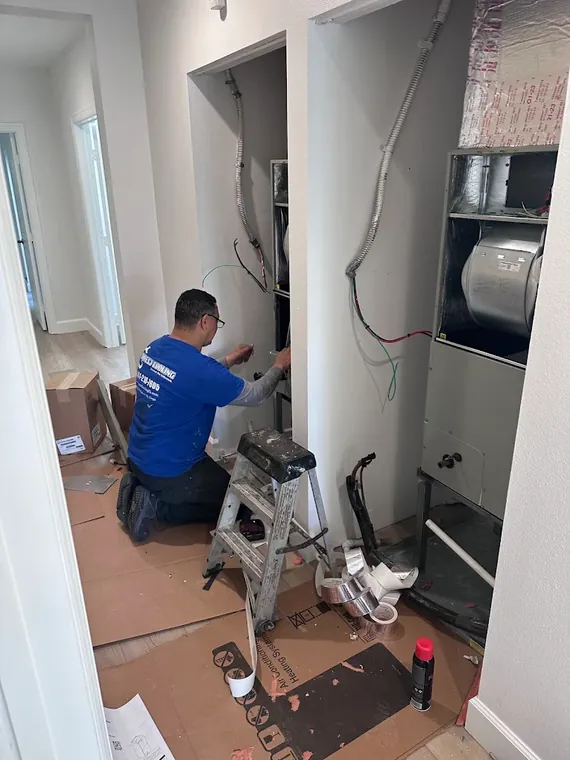
How AC Repair Differs Across Sandalfoot Cove's Four Housing Types
Single-family homes, condos, townhomes and manufactured homes each put the equipment in different places and raise different questions.
- Single-family homes, 1971 to 1987Mostly single-story slab construction with ductwork overhead. On a fifty-year-old house the questions are the condition of the duct board or flex runs, whether the return is sealed to the air handler, and whether the circuit matches the new equipment's nameplate.
- Condos, 1972 to 1981Condo units usually put the air handler in an interior closet and the condenser outside or on a shared pad. Access, condensate drainage and association sign-off shape the job as much as the equipment does. Ask your association what approval it needs before a replacement.
- Townhomes, 1980sSections 10 and 12 and the nearby Boca Rio North townhomes date from the 1980s. Outdoor units sit close together, so placement and service clearance matter on a replacement.
- Manufactured homesSection 1 and Sandalfoot Boulevard Estates, just west of US 441, hold manufactured homes. Equipment differs from home to home, so the data plate and the installation decide what a quote should include.
We sampled the FEMA National Flood Hazard Layer at the center of 27 plats in and around Sandalfoot Cove. Twenty sampled as Zone X. Seven sampled as Zone AO with a 1-foot depth: Sandalfoot South One, Two and Three, the Sandalfoot Boulevard Apartments, and all three Boca Rio Heights plats. FEMA defines Zone AO as an area with a 1% or greater annual chance of shallow flooding, usually sheet flow, averaging 1 to 3 feet deep. Your own parcel may differ from its plat's center, so check the FEMA map for your address.
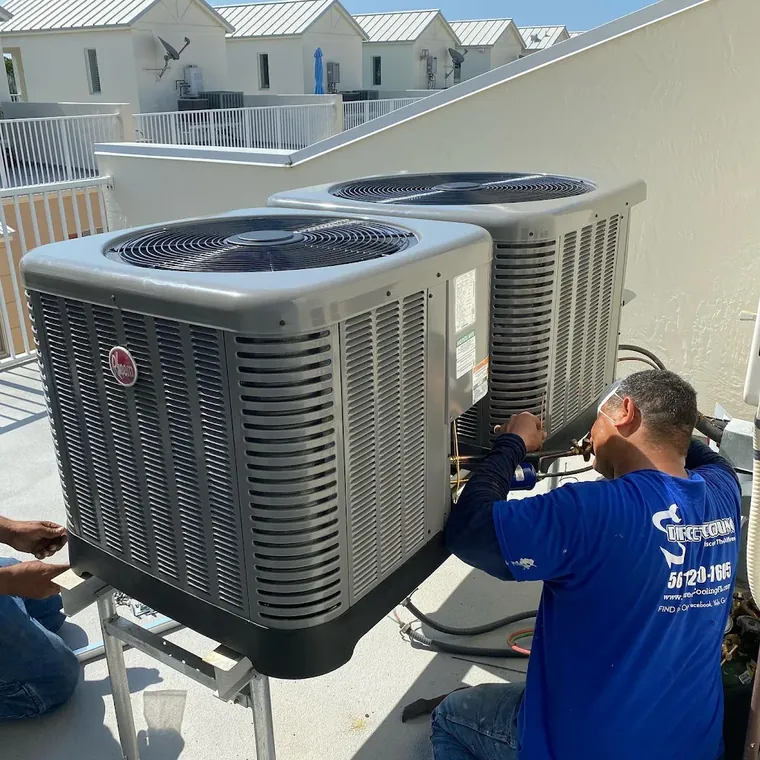
Raising an Outdoor Unit Where Sandalfoot Cove Floods Shallow
In a Zone AO pocket, the condenser height is part of the repair conversation. FEMA's homeowner guidance on flood protection says to raise and anchor air conditioning condensers and heat pumps on pedestals or platforms at least 1 foot above the potential flood elevation, and in identified high-risk zones to go to or above the regulatory flood elevation the local community has adopted. A condenser sitting on a low pad in a sheet-flow area is a candidate for a stand when it is replaced.
Wind is the other half. All of unincorporated Palm Beach County, Sandalfoot Cove included, sits in the wind-borne debris region on the county's design wind speed map, so a stand that lifts the unit also has to anchor it properly. Palm Beach County is not part of Florida's High-Velocity Hurricane Zone (that applies to Broward and Miami-Dade), but the anchoring still has to meet the Florida Building Code.
Boca Rio Heights: Our Permitted Work Inside Sandalfoot Cove
Our Sandalfoot Cove evidence is specific and small, and we would rather show it plainly than inflate it. Palm Beach County lists one general mechanical permit under our license at Boca Rio Heights, a group of three plats with 187 single-family homes built between 1980 and 1989. The Census Bureau's 2000 boundary for the Sandalfoot Cove census-designated place includes Boca Rio Heights, which is why we count it as Sandalfoot work.
Boca Rio Heights is a useful example of how mixed this area is. It is newer than the numbered Sandalfoot sections around it, its homes were mostly built in a single decade, and 164 of those 187 homes (87.7%) are homesteaded, so most owners live there year round. It also sits in one of the Zone AO pockets described above.
What to Check Before Replacing an Older Sandalfoot Cove System
Many Sandalfoot homes and condos are on equipment installed decades after the building. Before a replacement, these are the questions worth answering.
- Which refrigerant does your current system use? EPA ended production and import of new R-22 on January 1, 2020, but it does not require homeowners to replace working R-22 equipment, and reclaimed R-22 is still used for service.
- If your system uses R-410A, EPA rules allow you to keep using and repairing it. New residential equipment from American Standard and Rheem now ships with R-454B, a lower-GWP A2L refrigerant.
- What efficiency is the minimum? Since January 1, 2023, a new split air conditioner under 45,000 Btu/h sold in the Southeast must rate at least 14.3 SEER2 under DOE regional standards.
- Are the ducts sealed with mastic or metal tape? ENERGY STAR estimates a typical duct system loses 20% to 30% of the air moving through it, and cloth duct tape is not a lasting fix.
- Does the electrical circuit match the new unit's nameplate (breaker size, wire and a disconnect within sight of the condenser)?
- Is the outdoor unit in a Zone AO pocket? If so, plan the stand height and anchoring with the replacement.
How a Palm Beach County AC Change-Out Works in Sandalfoot Cove
Sandalfoot Cove carries Boca Raton mailing addresses, but every parcel there is unincorporated (municipality code 00 in the Property Appraiser record). Palm Beach County's Building Division issues the permit.
Diagnosis and quote
We confirm the problem, the equipment size and what a like-for-like replacement would be, and you get the readings and the options.
The right permit type
The county permits a straight A/C change-out as a Type 1 permit and a new system as a Type 2 permit. Adding a system or changing the setup is not a simple change-out.
Notice of Commencement
When the job is $15,000 or more, the county requires a recorded Notice of Commencement before the first inspection.
Installation
Old equipment out, refrigerant recovered, new equipment set on a code-compliant stand and anchored.
Inspection
The county inspects and closes the permit. In a condo, the association may also want proof of the permit.
Sandalfoot Cove Facts That Shape an AC Visit
A former census place
Sandalfoot Cove was a census-designated place with 16,582 people and 7,743 housing units in the 2000 census, covering about 3 square miles. Its census boundary stopped at US 441, though residents west of 441 often use the name too.
Two ZIP codes
Most of Sandalfoot Cove is in ZIP 33428 (median year built 1987, 3.9% seasonal homes). The eastern sections and Boca Rio Heights are in 33433 (median 1985, 5.5% seasonal), per Census ACS 2020 to 2024.
Inland, not coastal
The community sits roughly 7 to 8 miles from the beach at Deerfield Pier, well past the roughly 2-mile band where Carrier says salt spray drives coastal corrosion. Coil coatings for salt air are rarely the priority here.
Sandalfoot Cove, Section by Section
Pins sit at plat centers from county parcel records, never at a house. The southwest condo pins and Boca Rio Heights are the spots where FEMA's flood map samples as Zone AO.
The interactive map is not loading right now. The areas it covers:
- Direct Cooling office (Boca Commerce Park): 10058 Spanish Isles Blvd, Boca Raton. About 4.5 miles from the middle of Sandalfoot Cove.
- Boca Rio Heights (Mechanical permit on record): 187 single-family homes built 1980 to 1989 in three plats. Our county mechanical permit is here. All three plats sample as FEMA Zone AO.
- Sandalfoot Cove Sections 3 to 6 (Built 1971 to 1974): 556 single-family homes; 550 of them built 1971 to 1974. The oldest single-family core of the community.
- Sandalfoot Cove Sections 7 and 8 (Median 1977): 268 single-family homes, median build year 1977, in ZIP 33433.
- Isle of Sandalfoot (606 condos, 1975 to 1981): The largest single condo group in Sandalfoot Cove; 39% of Sandalfoot condo units are homesteaded.
- Sandalfoot South condos (Zone AO, built 1972 to 1973): Sandalfoot South One, Two and Three: 305 condo units. Their sample points fall in FEMA Zone AO, 1 foot depth.
- Sandalfoot Cove Sections 10 and 12 (1980s townhomes): 475 townhomes built 1981 to 1992.
- Sandalfoot Cove Section 1 (Manufactured homes): 171 manufactured homes on parcels dating back to 1963; the median home there was set in 2000.
- Sandalfoot Square (Shopping center): The commercial corner near US 441, the community's western edge.
Sandalfoot Cove AC Questions
 Direct CoolingFL Certified AC Contractor CAC1819111 Dispatch 24/7
 Hi, this is Direct Cooling. Tap a question below for a straight answer.
Tap a question to ask
- Does the City of Boca Raton permit AC work in Sandalfoot Cove?
- No. Sandalfoot Cove parcels are unincorporated Palm Beach County even though they use Boca Raton mailing addresses, so the county Building Division issues AC permits there. A straight change-out is a county Type 1 permit, and a job of $15,000 or more also needs a recorded Notice of Commencement.
- Is my Sandalfoot Cove home in a flood zone that affects the AC?
- Most plats we sampled are FEMA Zone X, but the Sandalfoot South condos, the Sandalfoot Boulevard Apartments and Boca Rio Heights sampled as Zone AO, shallow flooding about 1 foot deep. FEMA recommends raising outdoor units at least 1 foot above the potential flood elevation, so check your address on the FEMA map before a replacement.
- My 1970s Sandalfoot house still has an R-22 system. Do I have to replace it?
- No. EPA stopped new R-22 production and import on January 1, 2020, but it does not require homeowners to replace working equipment, and reclaimed R-22 is still available for service. The practical question is cost: once a leak or compressor failure makes repair expensive, replacement with current equipment usually makes more sense.
- How far is Direct Cooling from Sandalfoot Cove?
- Our office at Boca Commerce Park on Spanish Isles Boulevard is about 4.5 miles north of the center of Sandalfoot Cove. You can call or text (561) 210-7605; dispatch is monitored 24/7 and the office is open Monday to Friday, 8 to 5.
Sandalfoot Cove, We Are 4.5 Miles Up the Road
Call or text (561) 210-7605. Tell us your section or condo and we will know the build era before we arrive.
More From West Boca Raton
Sources · page reviewed 2026-10-06
- Palm Beach County ePZB permit search, contractor CAC1819111, read 2026-10-06
- Palm Beach County Property Appraiser, parcel and property details layer, read 2026-10-06
- Palm Beach County Property Appraiser, municipality codes, read 2026-10-06
- US Census TIGERweb, Census 2000 census designated places layer, read 2026-10-06
- Wikipedia, Sandalfoot Cove, Florida, read 2026-10-06
- US Census ACS 2020-2024 5-year (B25035, B25004, B25001), via Census Reporter, read 2026-10-06
- FEMA National Flood Hazard Layer, read 2026-10-06
- FEMA glossary, Zone AO, read 2026-10-06
- FEMA, Protect Your Home from Flooding (2020), read 2026-10-06
- Palm Beach County, ultimate design wind speed map (Risk Category II), read 2026-10-06
- Florida Building Code, High-Velocity Hurricane Zone definition, read 2026-10-06
- Palm Beach County Building Division, owner-builder guidelines (permit types), read 2026-10-06
- Palm Beach County, when a permit is required, read 2026-10-06
- EPA, Homeowners and consumers: frequent questions on the HCFC-22 phaseout, read 2026-10-06
- EPA, Frequent Questions on the Phasedown of HFCs, read 2026-10-06
- American Standard, Why are we changing refrigerants?, read 2026-10-06
- Rheem, What to know about the HVAC refrigerant change, read 2026-10-06
- U.S. DOE, 2023 central air conditioner and heat pump standards FAQ, read 2026-10-06
- ENERGY STAR, Duct sealing, read 2026-10-06
- Cummings et al., FSEC, duct leakage in 91 Florida homes, read 2026-10-06
- Cummings and Withers, FSEC, return leaks from hot attics (ASHRAE Journal, 2008), read 2026-10-06
- Carrier, Coastal heating and air, read 2026-10-06