
A unit AC replacement looks like the owner's business. Then a leak shows up in the unit below, a buyer's inspector asks how old the system is, or an owner sends a written records request. Each of those questions has an answer on a piece of paper that existed on installation day.
This guide maps Florida's condominium statute to the paperwork an AC replacement produces. It covers which documents to collect and where each comes from, how long to keep them, how to read the two county forms, which records protect the building, and what changes when the association is the buyer.
We quote the 2026 Florida Statutes as written. This is not legal advice. Your declaration, your board and your association's attorney govern how your records are kept.
Key takeaways
- The statute's official records include contracts for work, bids, and "A copy of all building permits" [1].
- Most official records are kept "for at least 7 years", and bids for at least 1 year [1].
- Associations of 25 or more units must post "Copies of all building permits issued for ongoing or planned construction" online [1].
- Nine documents make a complete AC file, from the approval to the refrigerant type.
- Managing a building with unit replacements coming up? Call or text Direct Cooling at (561) 210-7605.
Why the Statute Makes These Records the Association's Business
Florida's condominium statute decides what counts as an association record, and it is broad. Contracts for work, bids, every building permit and "All other written records of the association" related to its operation are on the list. Whether the AC itself belongs to the owner or the association depends on the declaration, but the paperwork usually lands in the association's files either way.
The official records list in section 718.111(12)(a) includes, among other items [1]:
- "All contracts for work to be performed."
- "Bids for materials, equipment, or services."
- "A copy of all building permits."
- "All other written records of the association not specifically included in the foregoing which are related to the operation of the association."
Who maintains the equipment is a separate question. The statute says "Maintenance of the common elements is the responsibility of the association, except for any maintenance responsibility for limited common elements assigned to the unit owner by the declaration" [2]. It defines limited common elements as "those common elements which are reserved for the use of a certain unit or units to the exclusion of all other units, as specified in the declaration" [3].
So read the declaration first. A condenser on the roof or a shared pad may be a limited common element. An air handler in the unit's closet may be the owner's. Our guide to approvals and permits for a condo AC replacement covers that step.
Whatever the declaration says, a building permit for work on the property is on the statute's list [1]. A manager who collects the permit and the papers around it is building the record the statute already expects.
The Nine Documents, and Where Each Comes From
Nine documents cover a unit AC replacement: the association's approval, the contract, the permit with its final inspection, the county efficiency card, the AHRI matched-system certificate, the warranty terms, the anchoring detail, the drain protection detail and the refrigerant type. The contractor produces most of them on installation day, so ask for them before the final payment.
Here is the file, document by document. The list is ours; the right column shows where each requirement comes from.
| Document | Who issues it | What it answers later |
|---|---|---|
| 1. Association approval | The board or manager | That the work was authorized under the declaration [2] |
| 2. Contract or invoice | The contractor | Scope, date and the license number, which Florida requires on every contract [6] |
| 3. Permit and final inspection | The city or county | That the work was permitted and passed; a permit copy is an official record [1] |
| 4. HVAC Efficiency Card | The contractor, on the county form | Model numbers, size and electrical data for the new and old system [4] |
| 5. AHRI certificate | The contractor, from the AHRI directory | That the outdoor and indoor units are a certified matched pair [5] |
| 6. Warranty terms | The manufacturer | Coverage; in Florida the full term runs from installation by a licensed contractor [7] |
| 7. Anchoring detail | The contractor | How the condenser is fastened to resist wind loads [9] |
| 8. Drain protection detail | The contractor | Which overflow protection the code required was installed [10] |
| 9. Refrigerant type | The contractor | What the system holds, for the next technician and the next buyer [11] |
Check the license number on the contract against the state's licensing portal, which searches by name, license number, city or county, or license type [8].
The communities we serve show why one file per unit matters. Century Village in West Boca has 5,712 condominiums in 16 associations; see AC repair in Century Village. Kings Point has 8,087 condo units and 512 townhomes; see AC repair in Kings Point.
Managers: we deliver the permit, the efficiency card, the AHRI certificate and the warranty terms with every unit replacement. Call or text Direct Cooling at (561) 210-7605, or see commercial HVAC and association service.
Retention, Owner Access and the Website Rule
Bids are kept at least one year. Most other official records, permits and contracts included, are kept within Florida for at least seven years. An owner who asks in writing must get access within 10 working days, and missing that deadline creates a presumption the association failed on purpose. Associations of 25 or more units must also post building permits for ongoing or planned construction online.
The retention rule reads: "Bids for work to be performed or for materials, equipment, or services must be maintained for at least 1 year after receipt of the bid. All other official records must be maintained within the state for at least 7 years, unless otherwise provided by general law" [1].
Access is strict. Records must be available "within 10 working days after receipt of a written request by the board or its designee" [1]. The statute adds that "The failure of an association to provide the records within 10 working days after receipt of a written request creates a rebuttable presumption that the association willfully failed to comply with this paragraph" [1]. Minimum damages are "$50 per calendar day for up to 10 days" [1].
Larger associations have a website duty. "An association managing a condominium with 25 or more units which does not contain timeshare units shall post digital copies of the documents specified in subparagraph 2." on a website or app [1]. That list includes "Copies of all building permits issued for ongoing or planned construction" [1]. It also includes a list of bids received in the past year, and "Summaries of bids for materials, equipment, or services which exceed $500 must be maintained on the website or application for 1 year" [1].
Ask your association's attorney whether unit AC permits belong on your site.
Reading the Permit Card and the Efficiency Card
In Palm Beach County, an AC replacement comes with the county's Florida HVAC Efficiency Card, form PB-O-021. It records the manufacturer, the air handler and condenser model numbers, the efficiency rating, voltage, heat strip size, tonnage and electrical sizing for both the new and the replaced system, and the contractor's qualifier signs it.
The county form says, "The following information is required for replacement of mechanical equipment and must be available for the inspector at time of inspections" [4].
For a manager, three parts of the card do most of the work:
- The permit number. The card starts with it, so the card and the permit file together [4].
- The two columns. The card records the "Replacement System Components" and the "Existing System Components" side by side [4]. That shows what was removed as well as what went in.
- The certification. The qualifier signs that "the information entered on this form accurately represents the system(s) installed" [4].
The card also records the SEER or EER rating, the heat strip size and the tonnage [4]. Those are the questions a buyer's inspector or the next contractor asks first.
Pair the card with the AHRI certificate. AHRI says its reference number is "a unique number identifying a condenser and evaporator combination that has been certified by AHRI as properly matched system", and that the certificate "can be printed for you to provide to your customer" [5].
Records That Protect the Building: Anchoring, Drain Protection and Refrigerant
Three records protect the building, not just the unit. The anchoring detail shows the condenser can resist wind loads. The drain protection detail shows how an overflow is caught before it reaches the unit below. The refrigerant type tells the next technician what is in the system. Ask for all three in writing.
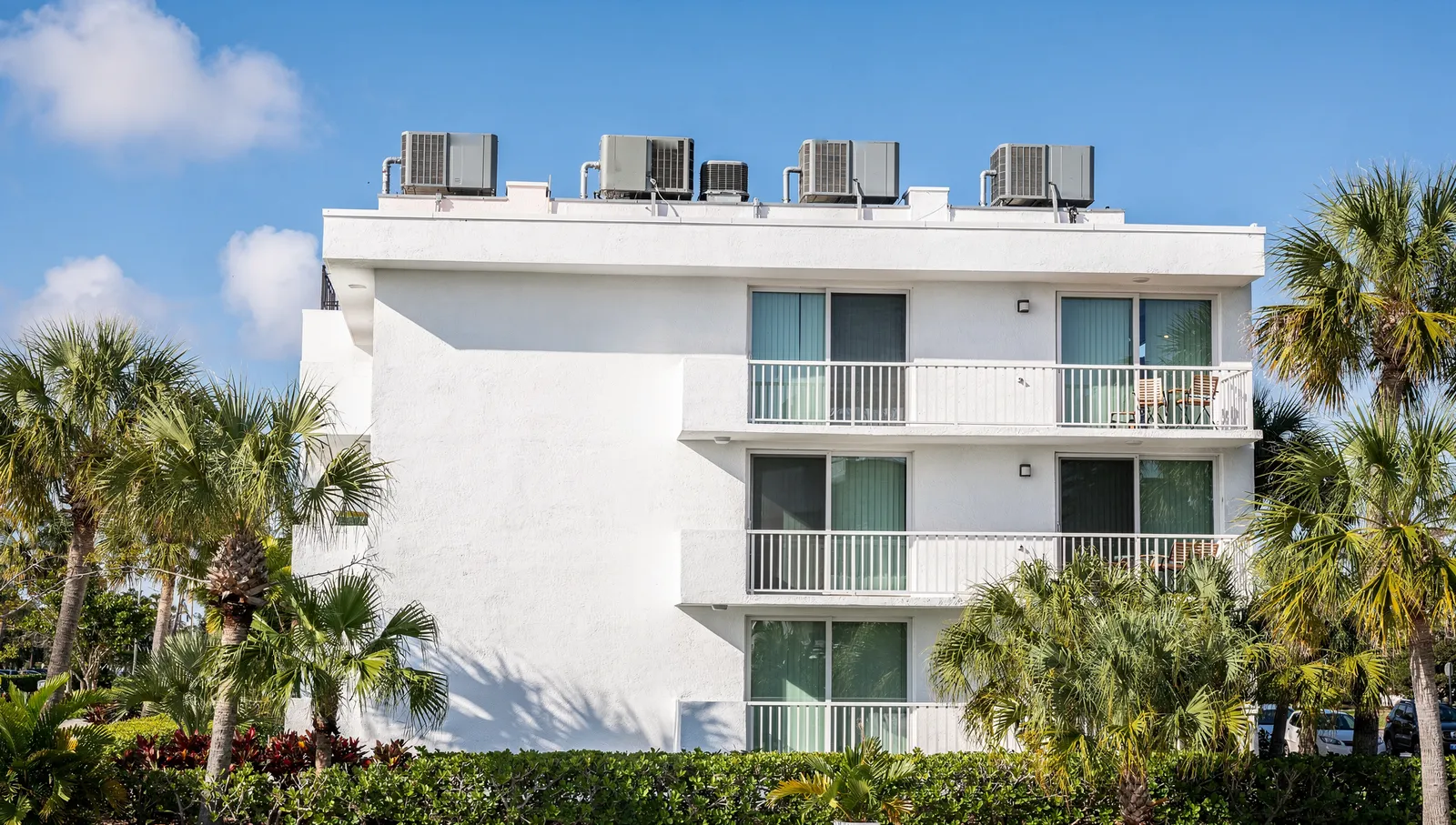
Anchoring. Palm Beach County's Building Code Advisory Board says that for equipment on rated stands or slabs, "the equipment must be adequately anchored to the rated stand, slab, or other approved means so as to resist the wind loads required by the latest Florida Building Code" [9]. Roof and pad condensers in our mid-rise buildings are the ones to document; Boca West's 3,482 homes are mostly condominiums built in the 1970s and early 1980s; see AC repair in Boca West.
Drain protection. The Florida Mechanical Code applies "where damage to any building components could occur as a result of overflow from the equipment primary condensate removal system" [10]. In that case it requires one of its listed auxiliary protection methods for each cooling coil [10]. In a stacked building an overflow can reach the unit below. Record which method was installed.
Refrigerant. Technicians "who maintain, service, repair, or dispose of equipment that could release ozone depleting refrigerants into the atmosphere must be certified", under EPA Section 608 [11]. Note the refrigerant on the file so the next call starts with the right answer.
The building's age shapes all three. Hunters Run is mostly 1980s condos; see AC repair in Hunters Run. The Polo Club has condominiums, townhomes and estate homes behind the same gates; see AC repair at the Polo Club.
When the Association Is the Buyer: Bids and the 5 Percent Rule
When the association itself pays for AC work, the bid rule may apply. Florida requires competitive bids when a contract for materials, equipment or services exceeds 5 percent of the association's total annual budget, reserves included. The association does not have to take the lowest bid, and the rule does not limit buying what it needs in an emergency.
The statute says that when a contract "requires payment by the association on behalf of any condominium operated by the association in the aggregate that exceeds 5 percent of the total annual budget of the association, including reserves, the association shall obtain competitive bids for the materials, equipment, or services" [12]. It adds, "Nothing contained herein shall be construed to require the association to accept the lowest bid" [12].
Emergencies are carved out: "Nothing contained herein is intended to limit the ability of an association to obtain needed products and services in an emergency" [12].
Every bid received becomes an official record, kept "for at least 1 year after receipt of the bid" [1]. For a board's checklist before it approves the work, see what a board should ask before approving.
Questions About Condo AC Records
 Direct CoolingFL Certified AC Contractor CAC1819111 Dispatch 24/7
Hi, this is Direct Cooling. Tap a question below for a straight answer.
Tap a question to ask
- Is a condo unit's air conditioner a common element?
- It depends on the declaration. The statute leaves maintenance of limited common elements to whatever "the declaration" assigns [2]. Read yours, and ask your association's attorney if it is unclear.
- Do HVAC systems have to be in a structural integrity reserve study?
- HVAC is not one of the named items. The study must cover roof, structure, fireproofing and fire protection systems, plumbing, electrical systems, waterproofing and exterior painting, and windows and exterior doors [13]. It also covers "Any other item that has a deferred maintenance expense or replacement cost that exceeds $25,000" or an inflation-adjusted amount, where its failure would affect the named items [13].
- Can a unit owner request the association's AC permit records?
- Yes. A building permit copy is an official record, and an owner who asks in writing must get access within 10 working days [1].
One Folder per Unit, Started on Installation Day
Florida law already treats contracts, bids and "A copy of all building permits" as official records, most kept at least seven years [1]. The simplest system is one folder per unit, started the day the new AC goes in, with the nine documents above.
The approval, the contract, the permit, the efficiency card, the AHRI certificate, the warranty terms, and the anchoring, drain and refrigerant details answer the leak, the sale and the records request before anyone asks. If an owner's system sits empty part of the year, see what an empty unit's AC costs over the summer.
Direct Cooling is a Florida Certified Air Conditioning Contractor, license CAC1819111, with our shop in West Boca Raton. Call or text (561) 210-7605 and we will deliver the paperwork with the work.
References
- Florida Legislature. Florida Statutes section 718.111, The association (2026 Florida Statutes), subsection (12). Read October 30, 2026. leg.state.fl.us/statutes/index.cfm?App_mode=Display_Statute&URL=07...
- Florida Senate. Florida Statutes section 718.113, Maintenance; limitation upon improvement (2025 Florida Statutes), subsection (1). Read October 30, 2026. flsenate.gov/Laws/Statutes/2025/718.113
- Florida Senate. Florida Statutes section 718.103, Definitions (2025 Florida Statutes), subsection (22). Read October 30, 2026. flsenate.gov/Laws/Statutes/2025/718.103
- Palm Beach County Planning, Zoning and Building, Building Division. Florida HVAC Efficiency Card Form (PB-O-021). Rev. 09/30/2020. discover.pbc.gov/pzb/building/Forms/AC%20Change%20Out%20Form.pdf
- AHRI. How to Use this Directory. No date shown; read October 30, 2026. ahrinet.org/certification/cee-directory/how-use-directory
- Florida Senate. Florida Statutes section 489.119, Business organizations; qualifying agents (2025 Florida Statutes), subsection (5). Read October 30, 2026. flsenate.gov/Laws/Statutes/2025/489.119
- Florida Legislature. Florida Statutes section 559.957 (2026 Florida Statutes; s. 3, ch. 2024-206). Read October 30, 2026. leg.state.fl.us/statutes/index.cfm?App_mode=Display_Statute&URL=05...
- Florida Department of Business and Professional Regulation. Licensing Portal: License Search. Live page dated 10/30/2026. myfloridalicense.com/wl11.asp
- Building Code Advisory Board of Palm Beach County. Technical Advisory: Wind Resistance of Exposed Mechanical Equipment or Appliances. March 15, 2017. discover.pbc.gov/pzb/building/BCAB/Wind_Resistance_of_Exposed_Mechanic...
- Florida Building Code, Mechanical, 8th Edition (2023). Section 307.2.3, Auxiliary and Secondary Drain Systems (UpCodes copy). Read October 30, 2026. up.codes/viewer/florida/fl-mechanical-code-2023/chapter/3/general-regu...
- U.S. Environmental Protection Agency. Section 608 Technician Certification. Updated March 3, 2026. epa.gov/section608/section-608-technician-certification-0
- Florida Senate. Florida Statutes section 718.3026, Contracts for products and services; in writing; bids; exceptions (2025 Florida Statutes). Read October 30, 2026. flsenate.gov/Laws/Statutes/2025/718.3026
- Florida Senate. Florida Statutes section 718.112, Bylaws (2025 Florida Statutes), paragraph (2)(g). Read October 30, 2026. flsenate.gov/Laws/Statutes/2025/718.112